Why Random Blog Posts Don't Rank
Publishing content without a strategy is like shouting into the void. Here's why most content fails to rank.
No Topical Authority
Google rewards sites that demonstrate deep expertise in a topic. Random posts across unrelated topics signal you're not an authority in anything.
Missing Internal Links
Without a cluster structure, your pages don't link to each other strategically. This means less link equity and worse rankings.
Keyword Cannibalization
Multiple posts targeting similar keywords compete against each other instead of working together. You end up diluting your own rankings.
How SEOAgent Plans Topic Clusters
SEOAgent analyzes your niche and your Search Console data to map content clusters, then your coding agent builds the pages you approve directly in your repo.
Pillar Page Plans
SEOAgent identifies your core topics and proposes comprehensive pillar pages. Your coding agent drafts them as real files in your codebase, built on your own expertise.
Supporting Content
Each pillar is mapped with cluster articles that dive deep into subtopics, all planned to link back to the pillar — and built in your repo on approval.
Keyword Gap Analysis
The cloud layer finds keywords competitors rank for that you don't, then proposes evidence-backed pages to fill those gaps.
Strategic Internal Links
SEOAgent plans the internal links between every piece so link equity flows through the cluster. Your agent applies the ones you approve.
Prioritized Roadmap
Get a sequenced plan that builds out your clusters methodically, prioritized by opportunity in your Search Console and SERP data.
Performance Tracking
Monitor how your clusters perform over time with integrated Google Search Console data, so the next suggestions are grounded in what actually moved.
How It Works
Install the Skill
Add the free SEOAgent Skill to Claude Code, Cursor, or Codex (or use the local CLI). Connect Google Search Console to ground suggestions in your real rankings.
Analyze Your Niche
SEOAgent scans your codebase, competitors, and Search Console data to identify cluster opportunities.
Get a Cluster Plan
Receive an evidence-backed plan with pillar topics, supporting articles, target keywords, and internal links — each with the data behind it.
Approve & Build in Your Repo
Approve the pages you want and your coding agent builds them as files in your codebase. Only approved changes land, shipped through your own CI/CD.
Topic Clusters in Action
SaaS Product Documentation
Build comprehensive guides around your product features, with cluster articles covering specific use cases and integrations.
E-commerce Category Pages
Create buying guides as pillars with supporting product comparisons, how-tos, and reviews in the cluster.
Local Service Area Pages
Establish authority in your service area with location-based pillars and neighborhood-specific cluster content.
Agency Expertise Showcases
Demonstrate your agency's expertise with comprehensive service pillars and case study clusters.
B2B Thought Leadership
Position your company as an industry leader with in-depth analysis pillars and trend commentary clusters.
Educational Resource Hubs
Create learning paths with course-like pillar content and lesson-style cluster articles.
Frequently asked questions
What is a topic cluster?
A topic cluster is a content strategy where a comprehensive "pillar" page covers a broad topic, surrounded by "cluster" articles that dive into specific subtopics. All content is interlinked to signal to search engines that your site has deep expertise in the subject.
How many articles are in a typical cluster?
A well-developed cluster typically has 1 pillar page and 8-15 supporting cluster articles. SEOAgent plans clusters based on keyword opportunity and competition in your niche, and you decide which pages to build.
Where do the cluster pages get created?
Directly in your codebase. Your coding agent (Claude Code, Cursor, or Codex) drafts each approved page as real files in your repo and ships them through your existing CI/CD. SEOAgent never auto-publishes to a live site behind your back.
Is SEOAgent keyword clustering software?
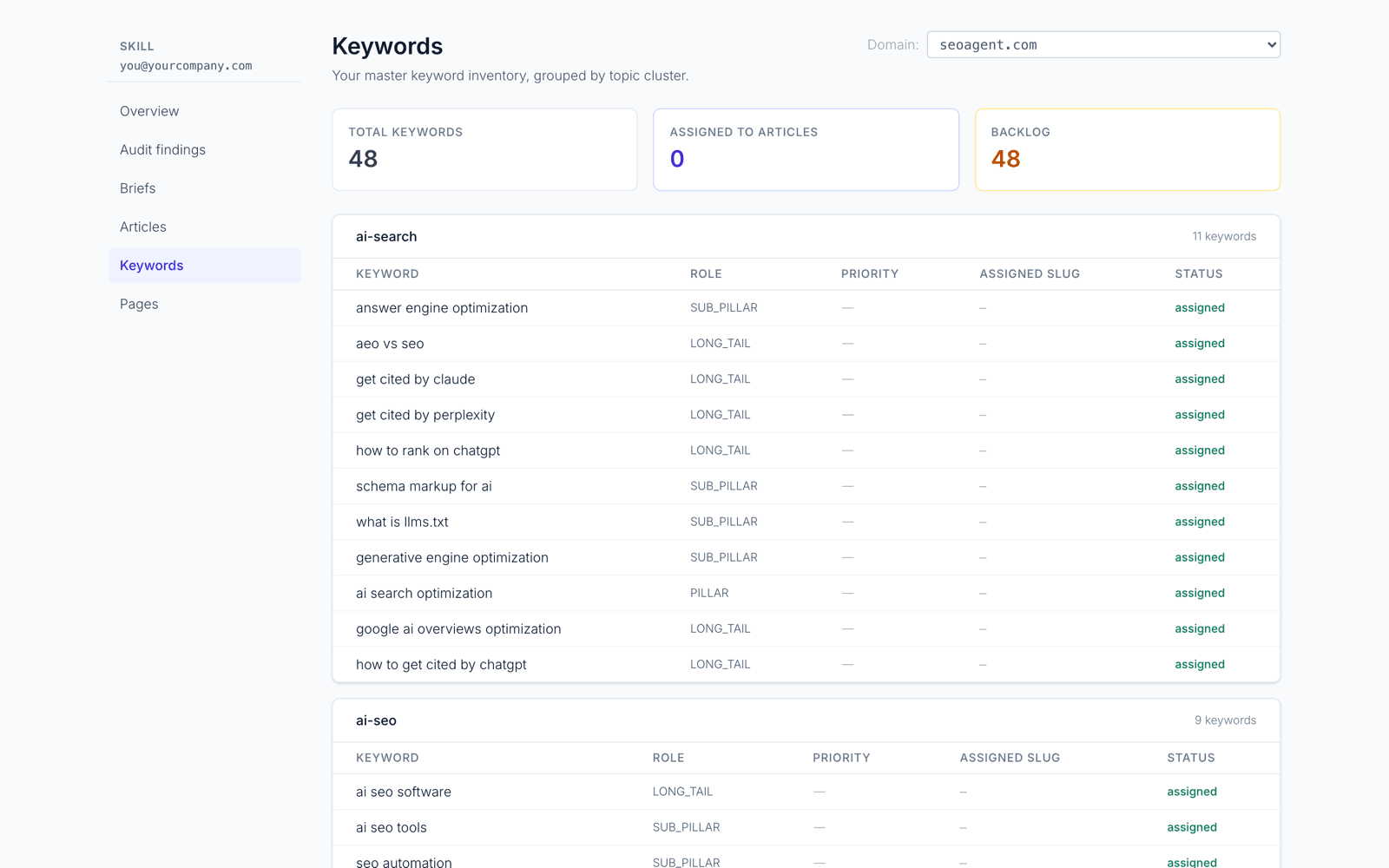
Yes, as part of strategy. SEOAgent groups your keyword inventory (Search Console queries plus enriched research keywords) into topic clusters by topic and intent, and gives each keyword a role: pillar, sub-pillar, or long-tail. Each cluster then maps to pages your coding agent builds. It does not cluster a pasted spreadsheet by SERP overlap; if you need to group a large one-off keyword export that way, a dedicated SERP-based clustering tool is the better fit.
Can I choose my own topics?
Yes. You can specify topics you want to cover, and SEOAgent will map clusters around them. You can also let SEOAgent surface the best opportunities based on your niche, competitors, and Search Console data — then approve what you want built.
More of the SEO engine
Every feature runs from the same Skill in your repo — install once, get all of it.
Start Building Topical Authority in Your Repo
Install the free SEOAgent Skill for Claude Code, Cursor, or Codex. Map strategic topic clusters from your real data and build the pages you approve directly in your codebase.