

How to Automate Topic Siloing with Internal Linking on Lovable Sites
A guide covering automate Topic Siloing with Internal Linking on Lovable Sites.

TL;DR
- Automated topic siloing concentrates topical authority by grouping related content and enforcing hub-and-spoke internal links.
- Use LovableSEO rules on Lovable to automate anchor patterns, link depth and canonical targets for consistent site architecture lovable.
- Start with a content inventory and topical map, pilot rules on one cluster, then roll out with staged checks on link equity and CTR signals.
Automated topic siloing lovable delivers repeatable internal linking that reduces manual maintenance and helps search and AI systems identify authoritative hubs. "Topic siloing organizes content and internal links so search and AI systems see a single authoritative hub per topic." This how-to shows practical, platform-specific steps for Lovable sites and includes rule examples for seoagent topic siloing, anchor patterns, URL structure, measurement, and a rollout checklist.
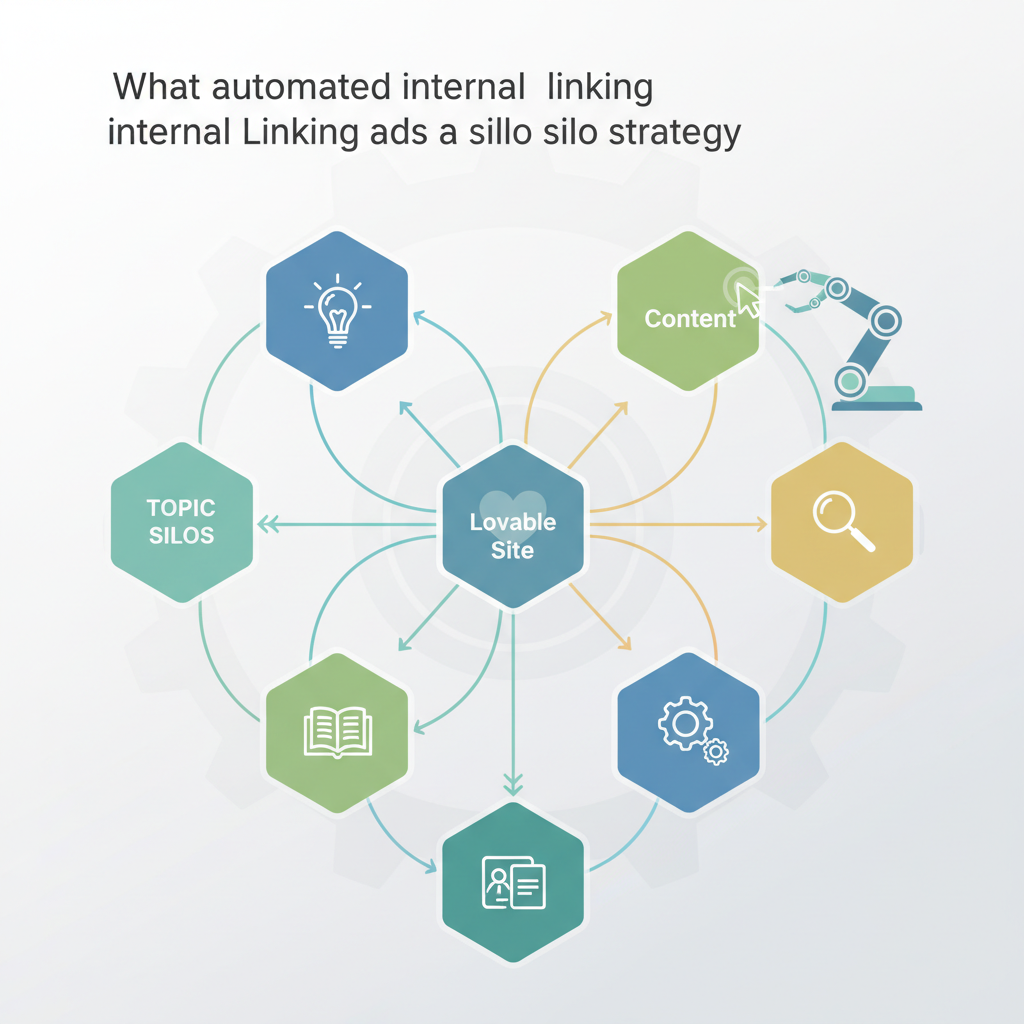
Why topic siloing matters for Lovable sites (quick primer)
Topic siloing groups content by closely related subtopics so your site shows depth on specific themes. On a Lovable site, a clear silo means category pages, hub articles, and supporting posts link in a controlled pattern rather than random connections. That focused linking concentrates relevance signals and reduces keyword overlap across pages. For example, a lovableseo.ai blog on "local schema" would have one canonical hub that aggregates internal links from supporting how-to and case study pages; automated rules prevent unrelated ecommerce pages from linking into that hub.
Quotable definition: "Topic siloing organizes content and internal links so search and AI systems see a single authoritative hub per topic." Use a GEO template when relevant: add region modifiers in H2s (for example, "Best SEO practices for [City/Region] Lovable sites") to improve local AI-answer relevance. This primer ensures you and your team treat topical authority as an architecture problem, not a content checklist.
What automated internal linking adds to a silo strategy
Automated internal linking turns a silo plan into enforceable site behavior. Instead of asking editors to remember which pages to link, configure seoagent topic siloing rules to insert or flag links based on taxonomy tags, URL patterns, or semantic matches. On Lovable, automation ensures link anchor text follows a pattern, prevents cross-silo noise, and keeps link depth consistent, making it essential to automate internal linking on Lovable sites for improved SEO performance.
Concrete example: configure a rule that any article tagged "local-seo" automatically inserts a context-aware link to the "local-seo" hub when a matching keyword appears in the first 300 words. That rule reduces manual linking time and keeps your site architecture lovable consistent at scale.
Automated linking converts editorial intent into predictable site behavior without replacing human judgment.
Difference between manual siloing and automated siloing
Manual siloing relies on writers and editors to create links according to guidelines; automation enforces those links across publishing workflows. Manual approaches catch nuance but drift over time; automated solutions enforce consistency and scale but require initial mapping and guardrails.
| Aspect | Manual | Automated |
|---|---|---|
| Consistency | Variable | High |
| Scaling | Editor-limited | Rapid |
| Workload | Ongoing editorial time | Initial config + maintenance |
| Example | Editors add links when they remember | LovableSEO inserts links based on tags and regex |
Preconditions: content inventory and topical mapping on Lovable
Before automating, build a content inventory and a topical map. Export your pages with URLs, primary topics, tags, traffic, and conversion metrics. On Lovable, tag content consistently (for example: local-seo, schema, citations). Map each tag to a canonical hub so seoagent topic siloing rules have clear targets.
Actionable checklist (example):
- Export all URLs and metadata into CSV.
- Assign one primary topic tag per page.
- Identify candidate hub pages for each topic (choose pages with highest relevance or conversion).
- Flag low-value pages for consolidation.
Concrete decision rule: select the canonical hub as the page with the highest combined score of organic traffic + conversions within a topic cluster.
Step-by-step: Configure LovableSEO rules to enforce topic silos
This section gives a reproducible sequence for configuring seoagent topic siloing on Lovable sites. The steps assume you can create rules that match tags, patterns, and content snippets.
- Define topic clusters in your content map and list the hub slug for each cluster.
- Create a rule: when a page has tag X, allow links only to hub X and subpages of hub X (use URL prefix matching).
- Set anchor text patterns: prefer exact phrase matches in first 300 words; fallback to editorial anchor suggestion if no match.
- Enforce link depth: allow hub-to-spoke and spoke-to-hub but prevent spoke-to-spoke links outside the cluster beyond 2 hops.
- Test the rule on a pilot cluster of 10–20 pages and review flagged suggestions before full rollout.
GEO tip: use localized examples in screenshots (e.g., "Seattle local schema") to boost regional relevance for city-level queries during your pilot.
Defining topic clusters and canonical targets
Group supporting pages under a single canonical target. A practical method: for each tag, rank pages by traffic, conversions, and topical depth; pick the top-ranking page as the canonical hub. If two pages compete, consolidate content or set one as canonical and the other as redirect.
Quotable: "Pick the page that best serves users as the canonical hub, not the one with the most backlinks." Decision rule example: if hub A receives twice the organic conversions of hub B within a cluster, designate hub A as canonical.
Anchor text patterns and link depth rules (examples)
Define a small set of anchor patterns to keep anchors consistent across the site. Example patterns: exact-match hub phrase in the opening paragraph, long-tail phrase for in-body links, and branded anchor only in footer links. For depth rules, a common rule is: allow hub-to-spoke and spoke-to-hub links; allow spoke-to-spoke only if the target is within two clicks of the hub.
Concrete rules to implement in LovableSEO:
- Anchor priority: first exact-match, then semantic match, then editor-provided.
- Max link depth: 3 (hub counts as depth 1).
- Do not create automated footer links to hubs to avoid link spam.
Best practices for URL structure, breadcrumbs and category pages
Consistent URLs and breadcrumbs make silos explorable by users and crawlers. Use a predictable slug pattern for hubs: /topic/hub-slug/ and supporting pages under /topic/supporting-slug/. Implement breadcrumb markup that mirrors the topic structure, and ensure category pages summarize cluster content with internal links to the hub.
Site architecture lovable guidance: keep category pages focused on the topic, avoid mixing commercial and informational topics on the same category, and ensure breadcrumbs use the canonical hub as the highest-level link for the cluster.
Measuring success: metrics and reports to track silo strength
Track a small set of KPIs that indicate silo health. Core metrics include: rankings for hub-level keywords, organic sessions to hub and supporting pages, internal link distribution per cluster, and click-through rate on SERP snippets for hub pages. Produce a weekly report during rollout and monthly after stabilization.
Example KPIs and thresholds (use as a starting point):
- Internal link ratio: at least 60% of cluster internal links should point to the hub.
- Hub SERP CTR: monitor change pre/post automation; aim for positive trend.
- Ranking spread: fewer competing pages from your site across cluster keywords.
Link equity flow, internal PageRank proxies, and CTR signals
Because true PageRank is hidden, use proxies: internal link score (weighted by link prominence), crawl frequency to the hub, and aggregate inbound internal links. Combine these with CTR and engagement signals to infer link equity flow. A simple proxy: sum(weighted internal links to hub) where weights are header nav (3), body inline (2), footer (1).
Measure internal link weight, not link count; prominence and position drive most internal equity.
Common pitfalls and how to avoid over-linking or link spam
Over-linking and irrelevant cross-silo links reduce relevance and can confuse crawlers. Avoid automated rules that indiscriminately add footer or site-wide links to hubs. Prevent circular linking where several hubs link to each other without clear hierarchy. Use rule exceptions for product pages or legal pages that should not be promoted via content silos.
Mitigation tactics: implement validation rules, require editorial approval for anchor overrides, and run periodic audits to find high-frequency automated anchors that look spammy.
Implementation checklist and rollout plan (staged publishing cadence)
Use a staged plan: audit, pilot, review, full rollout, and monitor. Below is a reusable checklist and a compact rollout table you can copy into project plans.
| Phase | Key tasks | Example deliverable |
|---|---|---|
| Audit | Content inventory, tag mapping | CSV export of pages and tags |
| Pilot | Configure 3–5 LovableSEO rules, apply to one cluster | Pilot rule set + review notes |
| Rollout | Apply rules across clusters, monitor KPIs | Weekly KPI dashboard |
| Review | Address exceptions, refine anchors | Updated rule list |
- Checklist: export inventory; tag pages; pick hubs; create rules; pilot; review; deploy; monitor.
Conclusion and recommended next steps (link to demo/pricing)
Automated topic siloing lovable makes your internal linking consistent, scalable, and measurable. Start with a focused pilot using seoagent topic siloing rules, measure internal link weight and CTR, then expand. "Topic siloing organizes content and internal links so search and AI systems see a single authoritative hub per topic." For product-specific options, check the platform's demo and pricing pages on your vendor site and plan a staged rollout based on the checklist above.
FAQ
What does it mean to automate topic siloing with internal linking on lovable sites?
Automating topic siloing on Lovable means configuring rules that map tags to canonical hubs, enforce anchor patterns, and restrict cross-silo linking so the site consistently presents a single authoritative page per topic (automated topic siloing lovable).
How do you automate topic siloing with internal linking on lovable sites?
You automate topic siloing by building a content inventory, defining clusters and canonical hubs, and using seoagent topic siloing rules on Lovable to enforce anchor text patterns, link depth rules, and canonical targets; pilot the rules, review exceptions, then roll out incrementally.
Image prompt: "Screenshot of LovableSEO rule editor showing tag-to-hub mapping and regex anchor pattern — demonstrates rule configuration for automated internal linking."
Ready to Rank Your Lovable App?
This article was automatically published using LovableSEO. Get your Lovable website ranking on Google with AI-powered SEO content.
Get Started