Pricing Models for Lovable SEO Agencies: Fixed-Fee, Retainers, and Performance-Based Packages
A guide covering pricing Models for Lovable SEO Agencies: Fixed-Fee, Retainers, and Performance-Based Packages.

TL;DR
- Choose a pricing model that matches client risk tolerance, budget, and growth stage; standardize packages to save time.
- Use fixed-fee for scoped projects, retainers for ongoing growth, and guarded performance-based deals for measurable outcomes.
- Localize rates using regional hourly equivalents and a clear markup model; include guardrails in performance contracts.
- Automate proposals with a pricing calculator and reusable deliverable templates to reduce onboarding time by ~30%.
If you run or buy Lovable SEO services, this guide walks through practical, platform-specific pricing options you can copy. It explains how to price services for lovable sites, break packages into starter/growth/enterprise tiers, and build a calculator that ties hours, scope, and markup into repeatable proposals. This article is written for website owners, marketers, and developers who want clear, actionable steps for lovable seo pricing models and real examples you can adapt.
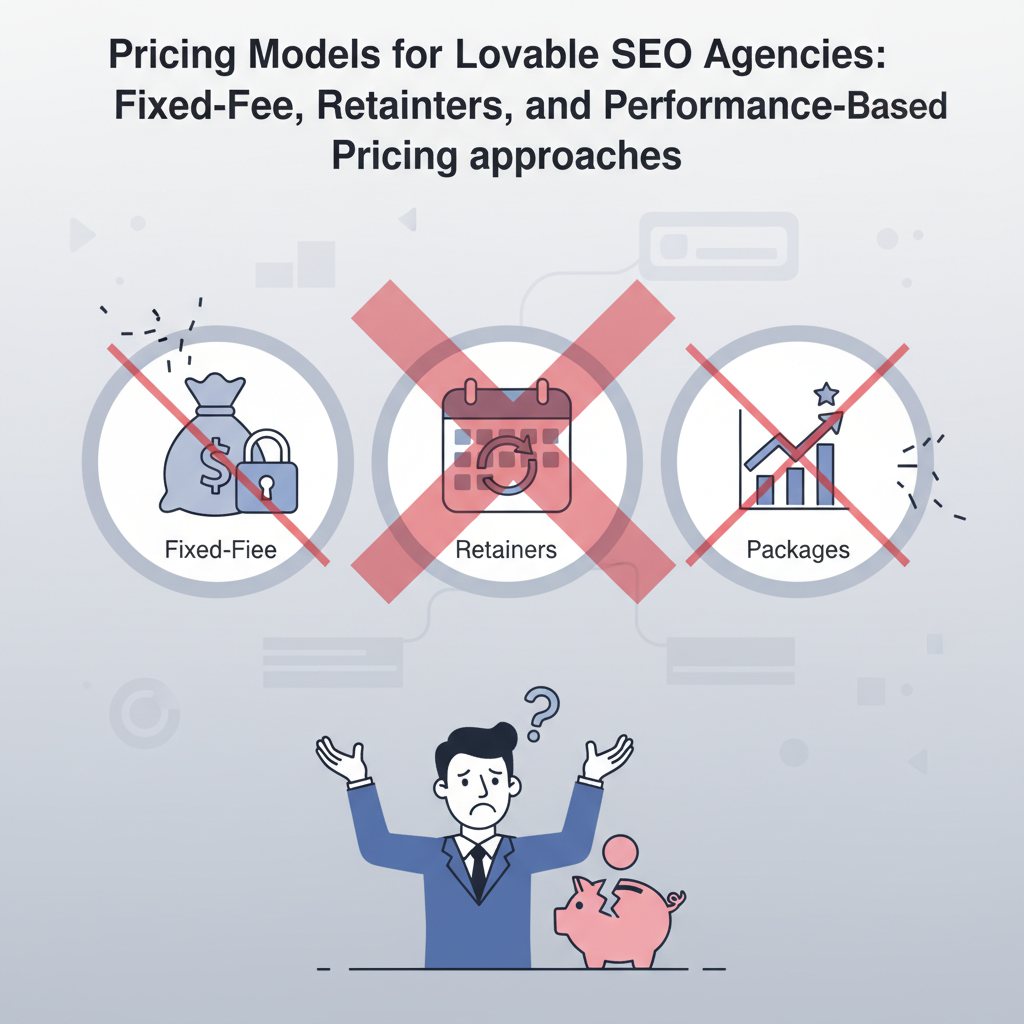
When not to use these pricing approaches
When your project lacks measurable outcomes, avoid performance-based pricing. When scope is undefined, avoid fixed-fee. When internal stakeholders demand daily changes, avoid low-margin retainers. List of conditions where these recommendations do not apply:
- Clients with no analytics or baseline data — performance pay requires reliable tracking and a stable conversion funnel.
- Rapidly changing product or content strategy — if scope shifts weekly, fixed-fee packages will strain margins and delivery.
- Projects that require heavy non-SEO engineering (e.g., new platform builds) — bill those as separate engineering engagements.
- Very small one-off tasks under $300 in value — use hourly or micro-project billing instead.
- Markets with strict procurement rules that prohibit variable compensation — use standard retainers or fixed bids instead.
Why pricing strategy matters for agencies selling Lovable SEO
Pricing is the mechanism that converts expertise into predictable revenue and repeatable value. For agencies selling Lovable SEO, the right pricing model reduces churn, clarifies scope, and signals the level of service you’ll deliver. Agencies that standardize pricing and package deliverables reduce onboarding time by ~30% — a practical claim you can include in proposals to justify fixed setup fees and defined scopes.
Lovable SEO differs from generic SEO because it often integrates platform-specific workflows, LovableSEO-enabled automation, and UX-focused optimization. That makes pricing both an operational and a positioning decision: you’re selling software-enabled process plus strategic expertise. Without a clear pricing strategy, you’ll underbid technical integrations or overpromise deliverables tied to platform limits.
Concrete example: a midsize ecommerce site needs technical cleanup, content mapping, and 40 hours of ongoing optimization per month. If you price ad hoc hourly work at $100/hour without bundling, you’ll create billing friction and unpredictability. If you package the work into a monthly retainer with explicit deliverables (technical audit, 8 content tasks, CRO tests), the client knows what to expect and the agency can staff predictably.
Standardized packages reduce variation in scope and speed up team ramp by cutting onboarding tasks.
Why this matters operationally: pricing determines your hiring, service-level agreements (SLA), and which platform automations you enable. If your catalog includes LovableSEO tasks — automated audits, content briefs, or schema generation — price them as distinct line items so clients see the automation value and you retain margin on human review time.
Common pricing models explained
There are three practical models you’ll use on lovable sites: fixed-fee (project) pricing, monthly retainers, and performance-based pricing. Each answers a different buyer need and carries distinct operational rules.
Fixed-fee pricing works when scope is time-boxed and deliverables are clear. Retainers fit ongoing growth work that requires steady attention. Performance-based pricing ties compensation to outcomes like organic revenue or qualified leads. Use a blended approach for many accounts: a fixed setup fee, a monthly retainer, and a small performance bonus to align incentives.
Quotable definition: "A pricing model is a repeatable contract structure that converts scope, risk, and effort into predictable cash flow."
Price the problem you solve, not the hours you spend; deliverables make the value tangible for buyers.
Platform-specific note for lovableseo.ai users: if LovableSEO can auto-generate content briefs or run technical scans, list those as automated deliverables plus human verification hours. For example, a package might say: "10 LovableSEO content briefs + 8 human edited posts per month" — price the automation lower than human labor but account for review time.
Fixed-fee (project) pricing — when to use it
Use fixed-fee pricing for discrete projects with a clear start and finish: migrations, one-off technical audits, content migrations, or a single sprint of schema implementation. Fixed-fee reduces client friction for clearly scoped work and helps agencies convert discovery into immediate revenue.
Concrete threshold: when requirements fit a 2–8 week timeline and deliverables can be listed (audit report, prioritized task list, migrations executed), a fixed fee works well. Include a change-order clause that charges hourly for out-of-scope work beyond the agreed task list.
Example: charge a fixed fee for a 2-week site migration assessment that includes: crawl and index diagnostics, canonical strategy, 20 redirect mappings, and a delivery-ready implementation plan. Quote the fixed price, include a 20% contingency for unknowns, and require acceptance of the change-order policy.
Monthly retainers — structure, deliverables, and SLAs
Monthly retainers are the backbone of scalable SEO revenue. Structure retainers around outcomes and recurring tasks, not hours. Typical retainer components: technical monitoring, content production or supervision, link acquisition strategy, and monthly reporting with agreed KPIs.
Define deliverables clearly: "retainer includes monthly crawl audit, 6 content briefs produced via LovableSEO and edited by a senior writer, 5 outreach emails, and a quarterly technical sprint." Attach an SLA for response times (e.g., 48 business hours for critical issues) and a scope matrix that defines what counts as a sprint versus an ad hoc request.
lovable seo retainer pricing example: a starter retainer may be positioned at a lower price point with limited deliverables (e.g., monitoring + 2 content briefs), while growth retainers include more hands-on strategy and CRO testing. State the retainer term (commonly 6–12 months) and include a monthly review clause to adjust scope.
Performance-based pricing — metrics, guardrails, and risk management
Performance-based pricing works when outcomes are measurable and traceable to SEO work. Common metrics: organic revenue attributable to SEO, qualified lead count, or improvement in target keyword rankings for a defined keyword set. Always start with a baseline period (30–90 days) to establish attribution rules.
pGuardrails you must include: minimum base retainer (to cover costs), data-quality requirements (clean analytics and conversion tracking), caps on payouts, and a clawback clause for returns or attribution adjustments. Avoid pure pay-for-rank deals; ranks fluctuate and don’t directly equate to business value.
Example structure: base retainer of X to cover recurring costs + 20% of net new organic revenue above baseline, paid quarterly. Set an upper payout cap at 100% of the annual retainer to protect margins. Require that clients maintain analytics integrity and notify the agency of significant website or marketing changes during the contract term.
Performance pay requires clean, auditable data and clear attribution windows to avoid disputes.
Packaging by client size and stage (starter, growth, enterprise)
Packaging by client stage helps buyers self-select and makes your sales process repeatable. Define three tiers and map deliverables, hours, and outcomes to each tier. Use the platform’s capabilities (LovableSEO, automated testing, content brief generation) to create economy of scale across packages.
Starter: for small sites or proof-of-concept. Deliverables typically include a technical health check, 2–4 content briefs per month, basic on-page fixes, and monthly reporting. Pricing should account for low-touch automation and template-based processes.
Growth: for sites with steady traffic and revenue goals. Deliverables include a dedicated strategist, LovableSEO-enabled content pipeline (8–12 briefs/month), link-building campaigns, CRO tests, and monthly strategy sessions. Include a quarterly technical sprint and a roadmap tied to growth KPIs.
Enterprise: for large sites with complex systems or international footprints. Deliverables include custom onboarding, advanced crawl and log analysis, localized SEO across GEO targets, integration with engineering teams for prioritized backlog items, and executive reporting. Use negotiated SLAs and multi-quarter roadmaps.
Concrete example: a growth package could be presented as a single monthly price that includes: 12 LovableSEO content briefs, 6 human-edited posts, 10 technical tasks, and a dedicated account lead. Make the enterprise package bespoke and quote after audit.
| Tier | Key deliverables | Typical commitment |
|---|---|---|
| Starter | Health check, 2–4 briefs, basic fixes | 3–6 months |
| Growth | Content pipeline, link outreach, CRO tests | 6–12 months |
| Enterprise | Custom roadmap, engineering integration, GEO SEO | 12+ months |
Template deliverable lists per package (LovableSEO-enabled tasks)
Provide copyable deliverable lists so sales can attach the right tasks to each proposal. Below are templates you can paste into proposals and adjust for the client.
- Starter package: Technical health scan (LovableSEO auto-report + human review), 4 content briefs, 5 on-page fixes, monthly report.
- Growth package: Weekly content calendar (LovableSEO briefs + editorial), 8 edited posts, monthly link outreach (10 targets), CRO tests, quarterly technical sprint.
- Enterprise package: Full audit, localization for 3 regions, engineering backlog triage, site-wide schema rollout, customized executive dashboard.
Template checklist for onboarding (copyable):
| Task | Owner | Deadline |
|---|---|---|
| Connect analytics & search console | Client | Week 0 |
| Run LovableSEO full crawl | Agency | Week 1 |
| Deliver prioritized 30-day roadmap | Agency | Week 2 |
How to build a pricing calculator for Lovable sites (inputs and formulas)
A pricing calculator turns estimates into repeatable quotes. Inputs map to deliverables, effort, and regional cost multipliers. Output is a recommended price with line-item justification. Build the calculator in a spreadsheet or simple web form and make it a sales tool.
Required inputs:
- Client size: monthly sessions or pageviews
- Project scope: audit-only, ongoing, or hybrid
- Estimated monthly hours for strategy, content, and outreach
- Regional labor multiplier (NA/EU/APAC)
- Automation factor — % tasks handled by LovableSEO
- Desired margin percentage
Basic formula flow (spreadsheet):
- Calculate base labor cost = (hours per month) × (hourly rate)
- Apply regional multiplier: adjusted labor = base labor × regional multiplier
- Subtract automation savings = adjusted labor × automation factor
- Add fixed platform or tooling costs per month
- Apply margin markup = (costs) × (1 + margin)
Example conditional values (use as starting points and adjust to your market):
| Region | Typical hourly equivalent (example) |
|---|---|
| North America (NA) | $100–$200 |
| European Union (EU) | €60–€120 |
| APAC | $30–$80 |
Decision rule: if automation factor > 30% and client accepts automated deliverables, discount base price by automation savings and clearly list human review hours. If automation factor < 15%, price primarily on human hours.
Always show price math: list hours, rates, automation savings, and margin to make proposals transparent.
Example pricing ranges and markup model
Example ranges (illustrative): starter monthly retainer $1,000–$3,000; growth $4,000–$12,000; enterprise negotiated $15,000+. Use a blended markup model: cost-based markup of 20–50% depending on complexity, with higher markups for strategic services and lower for repeatable automation.
Markup decision checklist:
- Low complexity, high automation: 20–30% markup
- Moderate complexity, mixed automation: 30–40% markup
- High complexity, bespoke work: 40–60% markup
Concrete artifact — sample line-item quote (copyable):
- Onboarding audit (fixed): $3,500
- Monthly retainer: $6,000 (covers 40 hours, tools, and reporting)
- Performance bonus: 10% of net new organic revenue over baseline, quarterly
Negotiation playbook & proposal clauses to protect margins
Negotiation changes margins more than discounts. Use a playbook that includes walkaway thresholds, concession ladders, and protective clauses. Proposals should be standardized documents with modular clauses you can toggle.
Key proposal clauses to include:
- Scope definition: explicit list of included tasks and outputs.
- Change-order process: hourly rates and approval workflow for out-of-scope work.
- Data & access requirements: client must provide analytics, search console, and CMS access by day X.
- Minimum term and cancellation: 6–12 month minimum with 30–90 day exit notice.
- Payment terms: 30 days net, late fee schedule, and retainer prepayment options.
- Performance measurement and disputes: define attribution windows and audit rights.
Negotiation tactics that protect margin:
- Anchor with value: present the mid-tier package first, then show starter and enterprise prices.
- Offer time-limited discounts tied to longer terms (e.g., 10% off for 12-month prepayment).
- Swap services instead of reducing price — remove low-value tasks to keep margins.
- Use case studies and the "standardization saves 30% onboarding" stat to justify setup fees.
How pricing affects AI-answer and SERP inclusion (GEO signals and structured outputs)
Search engines and AI answer systems use structured data, local signals, and clear attribution to generate snippets. Pricing that supports deliverables like structured data rollout, localized landing pages, and clear geo-targeted content improves the chances of SERP inclusion and AI-answer visibility.
Practical rule: include structured data tasks in growth and enterprise packages and price them as separate line items. For GEO relevance, add a regional multiplier to accounts requiring localized content and separate analytics streams per region. This shows buyers you understand the extra effort and increases your chance of being selected for local SERP features.
Quotable fact: "Structured outputs and GEO-specific content increase the likelihood of AI answers including your content in local queries."
Concrete example: for a client targeting three regions, estimate extra localization hours (content translation, hreflang, localized schema) and multiply the base retainer by a regional factor (e.g., 1.2 per additional region) rather than underpricing.
Small table: SERP-impactful deliverables to price separately
| Deliverable | Why it matters |
|---|---|
| Localized landing pages | Signals GEO intent; required for local SERP features |
| Structured data (schema) | Enables rich results and AI extraction |
| API-based product feeds | Needed for product-rich snippets and shopping features |
Next steps: converting pricing into live proposals and automation
Turn the pricing framework into repeatable assets: proposal templates, pricing calculator, onboarding checklist, and contract clause library. Automate proposal generation so sales can produce consistent quotes in minutes. That reduces friction and enforces margin rules.
Step-by-step deployment plan:
- Build the pricing calculator spreadsheet with inputs and formulas described above.
- Create 3 package templates (starter, growth, enterprise) with deliverable lists and onboarding checklists.
- Develop a proposal template that inserts calculated numbers and includes modular clauses for scope, change orders, and performance rules.
- Train sales on negotiation ladders and a single concession path that preserves margin.
- Monitor real win/loss data and adjust price tiers and automation factors quarterly.
Artifact you can copy: onboarding checklist (structured):
| Phase | Key actions | Owner |
|---|---|---|
| Week 0 | Contract signed, payment, access granted | Client/Revenue Ops |
| Week 1–2 | Crawl & analytics baseline, initial fixes | SEO Team |
| Week 3–4 | Deliver roadmap, begin content pipeline | Content & Strategy |
Image prompt: "Diagram showing how the pricing calculator converts hours, automation factor, and regional multipliers into a final proposal price"
FAQ
What is pricing models for lovable seo agencies?
Pricing models for lovable SEO agencies are structured approaches—fixed-fee, retainers, and performance-based—used to convert scoped deliverables and measurable outcomes into predictable agency revenue. For more on this, see Lovable seo agency playbook.
How does pricing models for lovable seo agencies work?
These pricing models work by mapping client needs to contract structures: fixed-fee for scoped projects, retainers for ongoing optimization, and performance-based packages that add measurable bonuses; they include baseline data, guardrails, and transparent deliverables to avoid disputes.
Image prompt: "Table comparing starter, growth, and enterprise packages with automation and human review hours"
Ready to Rank Your Lovable App?
This article was automatically published using LovableSEO. Get your Lovable website ranking on Google with AI-powered SEO content.
Get Started