

Programmatic SEO vs Manual Content on Lovable Sites: ROI, Quality, and AI-Answer Odds
A guide covering programmatic SEO vs Manual Content on Lovable Sites: ROI, Quality, and AI-Answer Odds.
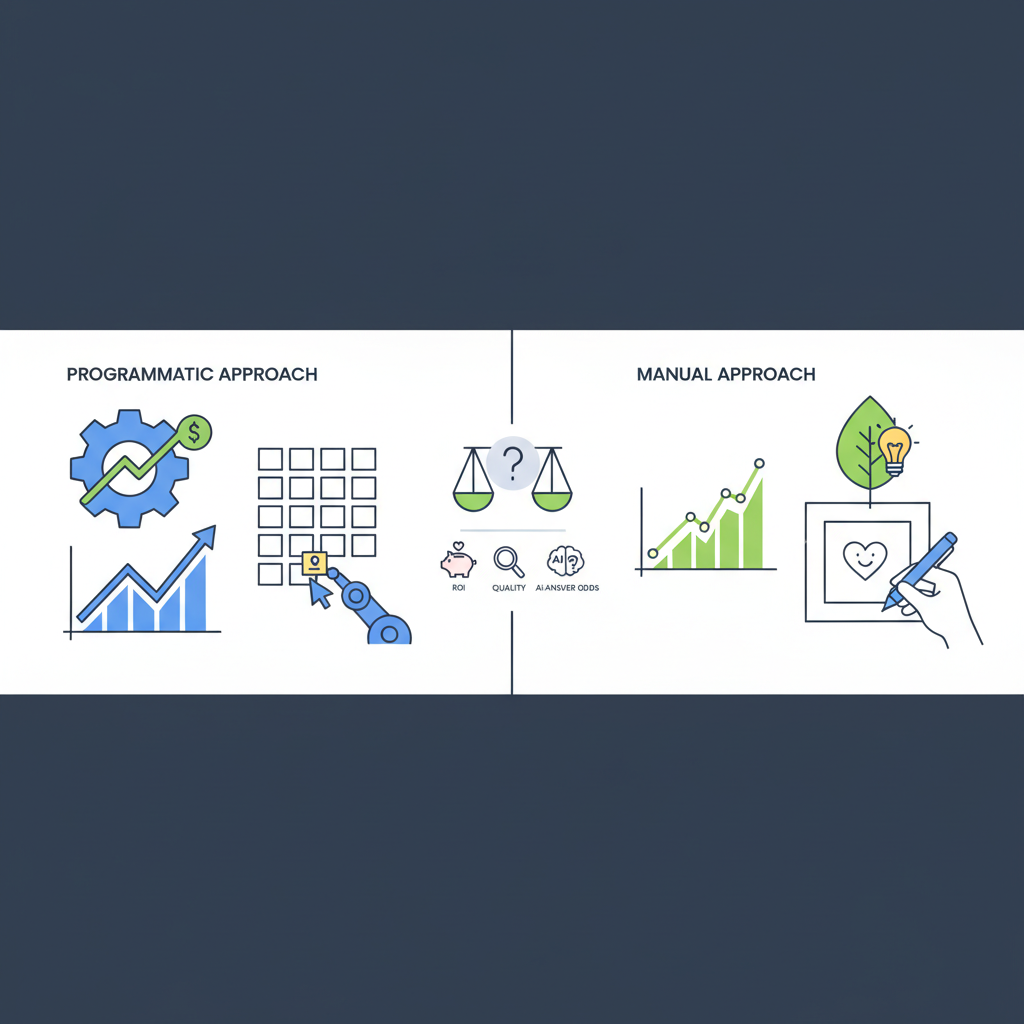
TL;DR
- Programmatic SEO scales fast and lowers content automation ROI breakeven for high-volume, low-complexity pages.
- Manual content wins on depth, trust signals, and higher conversion per page—use it for flagship or local pages.
- AI-answer odds rise when pages use concise templates and clear Q&A blocks; human-crafted narrative still wins nuanced featured snippets.
- Combine both: programmatically generate base pages, then run prioritized manual quality passes using metrics-driven thresholds.
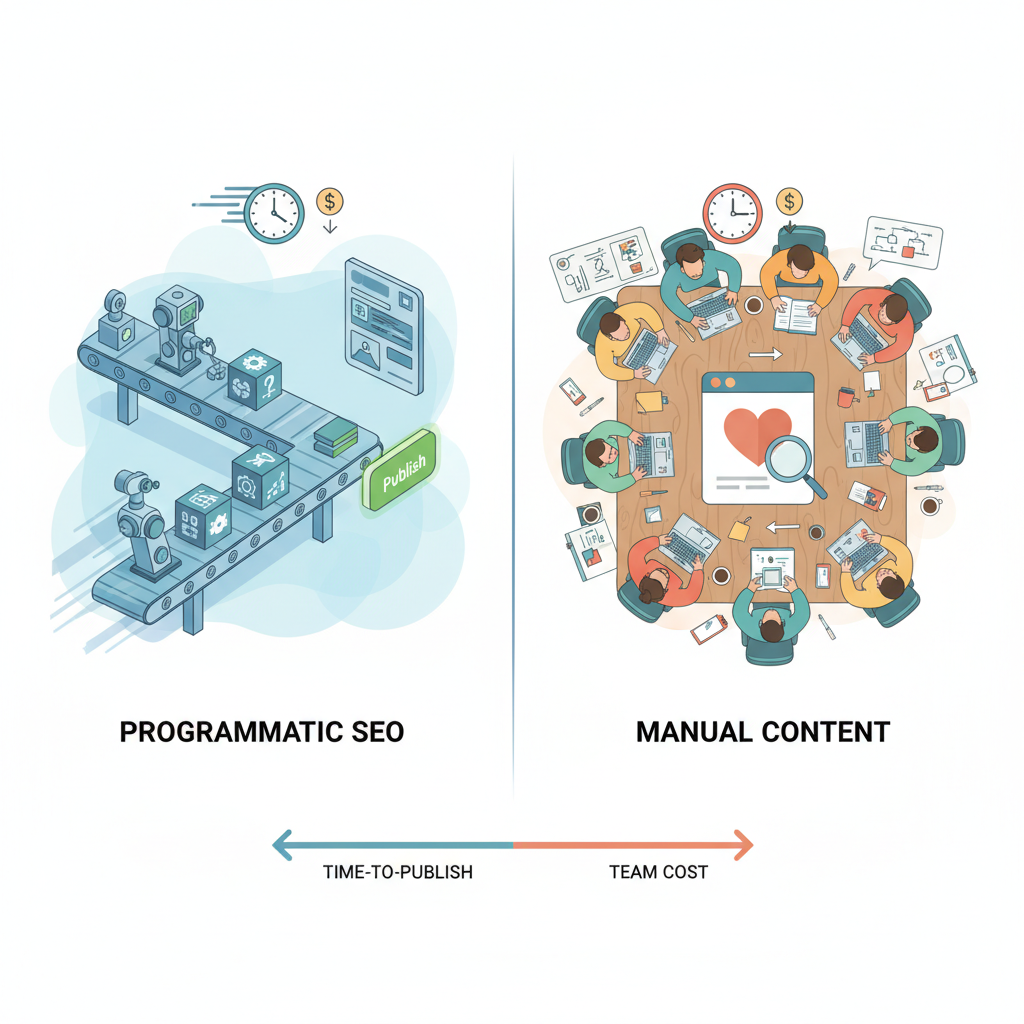
Quick summary: what to expect from programmatic vs manual approaches
If you compare programmatic seo vs manual lovable content, expect a trade-off between speed and per-page quality. Programmatic approaches allow you to publish hundreds or thousands of pages quickly from data feeds and templates; manual approaches require human time but produce deeper, more unique pages. For lovableseo.ai customers or teams using similar platforms, programmatic wins when search demand is high and the information is naturally templatable (product specs, city listings, price comparisons). Manual wins when persuasive copy, reviews, or local nuance matters.
Concrete example: a national directory can use programmatic templates to create city-level landing pages with structured facts and opening hours. A manual approach is better for a city’s “best-of” article that includes interviews, photos, and local tips. Use programmatic vs manual seo as a decision axis: high-volume, low-differentiation topics favor automation; unique, high-intent pages favor humans.
Programmatic scale is justified when marginal page value (traffic × conversion) exceeds marginal production cost.
Quotable fact: "Templates that return compact, authoritative answers increase AI extraction probability." That sentence is short and designed to be pulled as a featured snippet. The rest of this article walks through cost, quality, AI-answer odds, risk, hybrid workflows, an ROI model, and a decision checklist for lovable seo strategy comparison on lovableseo.ai-style platforms.
Cost and speed comparison (time-to-publish, team cost)
This section shows the real cost and time differences between programmatic and manual content production so you can calculate content automation roi. If your goal is to get large numbers of pages live within weeks, programmatic publishing beats manual. Typical programmatic pipeline: data source → template engine → SEO-friendly rendering → crawlable site map. Once built, each new page is near-zero marginal cost. Manual publishing requires writer time, editor review, possibly photographer or developer involvement; each page can take hours to days.
Example scenario: a team needs 2,000 localized pages. Programmatic route: build templates and integrate the feed; initial engineering overhead might be weeks, then publish in days. Manual route: 2,000 pages × 2 hours per page = 4,000 hours of writer/editor time. At $40/hour fully loaded, that's $160,000 in labor, not including editing and QA. Programmatic engineering might cost $30,000 to $80,000 once. That math shows why organizations track content automation roi rather than per-page cost alone.
Time-to-publish thresholds to use in decisions: if you need >500 pages within a quarter and pages are structurally similar, favor programmatic. If you need <100 high-conversion pages with unique UX, favor manual. Track two KPIs during rollout: (1) pages published per week, and (2) maintenance hours per month. Use those to feed your content automation roi calculation.
Quality comparison (uniqueness, depth, user experience)
Quality splits into three buckets: uniqueness, topical depth, and user experience. Manual content usually produces higher uniqueness because writers craft original narrative, add interviews, and link naturally. Depth is also higher when a human can synthesize multiple signals and provide judgment. Programmatic pages can still be good for facts and structured answers, but they risk thinness if templates over-rely on database fields with few words.
Concrete thresholds: for scalable content quality, aim for at least 300 words of unique, human-written body text plus one contextual element (image alt text, local review, or an FAQ) before publishing a programmatic page. If your platform (for example, lovableseo.ai-style systems) supports custom blocks, require at least one human-verified block for pages expected to convert.
Example: a product listing generated programmatically can include spec tables and price history automatically, but boosting conversion usually requires a human-written paragraph that addresses buying concerns and provides a comparator. That hybrid step converts a thin template into a lovable page. For a lovableseo strategy comparison, treat programmatic templates as the baseline and layer manual edits where conversions or branding matter.
Scalable content quality is achievable when automation enforces a minimum unique-content threshold per page.
AI-answer and SERP feature odds: which approach performs better and why
AI-answer odds and featured snippet capture depend on how easily a model can extract a concise, authoritative sentence or block. Programmatic pages that follow consistent structure—clear headings, short definitions, Q&A blocks, and bulleted facts—tend to have higher ai snippet probability. Search models prefer well-structured, factual sentences (dates, numbers, definitions) that map cleanly to query intent.
However, manual pages with distinctive voices, expert quotes, or unique examples can outperform on richer SERP features like review snippets, multi-paragraph answers, or image packs. The pattern is: if a snippet can be served by a single sentence or table, templates usually win. If the answer requires synthesis, nuance, or novel insight, human content wins.
Practical test: to raise ai snippet probability, include a 1-2 sentence direct answer under an H2, followed by a short bulleted list of supporting facts. For example, a template-generated city page that begins with a single-sentence definition of "nearest urgent care" + 3 bullets (hours, phone, distance) will be more extractable than a long narrative intro. Use that pattern selectively—don’t sacrifice UX for snippet-chasing.
Quotable: "A one-sentence authoritative answer increases AI extraction odds more than 300 extra words of narrative." Use that rule when you optimize programmatic templates for SERP features.
When templates help AI extraction
Templates help AI extraction when they produce predictable, label-like outputs: definitions, step lists, measurements, or Q&A pairs. Example template fields that raise ai snippet probability: Definition (one sentence), Top facts (3 bullets), and Quick answer (numeric result). For lovableseo.ai-style templates, include a dedicated "quick answer" field that always appears first on the page. Models favor that field.
Step-by-step: (1) Identify repeatable questions users ask, (2) map those to short fields in your template, (3) enforce a one-sentence answer length (15–25 words), (4) follow with a 3-item supporting list. This structure improves ai snippet probability while keeping pages useful for users.
When human-crafted content wins featured snippets
Human-crafted content wins when the answer requires judgment, comparison, or synthesis. Featured snippets that compare options, analyze trade-offs, or cite original research usually come from manual work. For example, a manual comparison of two service providers that includes a short case study, a quote from a local customer, and a clear recommendation will outrank templated pages for queries needing nuance.
Concrete example: a manual page that begins with "Use X when speed matters; use Y when coverage matters" plus a 50–100 word reasoning paragraph is harder for an extractor to condense but it proves value to users and search judges. Prioritize manual pages for buyer-intent queries, and reserve templates for discovery or directory-intent queries.
Risk analysis: duplicate content, thin pages, and manual cleanup costs
Programmatic publishing increases risk of duplicate content and thin pages if controls aren’t in place. Duplicate risk arises when multiple pages share the same canonical facts with only small differences (e.g., city pages that differ only in the city name). Thin-page risk emerges when templates output only a handful of keywords or repeat vendor descriptions. Manual cleanup costs can be significant: auditing and rewriting thousands of pages requires editorial bandwidth and project management.
Practical mitigation checklist:
- Use canonical tags and parameter handling for near-duplicate pages.
- Set a minimum unique-content threshold (example: at least 250 unique words + one human element) for pages that you index.
- Run an automated thin-page report monthly (filter pages with < 200 words, low engagement).
- Prioritize manual rewrites based on business value (top 10% of pages by traffic or conversion).
Concrete clean-up example: if you discover 5,000 thin pages, sample 100 by traffic decile, estimate rewrite time per page (1–2 hours), and calculate manual cleanup cost. Use that to decide whether to deindex low-value pages or invest in bulk manual editing. That calculation directly feeds into your content automation roi decision.
Hybrid workflows: best practices for combining programmatic scale with manual quality checks
If you want both scale and quality, adopt a hybrid workflow: generate at scale, then apply targeted manual passes using signals. Start with programmatic templates to cover demand. Then run prioritized quality passes on pages that meet business thresholds—traffic, click-through rate, conversions, or strategic importance.
Step-by-step hybrid workflow:
- Define production guardrails: minimum word count, required QA fields, structured Q&A presence.
- Publish a programmatic baseline and tag pages with metadata like "auto-generated" + demand score.
- Run analytics after 30–90 days and rank pages by ROI potential (traffic × conversion rate × AOV).
- Allocate human resources to high-priority pages for manual enrichment: add local quotes, UX images, or a short explainer paragraph.
- Repeat evaluation quarterly and deindex or merge pages that never achieve thresholds.
Use a decision rule: prioritize manual edits for pages in the top 20% of estimated monthly conversions. For scalable content quality, require editors to change at least 30% of a template's body to consider a page "human-enhanced." That threshold reduces duplicate-content risk and improves conversion lift.
ROI model: sample calculation comparing 3-month and 12-month outcomes
Use a simple ROI model for localization and programmatic rollouts. ROI formula (localization):
(estimated monthly traffic per city page * conversion rate * average order value) - content production cost = projected monthly incremental revenue. Use this for both programmatic and manual scenarios to compare payback.
Sample numbers (example only):
- Estimated monthly traffic per city page: 200 visits
- Conversion rate: 1.2%
- Average order value (AOV): $60
- Programmatic production cost per page: $8 (amortized engineering)
- Manual production cost per page: $80 (writer + editor)
3-month outcome: programmatic pays back ~8 weeks; manual pays back ~2.5 months. 12-month cumulative: programmatic yields ~$1,632 per page; manual yields ~$768 per page. Use these calculations with your own traffic and conversion estimates. This sample demonstrates why content automation roi often favors programmatic approaches for local or directory pages.
Quotable: "Calculate projected monthly incremental revenue per page before committing to mass automation."
| Metric | Programmatic | Manual |
|---|---|---|
| Production cost (per page) | $8 | $80 |
| Projected monthly revenue (per page) | $144 | $144 |
| Net monthly incremental | $136 | $64 |
| 12-month net | $1,632 | $768 |
Decision checklist: when to automate on Lovable sites (use-case scenarios)
Use this checklist to decide whether to automate on lovableseo.ai-style sites. If you answer "yes" to three or more items, programmatic publishing is likely a good fit.
- Search intent is informational or navigational and repeats across many targets (e.g., city pages, product specs).
- Data sources exist and are reliably structured (CSV, API, database).
- Expected monthly traffic per page exceeds your breakeven threshold (use the ROI formula above).
- Minimal by-default copy suffices for initial user needs (facts, hours, specs).
- You have engineering capacity to build template guardrails and monitoring.
Example scenarios for programmatic:
- Large franchise sites with hundreds of locations where contact info and hours are primary user needs.
- Price-aggregator pages showing spec comparisons that update frequently from feeds.
- Directory-style pages where structure matters more than narrative.
Scenarios for manual investment: flagship landing pages, high-value conversion funnels, and pages where local storytelling drives trust. For a lovable seo strategy comparison, use programmatic for breadth and manual for depth.
Actionable recommendations for implementation and testing
Follow these implementation steps to combine programmatic speed with manual quality and to measure content automation roi precisely.
- Define templates with mandatory fields: quick answer (15–25 words), 3 supporting bullets, one unique paragraph (≥150 words), and FAQ with at least one Q&A pair.
- Implement automated checks: minimum word count, presence of quick answer, duplicate-title detection.
- Launch a pilot of 100 pages; monitor organic clicks, CTR, and conversions for 90 days.
- Score pages using ROI signal = (clicks * CTR * conversion rate * AOV) and prioritize manual edits to top decile.
- Iterate templates based on which fields produced featured snippets and which pages had high ai snippet probability.
Image prompt captions (alt_text examples):
- "Template anatomy: quick answer, bullets, FAQ showing extractable AI features"
- "Decision matrix table comparing programmatic and manual costs and outcomes"
Case examples and recommended next steps (link to demo/pricing)
Example 1 (realistic scenario): a national service provider used programmatic templates to publish 3,500 location pages. By enforcing a one-sentence quick answer and a 200-word minimum, the team achieved featured snippet wins for question-based queries and recovered a favorable content automation roi within six months. Example 2: an e-commerce site applied programmatic product pages for spec-heavy SKUs and added manual comparison pages for best-sellers; conversions rose on the manual pages by 18% while programmatic pages increased discovery traffic.
Recommended next steps:
- Run the ROI formula on 10 sample pages to estimate payback.
- Pilot programmatic templates with strict guardrails and an analytics dashboard for 90 days.
- Prioritize manual editing for the top 20% of pages by estimated conversion value.
FAQ
What is programmatic seo vs manual content on lovable sites?
Programmatic SEO on lovable sites uses templates and data feeds to generate many similar pages automatically, while manual content is written and curated by humans to add depth, originality, and persuasive signals.
How does programmatic seo vs manual content on lovable sites work?
Programmatic content works by mapping structured data into templates that output SEO-ready pages; manual content works by assigning writers and editors to create or enrich pages. Many teams use a hybrid approach: programmatic templates for scale, and manual passes for high-value pages.
Ready to Rank Your Lovable App?
This article was automatically published using LovableSEO. Get your Lovable website ranking on Google with AI-powered SEO content.
Get Started