A/B Test Pricing Page CTAs and Trial Messaging on Lovable: Experiment Templates That Boost Trial-to-Paid Rates and AI Answer Odds
A guide covering a/B Test Pricing Page CTAs and Trial Messaging on Lovable: Experiment Templates That Boost Trial-to-Paid Rates and AI Answer Odds.
TL;DR
- Run focused pricing page experiments to lift trial starts and trial-to-paid rates while improving AI snippet eligibility.
- Test clear numeric answers and concise trial phrasing; these affect both human conversion and AI-inclusion.
- Use the provided 5 experiment templates and the two artifacts (checklist + comparison table) to run lightweight tests on Lovable.
Introduction
a/b test pricing page lovable belongs at the top of your conversion playbook when you want measurable uplift in trial starts and better odds of appearing in AI answer boxes. This guide walks you through why pricing page experiments matter for both SEO and CRO, specific hypotheses that move both metrics, five ready-to-run experiment templates for Lovable sites, required metrics, implementation guardrails, result interpretation, and a case study template you can copy to stakeholders.
When NOT to run these tests
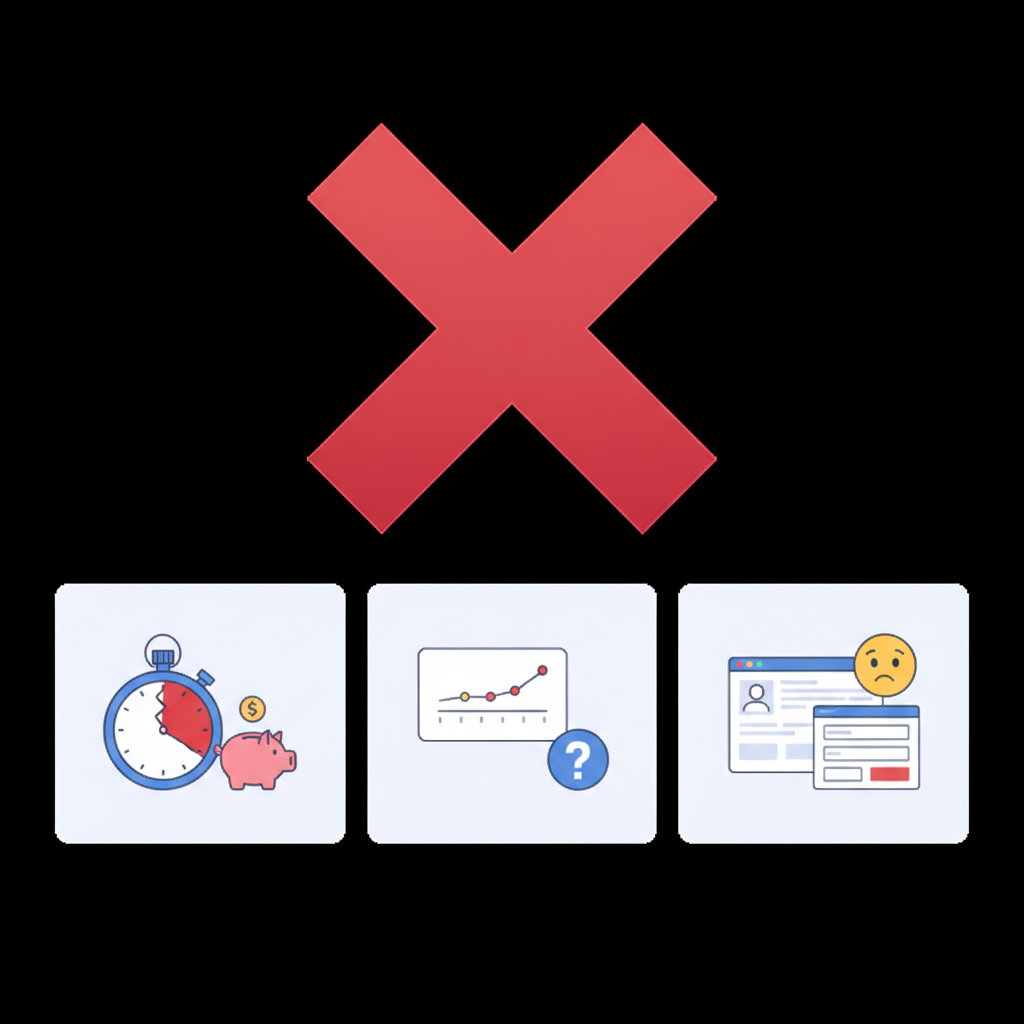
If you have fewer than 3,000 monthly pageviews to the pricing page, these A/B tests will likely be underpowered and give noisy results. When your product roadmap is about to change pricing or trial mechanics within 30 days, pause tests until after the change. If legal or procurement requires a fixed contract-based flow rather than a public trial, these experiments won't apply. Do not run pricing CTA tests across internationalized pages without first confirming currency and geo-pricing parity on Lovable; mixed currency exposures will confound AI-inclusion metrics. Finally, avoid testing live pages during major site migrations or canonical reshuffles—those events will obscure true lift.
Why running A/B tests on pricing pages is a high-impact SEO & CRO play
Pricing pages drive higher-intent traffic than most marketing pages. A small percentage gain in trial-to-paid conversion here yields disproportionate revenue impact because visitors are closer to purchase. For Lovable users, pricing page experiments are especially efficient: Lovable's page configuration and content blocks make it fast to spin up small variants without heavy engineering work. Specific examples: swapping a CTA from "Start trial" to "Start 7-day free trial — no card" or moving a short FAQ block that answers "How much does X cost?" both create measurable changes in click-through and AI snippet inclusion.
Concrete outcome to aim for: a realistic experiment goal is a 5–15% uplift in trial-to-paid conversion for clearly better-performing variants. That range is achievable with targeted changes to CTA phrasing, trial clarity, and pricing layout.
Clear numeric answers on pricing pages increase the chance of being selected for AI answers and reduce decision friction for users.
Hypotheses that affect both conversion and AI-inclusion (e.g., clear numeric answers, FAQ placement)
Focus hypotheses on clarity and extractability. AI systems prefer concise, unambiguous answers; humans prefer clarity and reduced cognitive load. Sample hypotheses you can test on Lovable:
- Hypothesis A: Presenting a single bolded price for the most popular tier increases trial starts by reducing choice paralysis and raises AI-inclusion impressions because the price is a clear extractable entity.
- Hypothesis B: Placing a short FAQ answer titled "How much does the plan cost per user?" above the fold improves CTR from search and raises AI snippets because the question-answer pair matches common query phrasing.
- Hypothesis C: Using explicit trial messaging like "7-day free trial — no card" lowers perceived friction and increases trial-to-paid rate compared with vague CTA microcopy.
Test each hypothesis with a measurable primary KPI (trial-to-paid conversion) and a secondary KPI (AI-inclusion impressions). Track both because clearer copy often produces small SEO gains that compound over time.
Run any test with a primary KPI and a secondary AI-inclusion metric; measure both simultaneously.
5 ready-to-run A/B test templates for Lovable pricing pages
Below are five templates tailored to Lovable's content blocks and typical SaaS flows. Each template includes the variant, primary KPI, minimum sample guidance, and a short rationale.
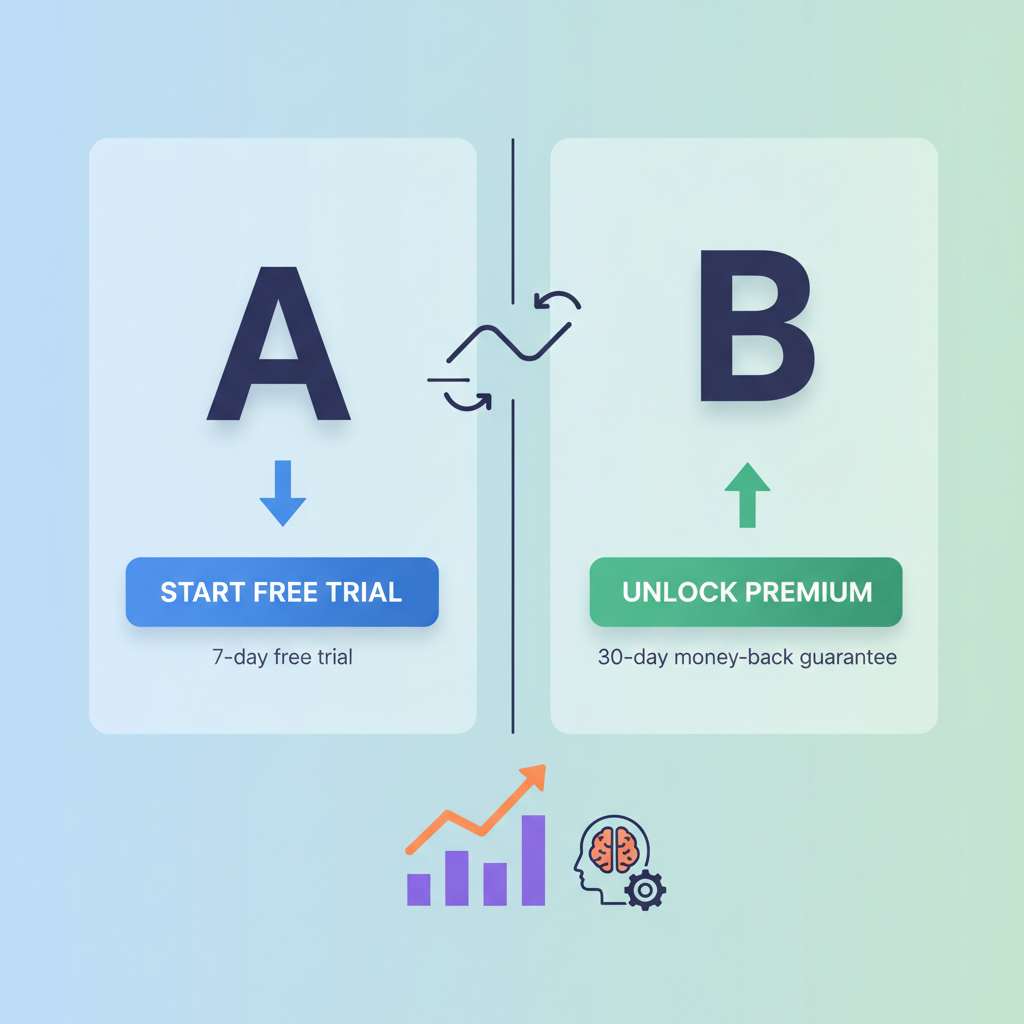
- CTA wording swap — Variant: "Start 7-day free trial" vs "7-day free trial — no card". Primary KPI: trial-to-paid. Minimum: 10k pageviews across variants. Rationale: explicit trial clarity reduces hesitation and provides extractable phrasing for AI.
- CTA color + microcopy — Variant A: neutral button with action phrasing, Variant B: accent color with microcopy above the button. Primary KPI: CTA CTR. Minimum: 5k pageviews per variant. Rationale: visual prominence plus supporting microcopy can lift clicks.
- Pricing display — Variant A: condensed summary with one highlighted price, Variant B: full tier table. Primary KPI: trial starts and AI-inclusion impressions. Minimum: 10k pageviews. Rationale: condensed numeric answers map better to AI snippets.
- FAQ placement — Variant A: FAQ below tiers, Variant B: single Q&A above the fold. Primary KPI: CTR from search and AI-inclusion. Minimum: 8k pageviews. Rationale: relocating clear Q&A improves snippet eligibility.
- Trial commitment prompt — Variant A: signup form asks for card, Variant B: no-card CTA with reminder of trial length. Primary KPI: trial starts; Secondary: trial-to-paid. Minimum: 10k pageviews. Rationale: removing friction increases starts and filters better leads.
CTA copy & color test (microcopy vs action phrasing)
Test two axes together: copy and visual prominence. Create four cells if traffic allows: action phrase + neutral color, action phrase + accent color, microcopy + neutral, microcopy + accent. Measure CTA CTR first, then downstream trial starts. Example microcopy: "Try free for 7 days — cancel anytime." Example action phrasing: "Start your trial." For Lovable sites, implement variants by changing the CTA text block and the button style in the pricing template; no backend changes are required. Track results at both the button click event and the successful trial start event to catch false positives from accidental clicks.
Trial length and clarity test ("7-day free trial" vs "Start 7-day trial")
Small phrasing differences alter expectations. "7-day free trial" reads like a label, while "Start 7-day trial" is an action. Test which prompts more signups and better trial-to-paid conversion. Run for at least two weeks and ensure variants hit the minimum pageview thresholds. For a concrete plan: Run a 2-week A/B test comparing "Start 7-day free trial" vs "7-day free trial — no card" across 10k pageviews minimum; primary KPI: trial-to-paid rate uplift, secondary KPI: AI-inclusion impressions. Aim for 5–15% uplift in trial-to-paid as a realistic target.
Pricing display test (single price vs. tier table vs. condensed summary for AI snippets)
Make prices easy to extract. Variant A: single prominent price with a one-line explanation (best for AI answers). Variant B: full tier table with features (best for comparison shoppers). Variant C: condensed summary (short bullets plus price). Measure AI-inclusion impressions and trial starts. Use the comparison table below to decide which to implement first based on your audience.
| Variant | When to use | Primary KPI |
|---|---|---|
| Single price | When 70%+ visitors know what they need | AI-inclusion impressions |
| Tier table | When visitors compare features | Trial starts |
| Condensed summary | When you want both snippet eligibility and quick scanning | Trial-to-paid conversion |
Metrics to track: CTR from search, AI-inclusion impressions, trial starts, trial-to-paid conversion
Define a measurement plan before you run a test. Required metrics include:
- CTR from search (track via your analytics or search console equivalent).
- Trial starts (event when a user completes the trial sign-up).
- Trial-to-paid conversion (users who convert to paid within N days; define N, e.g., 30 days).
Example KPIs and thresholds: P95 time-to-first-byte for the pricing page should be under 500ms for typical SaaS sites; if your Lovable pages are slower, test results may be biased. Use a sample-size calculator (choose 80% power, 5% significance) to set minimum pageviews per variant—10k is a practical baseline for pricing experiments.
Implementing tests on Lovable: lightweight experiment setup, guardrails, and sample timelines
On Lovable, implement tests by duplicating the pricing page template and modifying the specific content blocks you want to test. Keep structural and SEO elements identical between variants. Guardrails: For more on this, see Lovable landing page seo.
- Only change one user-facing variable at a time per test unless you use a factorial design.
- Preserve meta tags and canonical settings across variants until after the experiment concludes.
- Run tests for a minimum of two weeks and until you hit the pre-calculated sample size.
Use this launch checklist:
| Step | Action |
|---|---|
| 1 | Define primary & secondary KPIs and sample-size target |
| 2 | Create variant pages in Lovable, maintain same canonical tags |
| 3 | Instrument events for CTA clicks, trial starts, and conversions |
| 4 | Run experiment for full traffic window (min 2 weeks) |
| 5 | Analyze using pre-defined metrics, then deploy winner |
Interpreting results and deploying winners without harming SEO (canonical, noindex rules, and content parity)
Interpret lift using both relative and absolute metrics. A 10% relative increase on a low base might be small in absolute dollars; translate lift into ARR impact for stakeholders. When deploying winners, preserve SEO by keeping canonical tags pointing to the primary pricing URL. If you must leave a variant live for personalization, ensure content parity: don't serve drastically different H1s or meta descriptions to bots vs humans. If an experiment variant reduces organic visibility, revert and retest with smaller copy changes.
Decision rule example: adopt a variant if it shows statistically significant uplift in trial-to-paid with no >5% drop in search impressions or AI-inclusion impressions over 14 days.
Case study template + how to report lift to stakeholders
Use a concise case study format that ties copy changes to revenue impact. Template sections:
- Objective: e.g., increase trial-to-paid conversion for self-serve signups.
- Hypothesis: short clear statement, e.g., "Making the trial messaging explicit increases trial-to-paid by reducing friction."
- Method: sample size, duration, variants tested, and KPIs.
- Results: numeric lift, confidence intervals, absolute ARR impact.
- Recommendation: deploy, run follow-up tests, or roll back.
When reporting lift, translate percentages into customer and revenue terms. Example: "A 7% relative lift in trial-to-paid across a baseline of 1,200 trials/month equals ~84 additional paid customers monthly; at $25 ARR each, that’s $2,100 monthly recurring revenue." Use conservative estimates and avoid invented SLA claims.
FAQ
What is a/b test pricing page ctas and trial messaging on lovable?
A/B test pricing page CTAs and trial messaging on Lovable is the practice of creating variant pricing page content within the Lovable platform to compare different CTA texts, trial descriptions, and pricing layouts with the goal of improving trial starts, trial-to-paid conversion, and AI snippet eligibility.
How does a/b test pricing page ctas and trial messaging on lovable work?
It works by duplicating the pricing page template in Lovable, changing the specific copy or layout you want to test, routing a randomized sample of visitors to each variant, tracking predefined KPIs (CTA CTR, trial starts, trial-to-paid, AI-inclusion impressions), and then analyzing results to select and deploy the winning variant while preserving canonical and SEO settings.
Ready to Rank Your Lovable App?
This article was automatically published using LovableSEO. Get your Lovable website ranking on Google with AI-powered SEO content.
Get Started