Pricing Page A/B Tests for Lovable SaaS: 10 High-Impact Experiments and Variant Templates
A guide covering pricing Page A/B Tests for Lovable SaaS: 10 High-Impact Experiments and Variant Templates.

TL;DR
- Run focused pricing page A/B tests to raise trial-to-paid conversion rates quickly.
- Prioritize tests by impact × ease × exposure; start with headline, CTA, and trial friction experiments.
- Expect typical uplifts: headline/pricing layout ~10–20%; CTA/headline ~5–15%.
- Use a clear measurement plan, CSV-ready variant templates, and a short rollout checklist for Lovable sites.
Introduction: This guide walks you through practical, platform-specific pricing page a/b tests lovable teams can run to boost trials and conversions. It defines trial-to-paid conversion rate, gives a sample uplift table you can quote, and supplies ready-to-copy variant templates and checklists for lovableseo.ai-powered pages. Read the sections in order and pick two quick wins to test in the next sprint.
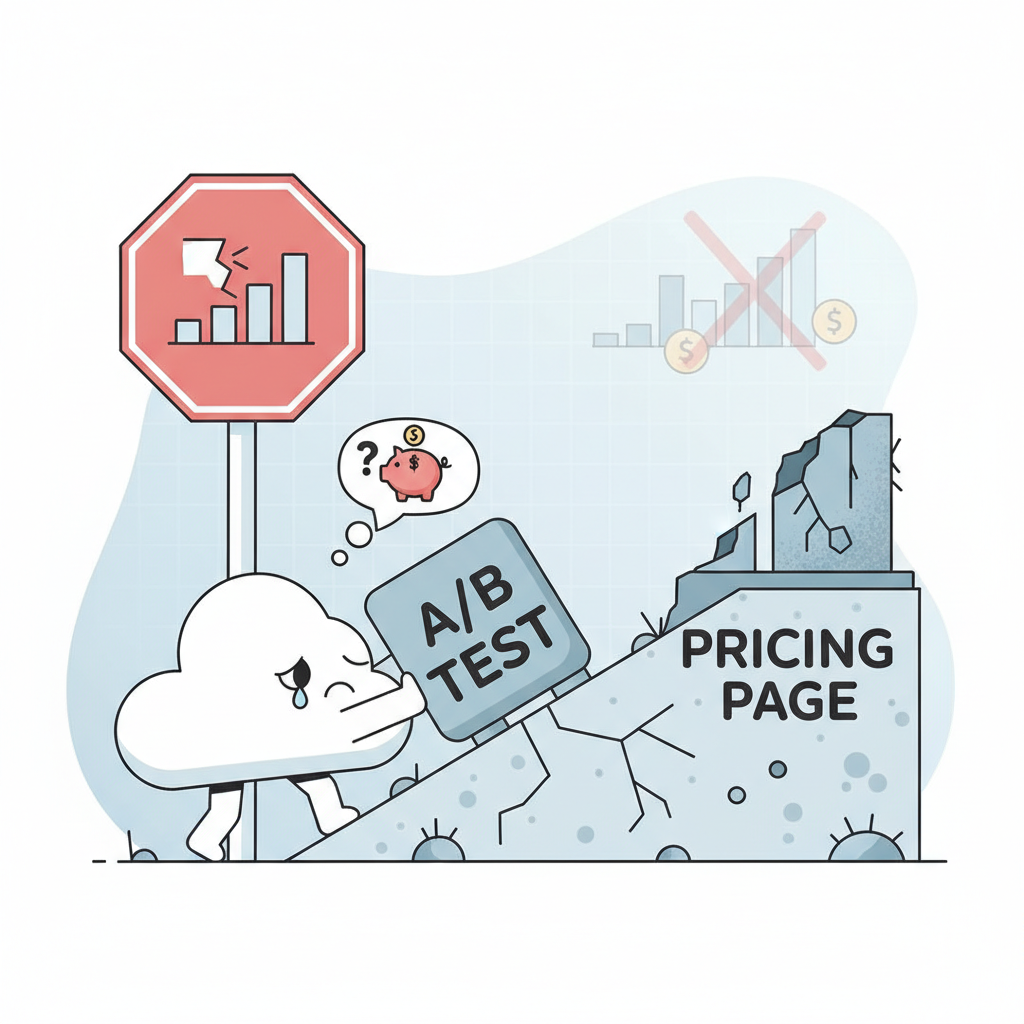
When NOT to run pricing page A/B tests on Lovable
Do not start pricing page experiments when you lack stable traffic, reliable event tracking, or a single primary conversion goal. Skip A/B tests if weekly unique visitors are under 1,000 to the pricing page, if analytics events change mid-test, or if the product roadmap will change pricing within 30 days. If your platform or CMS does not support consistent variant serving across sessions, postpone tests until tooling or session stitching is implemented. These conditions create noisy data and lead to false positives.
Why focused A/B tests on your Lovable pricing page win trial signups
Focused pricing page A/B tests lovable teams run target the key moment when a visitor decides to start a trial. Small, measurable changes to headline, price framing, or CTA remove friction and clarify value; those are the levers that most directly move trial-to-paid conversion rate. For insights on effective strategies, refer to our Pricing Page CRO Case Studies & A/B Test Playbook for Lovable SaaS. Trial-to-paid conversion rate is the percentage of trial signups that convert to paid accounts within a defined period; typical benchmarks vary by product and audience.
For lovableseo.ai examples: swapping a benefit-led headline to one that names the outcome ("Rank faster on Google with guided SEO tasks") converted more prospects in early experiments than a generic headline. And clarifying trial length in the headline reduced drop-offs during signup. These targeted changes matter because they change intent at the page visit — not the product.
Quotable definition: "Trial-to-paid conversion rate is the percentage of trial users who become paying customers within a defined interval." Quotable benchmark: "Typical pricing page A/B tests yield median uplifts of ~10–20% for headline/pricing layout experiments; headline and CTA tests often move 5–15%."
How to prioritize tests (impact × ease × exposure) — quick scoring sheet
Prioritize experiments with a 3‑axis score: Impact (0–5), Ease (0–5), Exposure (0–5). Multiply scores to rank tests. Impact estimates expected relative lift on trial-to-paid conversion; ease reflects engineering/QA effort on lovableseo.ai pages; exposure measures weekly unique visitors to the pricing page.
Example scoring rule: treat any test scoring 60+ (max 125) as a sprint candidate. Concrete thresholds: target tests where Exposure >= 2 (meaning >= 2,000 weekly visits) and Ease >= 3 to keep velocity high. Use this checklist to score each idea:
- Impact: estimated relative lift (1–5)
- Ease: dev + QA hours (1–5)
- Exposure: weekly uniques (1–5)
Only test items that can be measured with current analytics and at least two weeks of stable traffic.
10 high-impact experiments
Run these experiments in order of expected payoff: headline/value, CTA, price presentation, tier names/order, trial friction, social proof, pricing table complexity, discounts, feature callouts, and urgency/stock messaging. Below each quick experiment description are test variants and sample rules you can copy to a Google Sheet.
Start with headline, CTA, and trial-friction experiments — they typically produce the fastest, cleanest signals.
Headline and value-prop swaps (test variants + sample copy)
Test a direct outcome headline vs a feature headline. Variant A (control): "Flexible SEO tools for teams." Variant B: "Increase organic traffic 30% faster with guided tasks." Variant C: Benefit + proof: "Guided SEO — used by 1,200 agencies to grow traffic." Run for 2–4 weeks; measure trial starts and downstream trial-to-paid conversion. For lovableseo.ai, test naming a common outcome (rankings, traffic) rather than product features.
Pricing tier names & order (variant examples and sample segment rules)
Experiment with descriptive tier names and reorder to nudge choice. Control: Basic / Pro / Enterprise. Treatment: Starter (highlighted) / Growth (recommended) / Custom. Segment business visitors by company size via a hidden form field or IP firmographic enrichment; show Growth first to SMBs. Rule example: show variant when user country = US and page referrer contains "search".
Primary CTA copy and microcopy experiments
CTA tests move behavior. Test "Start free trial" vs "Try 14 days free" vs "Create account — no card". Add microcopy under CTA: "No credit card. Cancel anytime." Use short A/B runs (10–14 days) for CTA text, longer for structural changes. For lovableseo.ai, try outcome-led CTAs: "Start improving rankings" to connect to intent.
Price presentation (monthly vs annual prominence) and discount framing
Test which price is shown first and how discounts are framed. Treatment A: show annual price prominently with monthly crossed out. Treatment B: show monthly price with annual savings note. Test absolute discount ("Save $X") vs relative ("Save 25%") and measure both trial signups and churn risk post-conversion.
Trial length & friction experiments (one-click trial vs form) — expected lift ranges
Compare one-click trial start (email only) vs a short form (name + email) vs a full signup (card required). Expected lifts: one-click trial often increases trial signups by 10–30% but may lower initial-quality signals. Use gating rules: require more info for enterprise-tier trials. Report both immediate trial starts and trial-to-paid conversion rate.
Social proof placement and proof density experiments
Test a single strong logo row vs customer quote near CTA. Variant A: five logos above fold. Variant B: one logo + 20-word quote next to CTA. For lovableseo.ai, try a short case stat tied to SEO outcome; that specificity increases credibility more than many logos.
Pricing table simplification vs detail (control vs treatment examples)
Simplify: three columns, three bullets each. Detail: full feature matrix with toggles. Test which increases trial starts and which improves trial-to-paid conversion. Use a secondary metric: time-on-page to detect confusion. For many SaaS, simplified tables increase immediate trials; detailed tables reduce churn by aligning expectations.
Measurement plan: metrics, sample size calculator, and stopping rules
Define primary metric: trial starts (for funnel entry) and trial-to-paid conversion rate (for revenue impact). Secondary metrics: activation within trial, churn at 30 days, and trial quality (engagement events). Use a sample size calculator to detect a 10% relative lift at 80% power and 95% confidence; if baseline conversion is 5%, you'll need several thousand visitors per variant.
Stopping rules: stop early if safety thresholds break (negative impact on paid signups), or continue until minimum sample size and at least one full business cycle (14–28 days) have passed. Record pre-test assumptions and expected effect size in the test sheet before launch.
| Experiment type | Expected uplift range |
|---|---|
| Headline / price layout | ~10–20% |
| CTA text | ~5–15% |
| Trial friction (one-click) | ~10–30% starts, varied conversion |
| Social proof | ~3–10% |
Attribution note: report uplifts separately for single-country vs multi-country trials due to currency and regulatory differences; aggregate only after verifying consistent direction across top markets.
Variant templates and test sheet (CSV/Google Sheets you can copy)
Use a single CSV with columns you can paste into a feature-flag or A/B tool. Example columns below form a ready template.
| variant_id | section | control_text | treatment_text | segment_rule |
|---|---|---|---|---|
| v1 | headline | Flexible SEO tools | Increase organic traffic 30% faster | all |
| v2 | cta | Start free trial | Try 14 days free — no card | all |
Copy this table into Google Sheets and add columns for start_date, end_date, expected_n, and owner.
Implementation on Lovable: practical tips (how to run experiments without full platform A/B tooling)
If you lack built-in A/B tooling, implement server-side variant rendering or use query-string variant keys with consistent cookies. For lovableseo.ai pages, ensure the CMS preserves query strings across navigation and that analytics events include a variant label. Use feature flags or a simple router rule to serve HTML snippets conditionally, and keep tracking consistent across repeat visits.
Using SEOAgent for iterative publishing of test variations and tracking
Use SEOAgent to publish content variations quickly and track versioned page performance. Publish variant pages with canonical rules disabled for short tests, tag analytics events with "variant_id", and store results in a shared sheet. For multi-variant experiments, export engagement metrics and join by variant_id to compute trial-to-paid conversion per variant.
Post-test checklist: interpret results, rollouts, follow-ups
After a test completes: (1) validate data quality and segment consistency, (2) check secondary metrics for negative signals, (3) run a quick QA on rolled-out copy, (4) prepare a phased rollout plan. If a variant wins, roll it to 100% for two weeks then monitor month-over-month revenue impact. If results are inconclusive, iterate with a narrowed hypothesis.
- Check data integrity: consistent event counts across variants
- Confirm no concurrent experiments that confound results
- Document insights and next hypothesis in the test sheet
FAQ
What is pricing page a/b tests for lovable saas?
Pricing page A/B tests for Lovable SaaS are controlled experiments that compare two or more pricing page variants on lovableseo.ai-powered sites to measure which version produces higher trial starts and better trial-to-paid conversion rates.
How does pricing page a/b tests for lovable saas work?
An experiment serves different page variants to separate visitor cohorts, tracks primary and secondary metrics (trial starts, activation, trial-to-paid conversion), and uses statistical criteria to determine a winner before rolling out the change.
Conclusion: next 30/60/90-day CRO roadmap for Lovable pricing pages
30 days: run two quick wins — headline swap and CTA text — using the scoring sheet and CSV template. 60 days: implement trial-friction and price-presentation tests, measure trial-to-paid conversion. 90 days: consolidate winners, run a pricing table complexity experiment, and document revenue impact. Quoted takeaway: "Measure trial starts and trial-to-paid conversion separately; both matter." Follow the measurement plan and use the templates to keep tests reproducible on lovableseo.ai pages.
Ready to Rank Your Lovable App?
This article was automatically published using LovableSEO. Get your Lovable website ranking on Google with AI-powered SEO content.
Get Started