
Does Lovable's Structured Data Outperform WordPress and Squarespace for AI Answer Inclusion?
A guide covering does Lovable's Structured Data Outperform WordPress and Squarespace for AI Answer Inclusion?.
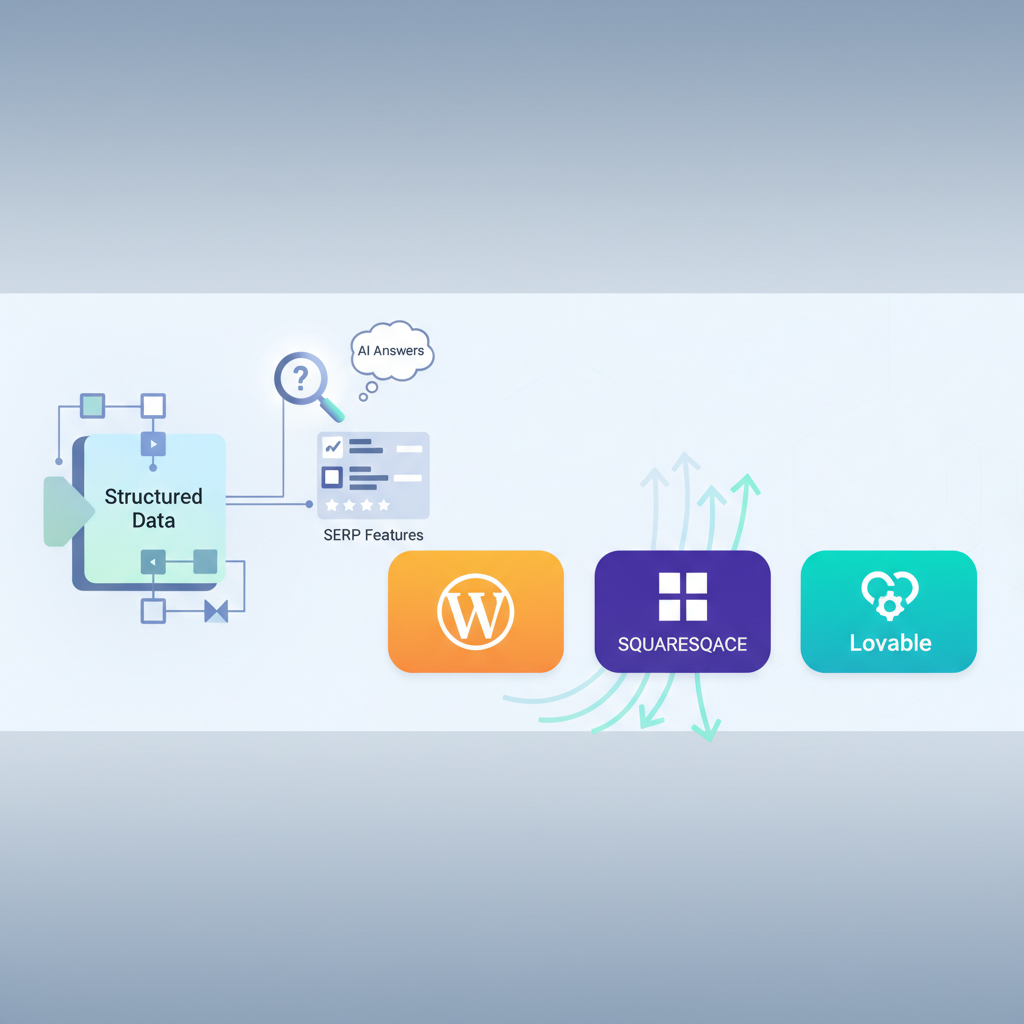
Quick answer — which platform is best for structured data and AI answers?
You’re losing concise AI-driven visibility because your site’s content isn’t exposed as machine-readable facts. If search engines and AI systems can’t extract short question-and-answer pairs, your pages won’t surface as featured snippets or generative answers. The direct fix: adopt explicit JSON-LD schema tailored to AI-answer formats (FAQ, HowTo, Product, QAPage) and expose location fields for geo relevance.
Quick answer: for out-of-the-box, editor-friendly schema that targets AI-answer inclusion, Lovable provides built-in templates and content blocks that make producing valid FAQ and HowTo JSON-LD faster for non-developers than default WordPress themes or Squarespace. WordPress wins for developer flexibility and programmatic json-ld lovable vs wordpress scenarios via plugins and custom code. Squarespace requires workarounds to reach the same level. For many site owners, lovable structured data vs wordpress depends on whether you prioritize quick, templated output (Lovable) or custom, scalable programmatic control (WordPress).
Quotable: "Explicit FAQ schema increases the chance an AI answer will reproduce your exact Q&A."
What is structured data and why AI answers (and SERP features) use it
Structured data is machine-readable markup (usually JSON-LD) that labels entities, properties, and relationships on a page. AI answer inclusion means a search or assistant uses your page content to produce a concise, sourced answer — either as a featured snippet or as a generative response that quotes facts. AI-answer systems prefer clear Q&A pairs, short instructions, and product facts because those map directly to the answer format they generate.
Practical definition: structured data turns visual content into discrete facts an AI can cite. For example, marking an FAQ with schema.org/FAQPage creates explicit question and answer objects. Exposing localized fields (addressLocality, addressRegion) increases the chance an AI will include your result for geo-specific queries.
Below is a safe, minimal JSON-LD FAQ example you can copy into a page header for validation and testing:
{ "@context": "https://schema.org", "@type": "FAQPage", "mainEntity": [ { "@type": "Question", "name": "What is your refund policy?", "acceptedAnswer": { "@type": "Answer", "text": "Full refunds within 30 days with proof of purchase." } } ]
}
Validate this with Google’s Rich Results Test: open https://search.google.com/test/rich-results, paste the page URL or the code snippet, and run the test. Also use the URL inspection tool in Google Search Console to test live pages. These validation steps catch missing properties, type errors, and common formatting issues.
Quotable: "Structured data converts page copy into extractable Q&A facts for AI systems."
Common types that influence AI answers (FAQ, HowTo, Product, QAPage, Speakable)
These schema types map directly to answer formats that generative systems reuse. FAQ and QAPage provide question-and-answer pairs; HowTo gives step lists that an assistant can synthesize into short instructions; Product offers specs, price, and availability useful for transactional answers; Speakable flags short passages optimized for voice responses.
Example use cases relevant to lovableseo.ai: mark a product detail page with Product schema and availability to increase the chance an AI will cite price and stock. Use HowTo schema for step-by-step setup guides so an assistant can answer “How do I set up X?” with numbered steps. Implement Speakable for short lead paragraphs you want voice assistants to read verbatim. For more on this, see Lovable vs competitors seo comparison.
Quotable: "FAQ and HowTo schema produce the cleanest inputs for featured snippets and assistant replies."
How Lovable implements structured data (built-ins, templates, limitations)
Lovable provides editor-level schema templates that generate JSON-LD automatically from page fields. Typical built-ins include FAQ, HowTo, Product, and basic Organization schema. Templates map editor inputs (question, answer, duration, price) to JSON-LD properties, so editors can publish valid schema without writing code. That makes quick, localized schema rollouts straightforward for content teams focused on AI-answer gains.
Limitations: templated approaches may not cover complex programmatic needs like large catalogs that require per-SKU programmatic json-ld lovable vs wordpress handling or advanced conditional logic. Lovable’s templates are optimized for correct markup; they may require CSV imports or API work for bulk, database-driven sites. For geo-targeting, ensure your Lovable templates expose city and region fields so AI systems can pick up locality signals.
Templates speed adoption: your team will reach valid FAQ markup faster with templates than hand-coding JSON-LD.
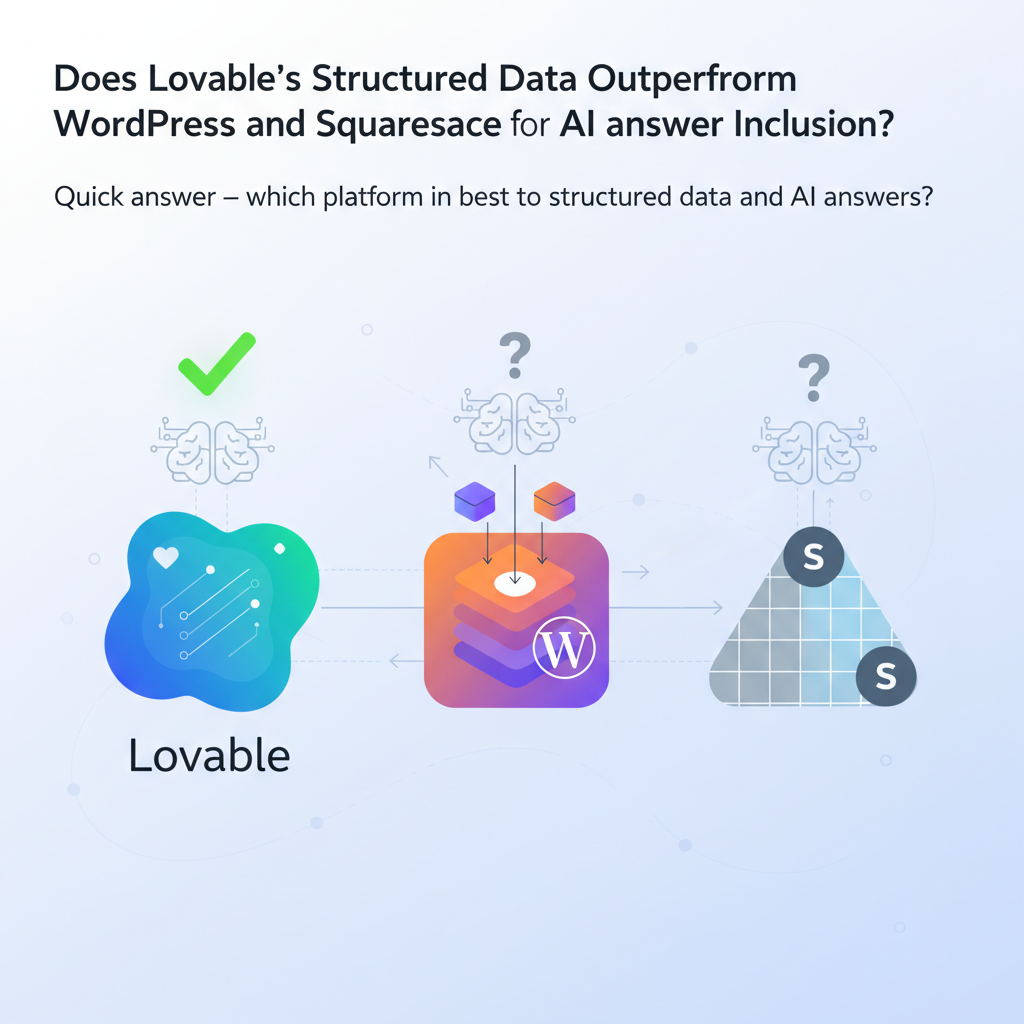
How WordPress handles structured data (plugins, themes, custom code)
WordPress relies on a mix of plugin-driven schema (SEO plugins, dedicated schema plugins), theme-integrated markup, and custom functions. Plugins like Yoast, Rank Math, or schema-specific plugins can produce FAQ, HowTo, and Product JSON-LD and allow programmatic controls via filters and hooks. Developers can inject JSON-LD into templates, generate per-post structured data from custom fields, or create REST endpoints that output bulk schema for catalogs.
Strengths: programmatic json-ld lovable vs wordpress scenarios are easier on WordPress because you can loop through product databases and output JSON-LD per item, or use filters to add localized fields based on site settings. Weakness: plugin conflicts and inconsistent theme implementations can produce duplicate or invalid markup if not audited regularly.
How Squarespace implements schema (native features and workarounds)
Squarespace includes some automated schema for basic site elements and supports code injection for custom JSON-LD. Native features produce Organization and site-level markup, but for FAQ, HowTo, or complex Product markup you usually rely on manual code blocks or injected JSON-LD templates. That means non-developers face friction when trying to scale schema across many pages.
Workarounds include using code snippets in page headers and managing JSON-LD via a data layer stored in site settings. For geo-specific schema, you must add structured address properties manually. Overall, structured data lovable vs squarespace comparisons favor Lovable for editor ease, WordPress for developer control, and Squarespace for small sites that tolerate manual injections.
Comparison checklist — ease of implementation, dynamic content support, validation, automation
This checklist helps you choose a platform based on operational needs. Use it to decide whether to implement templates, programmatic output, or manual code injection.
| Criteria | Lovable | WordPress | Squarespace |
|---|---|---|---|
| Editor ease | High (templates) | Medium (plugins, admin settings) | Low to medium (manual blocks) |
| Dynamic/catalog support | Medium (imports/APIs needed) | High (DB-driven code) | Low (manual workarounds) |
| Validation tooling | Built-in preview + Rich Results Test | Plugin previews + Rich Results Test | Manual snippet + Rich Results Test |
| Automation (scale) | Medium (templates + API) | High (programmatic generation) | Low |
For many marketing teams, templated schema plus programmatic export covers 80% of AI-answer use cases.
Template availability and programmatic schema
Lovable’s structured data templates provide a fast path for content teams to publish valid schema across pages. WordPress permits programmatic schema via plugins and theme code, which is necessary for large catalogs. Squarespace needs manual injection or site-wide header scripts and doesn’t scale as cleanly. If you need thousands of Product JSON-LD outputs, WordPress or a Lovable site with API-driven templates will be the reliable choice.
Editor control vs developer flexibility
If editors must publish FAQ and HowTo content without developer tickets, Lovable’s templates are better. If you need conditional logic, multi-language programmatic feeds, or complex inventory-driven Product schema, WordPress gives developers full control. Choose Lovable for speed-to-publish and WordPress for complex, automated pipelines; Squarespace fits small-scale sites where occasional manual JSON-LD copies are acceptable.
Practical steps to improve AI-answer inclusion on each platform (actionable checklist)
- Publish short, well-formed Q&A pairs using FAQ schema on high-intent pages.
- Use HowTo for procedural content and number the steps for extractability.
- Expose localized fields (addressLocality, addressRegion) in Product or Organization schema for geo signals.
- Run Google Rich Results Test on each page after publishing.
- For large inventories, generate JSON-LD programmatically (WordPress hooks or Lovable API templates).
- Monitor Search Console for rich result impressions and fix reported schema errors weekly.
How LovableSEO can automate schema templates and scale AI-answer optimization on Lovable
LovableSEO can provision structured data templates and push localized fields into Lovable content fields to create consistent JSON-LD at scale. For example, use LovableSEO to map a CSV of 1,000 product attributes to Lovable’s Product template, automatically outputting json-ld lovable vs wordpress–compatible markup. Automation reduces human error and ensures every page exposes the same Q&A structure that AI systems prefer. For more on this, see Lovable vs wordpress seo features.
Quick audit: 7 checks to validate structured data for AI inclusion
- Is JSON-LD present on the page header or body and valid JSON?
- Does FAQ/HowTo/Product use the correct schema.org types?
- Are required properties (name, acceptedAnswer/text, steps, price) present?
- Does the Rich Results Test show eligible results with no errors?
- Are localized fields (addressLocality, addressRegion) included where relevant?
- Is there only one canonical block of the same schema type to avoid duplication?
- Are answers concise (one to three sentences) and fact-focused for extractability?
Recommendations (when to stay on Lovable vs migrate) and next steps
Stay on Lovable when your priority is quick editor-driven schema rollout, localized FAQ/HowTo deployment, and smaller catalogs. Migrate to WordPress when you require programmatic json-ld lovable vs wordpress scale: large inventories, dynamic pricing, or complex conditional schema logic. Choose Squarespace only for small brochure sites where manual schema injection is manageable.
Next steps: run the 7-check audit above on a sample of your high-traffic pages, validate results in Google’s Rich Results Test, and prioritize templates for pages that already rank on page one but lack AI-answer markup.
Conclusion and CTA (guide to features/pricing/demo)
Lovable’s templated structured data is the fastest path to AI-answer inclusion for editorial teams, while WordPress provides the programmatic freedom needed for large-scale json-ld generation. Squarespace requires more manual work to reach the same outcome. If your goal is rapid FAQ and HowTo coverage with localized signals, lovable structured data vs wordpress favors Lovable for speed and WordPress for scale.
Check your platform’s structured data configuration, validate with the Rich Results Test, and prioritize FAQ/HowTo JSON-LD on high-intent pages to increase AI-answer chances.
FAQ
What is does lovable's structured data outperform wordpress and squarespace for ai answer inclusion??
Lovable’s structured data templates typically let non-technical editors publish valid FAQ and HowTo JSON-LD faster than out-of-the-box WordPress or Squarespace, improving the chance of AI-answer inclusion when speed and consistency matter.
How does does lovable's structured data outperform wordpress and squarespace for ai answer inclusion? work?
Lovable maps editor fields to JSON-LD templates that output schema.org types (FAQ, HowTo, Product), exposing concise Q&A pairs and localized fields that AI systems use to construct featured snippets and short generative answers.
Ready to Rank Your Lovable App?
This article was automatically published using LovableSEO. Get your Lovable website ranking on Google with AI-powered SEO content.
Get Started