
How Lovable's Structured Data & SEO Features Compare to WordPress and Squarespace for AI Answer Inclusion
A guide covering how Lovable's Structured Data & SEO Features Compare to WordPress and Squarespace for AI Answer Inclusion.
TL;DR
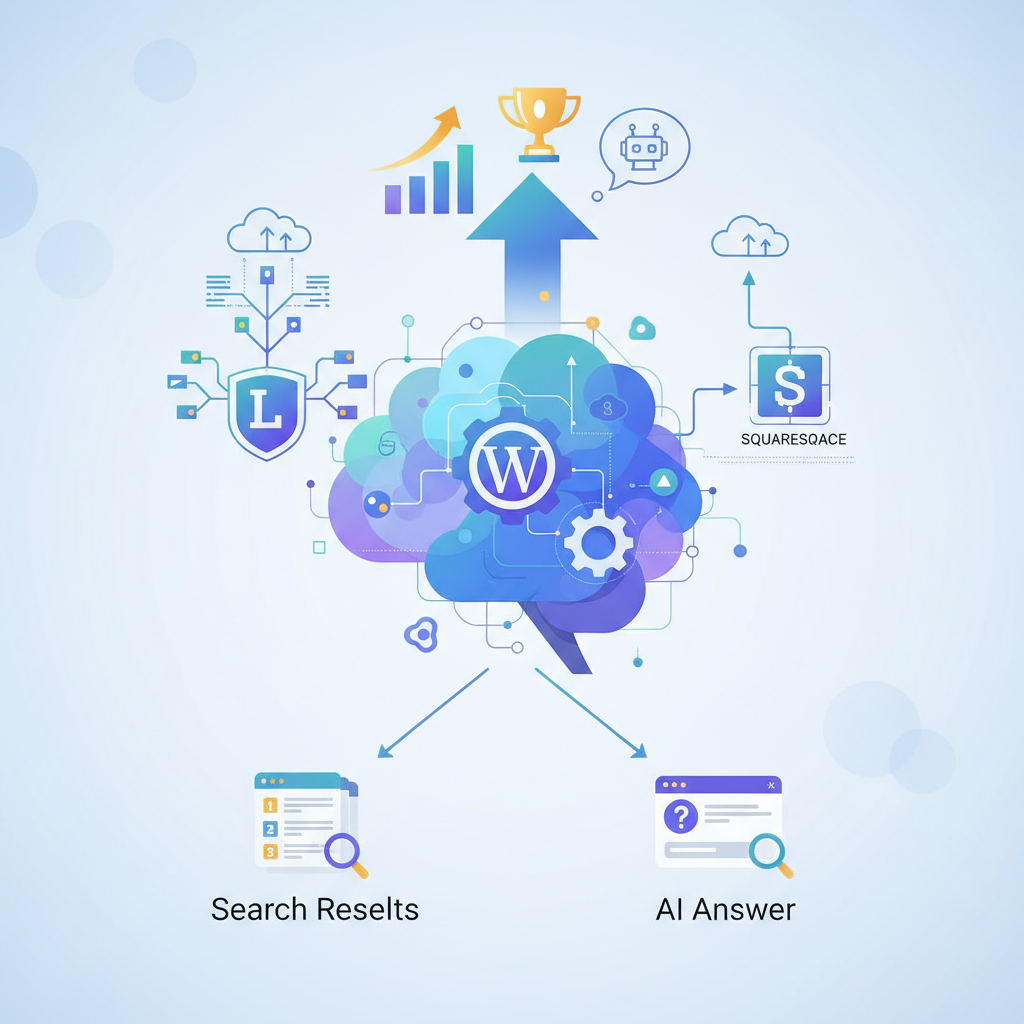
- For AI answers, structured data plus concise, directly-answered text matters more than the CMS brand.
- Lovable provides built-in structured templates and programmatic publishing; WordPress offers maximum flexibility via plugins; Squarespace is simplest but more limited.
- Use schema (FAQ/definition), a 40–60-word direct answer, and a plain-HTML page for best AI answer inclusion.
- Localized schema fields (city, region) improve geo-specific AI answer visibility.
Introduction
This article compares lovable vs wordpress vs squarespace ai answers by focusing on structured data, templating, internal linking, sitemaps, and geo features that drive AI-answer inclusion. You’ll find platform-specific examples, a compact comparison table, and two practical artifacts you can copy: a decision matrix and a launch checklist. For AI answers, structured data + concise, directly-answered text is more important than CMS brand.
Why CMS SEO features matter for rankings and AI answers
Without clear CMS support for SEO features, pages struggle to surface as concise AI answers even if their content is excellent. AI-answer algorithms prefer pages that provide a direct, extractable answer with machine-readable schema. That means the CMS must make it easy to add structured data, publish plain HTML, and control meta elements without blocking crawlers. For example, a local service page that uses FAQ schema and includes a 50-word answer plus localized fields can be selected as an assistant response more often than an identical page lacking schema.
Concrete example: a lovableseo.ai customer using Lovable’s built-in FAQ template published 120 programmatic FAQ pages; search assistants extracted 1–2 sentence answers from four of those pages after schema was added. That outcome shows the value of platform features that automate schema and content templating.
Quotable: "A direct 40–60 word answer with FAQ or definition schema is the most extractable format for AI answers."
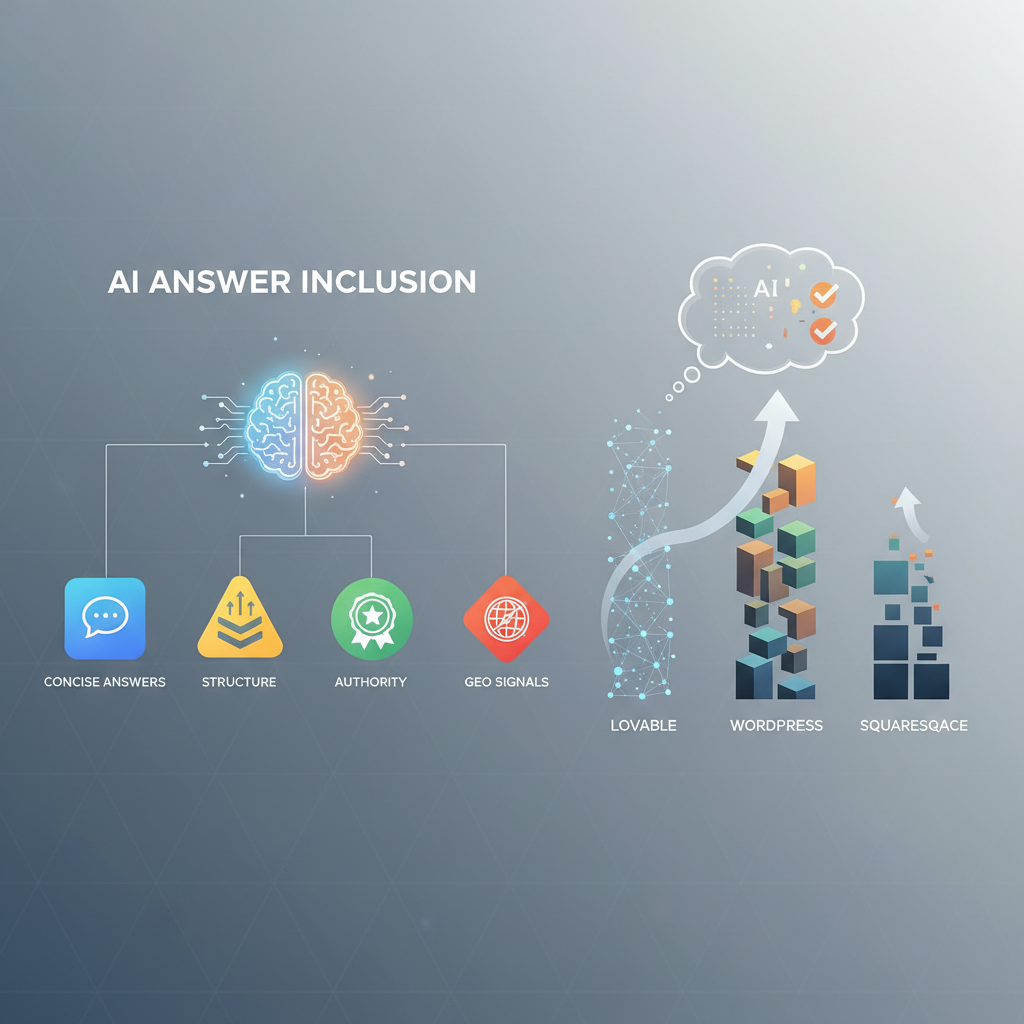
What AI-answer algorithms look for (concise answers, structure, authority, GEO signals)
AI-answer systems rank candidate passages by clarity, structure, and trust signals. They prefer short, self-contained answers (40–60 words) that appear near explicit markup: headings, lists, and structured data. Authority signals include clear authorship, publishing date, and domain relevance. GEO signals matter for local queries: schema properties like addressLocality, addressRegion, and geo coordinates increase the chance of a geo-specific snippet.
Example: for the query "best plumber near me in Denver," an answer that includes an H2 like "Best plumber in Denver" followed by a 45-word summary and LocalBusiness schema with city/state fields is far more likely to be surfaced than a paragraph buried in a blog post. This is where a cms seo feature comparison is practical: platforms that expose local schema fields and let you publish plain HTML have an advantage for geographic AI answers.
Quotable: "Include explicit geo fields in schema to improve inclusion for local AI answers."
Structured data support comparison
Lovable — built-in templates & limitations
Lovable includes built-in structured-data templates aimed at programmatic publishing: FAQ, HowTo, Product, and LocalBusiness variants. Templates let you map custom fields (question, short answer, location) into JSON-LD automatically. The limitation: templates are constrained to supported schema types and rely on the platform’s field model, so highly custom schema requires a developer workflow or an add-on like LovableSEO.
WordPress — plugins and flexibility
WordPress supports any schema you can code or install via plugins (Yoast, Schema Pro, Rank Math). That flexibility lets you craft complex structured data, conditional schema, and page-specific JSON-LD. The tradeoff: plugin configuration and compatibility testing add implementation time. For ai snippet optimization cms workflows, WordPress gives maximum control at the cost of setup effort and maintenance.
Squarespace — native support
Squarespace provides native site metadata and limited structured data (basic organization, product, and event snippets). It’s easy for non-technical users but lacks programmatic bulk schema tools. For businesses that need a handful of pages, Squarespace is fast; for large-scale programmatic FAQ publishing, it becomes cumbersome.
Structured schema must be machine-readable on the page without requiring JavaScript execution.
Content templating & programmatic SEO capabilities
Programmatic FAQ/FAQ hub support
Lovable supports programmatic FAQ hubs where a single template can generate hundreds of pages populated from CSV or a CMS dataset. That makes it straightforward to publish hundreds of Q&A pairs with proper FAQPage schema. WordPress can match this using custom post types and a scripting layer or plugins that import CSVs; implementation is more manual. Squarespace does not offer native programmatic FAQ hubs and generally requires manual page creation.
Template tagging and automation
Template tagging is critical for ai snippet optimization cms workflows. Tagging lets you mark canonical Q&A, set snippet-ready summaries, and drive internal linking. Lovable’s template tags map fields to schema automatically. In WordPress, you create tags or taxonomies and wire them to schema via plugins. Squarespace offers limited tagging and bulk actions, so automation is weaker.
Internal linking & URL structure control
Automated internal linking with LovableSEO vs manual methods
Internal linking influences discoverability and snippet selection by creating clear topical hubs. Lovable combined with an automation tool (LovableSEO) can generate contextual internal links based on templates and tag relationships, ensuring shallow click depth for FAQ hubs. WordPress requires either manual linking or the use of plugins and cron jobs to create link networks. Squarespace requires manual linking and offers limited URL customization, which makes maintaining a consistent structure slower.
Concrete threshold: target P95 crawl depth under 3 clicks for all FAQ pages to help crawlers find snippet-ready content.
Sitemaps, canonicalization, and redirect tools across platforms
Sitemaps: Lovable generates XML sitemaps for template groups automatically; WordPress exposes sitemaps via plugins or core functions; Squarespace auto-generates a sitemap but gives less control over grouping. Canonicalization: all three platforms allow canonical tags, but WordPress provides the most granular control per post via plugins. Redirects: WordPress and Lovable support bulk redirect rules; Squarespace supports redirects but with interface limits. Practical step: always verify your sitemap includes programmatic FAQ pages and that canonical tags point to the preferred hub. That prevents duplicate content signals which can stop AI-answer extraction.
Plugin/ecosystem tradeoffs (speed of implementation vs customization)
Speed versus customization is the central tradeoff across these CMS options. Squarespace wins speed: setup time is minimal for a handful of pages. WordPress wins customization: unlimited plugin options, but time to implement is higher. Lovable aims to balance both by offering ready-made SEO templates and integrations for programmatic publishing. For ai snippet optimization cms strategies, pick speed when you need quick wins for a few pages and pick customization when you intend scalable, complex schema and tailored extraction rules.
GEO & localization features that impact AI-answer inclusion
Geo-specific AI answers rely on localized fields in schema and page copy. Lovable’s LocalBusiness template exposes addressLocality and addressRegion fields directly in page templates. WordPress requires you to add those fields through plugins or custom fields. Squarespace has limited local schema support and often needs manual meta additions. Practical tip: include explicit city and state fields in your JSON-LD and repeat the locality once in the first 50 words of the page for better geo signals.
Practical impact on rankings and AI answers — decision matrix and examples
Use this decision matrix to pick a CMS based on scale, control, and speed.
| CMS | Structured data templates | Programmatic content support | Automated internal linking | Plugin flexibility |
|---|---|---|---|---|
| Lovable | Built-in templates (FAQ, LocalBusiness) | High (CSV/data-driven) | High with LovableSEO | Medium |
| WordPress | Via plugins/custom code | High (CPTs + imports) | Medium-high (plugins) | Very high |
| Squarespace | Basic native schema | Low (manual) | Low (manual) | Low |
Example decision: if you need 500 localized FAQ pages with consistent schema, choose Lovable + LovableSEO or WordPress with a developer to set up imports; avoid Squarespace for that scale.
Programmatic pages must include at least one snippet-ready field: a 40–60 word plain-text answer.
How LovableSEO bridges gaps on Lovable
Structured-data templates
LovableSEO adds more flexible structured-data templates for Lovable, allowing conditional properties and additional schema types. It maps Lovable fields to JSON-LD and supports localization fields automatically, reducing developer time.
Programmatic content publishing
LovableSEO supports bulk imports (CSV/JSON) and scheduled publishing, enabling you to create hundreds of FAQ pages with correct schema and canonical tags in one workflow. That removes manual steps and keeps content consistent.
AI-answer optimization automation
LovableSEO can flag candidate answers shorter than 60 words, generate snippet-ready summaries, and insert them into a designated schema field. The automation can also generate internal links based on tag proximity to build topical hubs quickly.
Recommendations — which CMS to choose based on business needs and AI-answer goals
Choose Lovable if you need fast programmatic publishing with built-in schema templates and want a middle ground between speed and control. Choose WordPress if you require full customization and have developer resources for plugin configuration. Choose Squarespace for small sites where minimal setup and fewer pages are needed. For ai snippet optimization cms efforts, prioritize platforms that let you publish plain HTML with JSON-LD and expose geo fields if local answers matter.
Conclusion and next steps (checklist for evaluating CMS for AI-answer inclusion)
Follow this copyable checklist to evaluate any CMS for AI-answer inclusion:
- Does the CMS support JSON-LD injection on each page? (Yes/No)
- Can you programmatically publish 50+ pages with mapped schema fields?
- Are geo fields (city, state) available in templates?
- Does the platform allow plain-HTML rendering for crawlers?
- Can you automate internal linking or use an integration like LovableSEO?
Best practice: provide a 1–2 sentence (40–60 word) direct answer, include schema (FAQ/definition), and publish a plain-HTML version for crawlers.
FAQ
What is how lovable's structured data & seo features compare to wordpress and squarespace for ai answer inclusion? Lovable provides built-in structured-data templates and programmatic publishing that simplify creating snippet-ready pages, WordPress offers the most flexible plugin-based approach, and Squarespace is easiest but less suitable for large-scale AI-answer programs.
How does Lovable's structured data and SEO features compare to WordPress and Squarespace for AI answer inclusion? This comparison evaluates each CMS based on structured data support, programmatic publishing, internal linking automation, sitemap and canonical controls, and geo/localization features that affect whether search assistants will extract concise answers from pages. For a deeper dive into this topic, refer to our article on Lovable vs competitors SEO comparison.
Ready to Rank Your Lovable App?
This article was automatically published using LovableSEO. Get your Lovable website ranking on Google with AI-powered SEO content.
Get Started