How to Price Fixed-Fee SEO Packages for Lovable Sites: Rate Templates, Scope Limits, and Hourly Equivalents
A guide covering price Fixed-Fee SEO Packages for Lovable Sites: Rate Templates, Scope Limits, and Hourly Equivalents.
TL;DR
- Problem: You need predictable pricing for Lovable customers but fear undercharging or scope creep.
- Quick answer: Define a clear scope, convert target hours to an seo hourly equivalent, and publish three tiers (Starter, Growth, Scale) using a lovable seo pricing template.
- Definition: Fixed-fee SEO = a single recurring price that covers a well-defined monthly scope of deliverables and limits.
Quick summary — when fixed-fee works best for Lovable clients
Many website owners and marketers at small-to-midsize SaaS brands face the same pain: unpredictable invoices and inconsistent deliverables from hourly SEO engagements. Fixed-fee seo packages for lovable sites solve this by packaging repeatable work into measurable monthly outcomes. Use fixed-fee when the platform’s product pages, pricing pages, and product feed patterns are stable and you can standardize outputs.
Quick answer: sell fixed-fee packages when you can scope recurring tasks (technical checks, on-page tweaks, programmatic content support, and reporting) into predictable monthly hours. For lovableseo.ai customers, typical SMB engagements range from 20–60 hrs/month depending on the tier and site complexity. For more on this, see Lovable seo agency playbook.
Quotable: "Fixed-fee SEO is a single monthly price that buys a consistent, documented scope of SEO work."
Common scopes included in fixed-fee packages for Lovable sites
Fixed-fee seo packages for lovable sites normally bundle repeatable tasks that map to product-led websites. Typical scope items you can standardize:
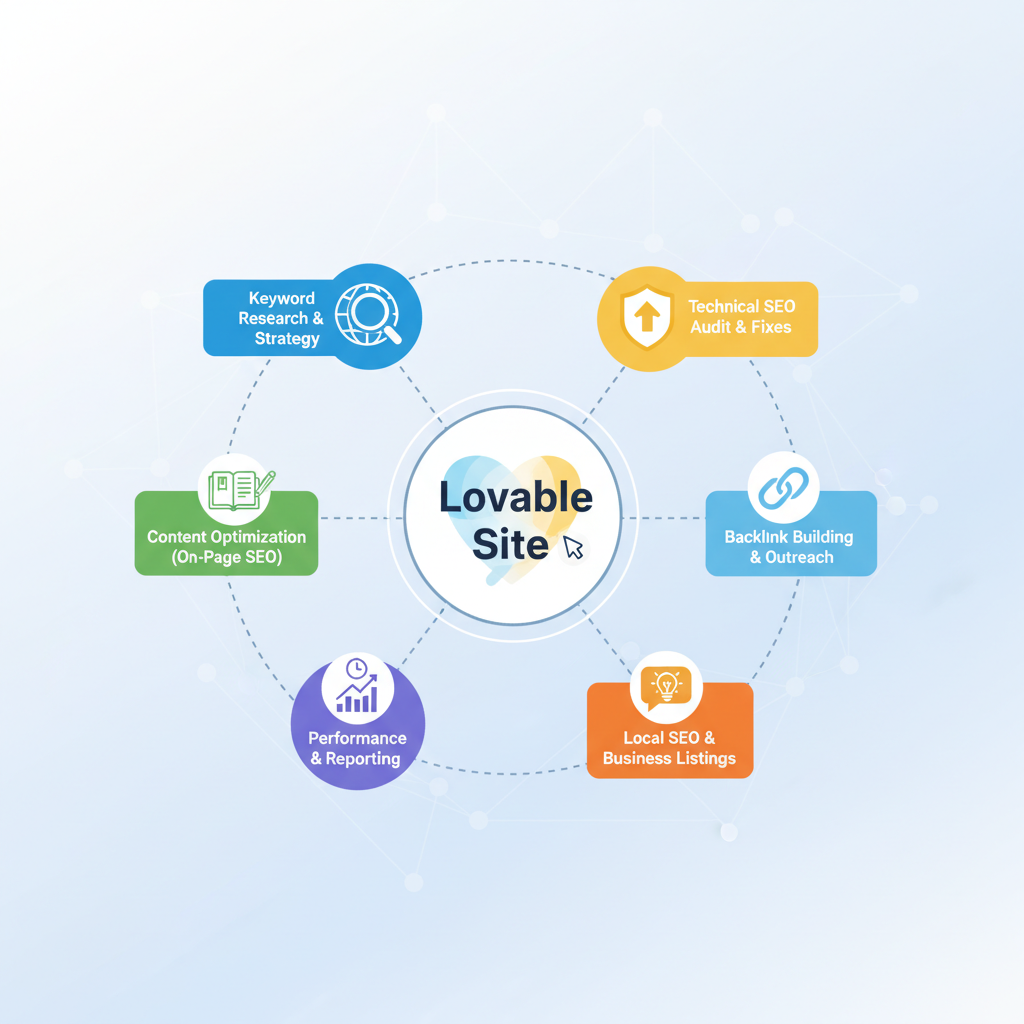
- Monthly technical audit & prioritized fixes (crawl, index, schema)
- On-page optimization for product and pricing pages
- Programmatic content templates and feed updates via LovableSEO or similar
- Content briefs and a fixed number of new pages or category descriptions
- Backlink outreach quota or link report (if offered)
- Monthly monitoring, KPI reporting, and one strategic call
Concrete scope rule: list deliverables as quotas (e.g., "Up to 8 product page optimizations, 4 content templates, 2 schema updates"). That makes the lovable seo pricing template transparent to buyers and prevent scope ambiguity. For more on this, see Lovable seo pricing models.
On-page optimization for Lovable product & pricing pages
Product and pricing pages drive conversions; optimize them first. A fixed-fee scope can include a standard checklist per page type: title + meta rewrite, H1/H2 structure, product schema, canonical checks, price schema, and internal linking to best-fit category pages. For example, a Starter package might cover optimizations for up to 10 product pages; Growth covers 30; Scale covers unlimited within a monthly cap.
Practical rule: estimate 1–2 hours per product page for audit and update; estimate 3–5 hours for complex pricing pages with dynamic pricing or variant schema. Use those estimates to compute the seo hourly equivalent used in pricing math.
Alt text: Screenshot of a product page before-and-after SEO changes, highlighting title, schema, and pricing table adjustments
Programmatic content support (LovableSEO templates & feeds)
Lovable customers often use programmatic pages driven by feeds. Include programmatic support in fixed-fee packages: template setup, feed validation, and monthly feed optimizations. Scope items: one template creation, two template revisions per month, feed health checks, and a cadence for new SKU/page generation.
Example: For a 40-hour monthly package, allocate 8–12 hours to programmatic work if the client has 1,000+ SKUs. State limits: "Includes template changes for up to one feed and 2 feed updates/month; additional feeds billed via change order." That phrasing belongs in your lovable seo pricing template.
Monthly monitoring and reporting (KPIs to track)
Reporting is not optional for fixed-fee plans. Track a compact KPI set that matches Lovable site goals: organic sessions (by product category), conversions from product pages, index coverage changes, top 10 keyword movements, and technical issue counts fixed. Present a one-page dashboard and a 30-minute review call each month.
Example KPI targets: reduce critical technical issues to zero within 30 days; increase top-10 product keywords by X per quarter (set X based on baseline). Provide an explicit SLA-style commitment in the scope: "Monthly report delivered within 5 business days of month end."
Fixed scope wins when deliverables are quotas, not time estimates.
Pricing approaches — cost-plus, value-based, and hourly-equivalent
Three practical ways to set the fixed fee:
- Cost-plus: Calculate your deliverable hours × team hourly rates, add margin. Transparent but tied to cost.
- Value-based: Price according to the value the work creates (e.g., increase in MRR or conversions). Higher upside but needs proof points.
- Hourly-equivalent: Choose target monthly hours that fit the scope and publish the fixed fee that equals those hours at a chosen hourly rate.
Hourly-equivalent is easy for Lovable agency teams because you can map each deliverable to an estimated hour range and show clients the math. Use regional benchmarks: US agencies $60–$150/hr; offshore teams $20–$60/hr. Typical Lovable SMB engagements run 20–60 hrs/month depending on tier.
Publish the hourly-equivalent so clients see how fixed fees translate to effort.
How to calculate an hourly-equivalent rate for Lovable agency teams
Step-by-step:
- List monthly deliverables and estimate hours per item.
- Sum estimated hours for a realistic monthly load (use 80% utilization for buffer).
- Choose a blended hourly rate based on team mix (e.g., 50% senior @ $120, 50% junior @ $60 → blended $90/hr).
- Multiply hours × blended rate → base fee. Add fixed overhead and margin to reach final fixed fee.
Quotable formula: "seo hourly equivalent = (monthly deliverable hours × blended hourly rate) + overhead + margin."
| Example | Hours/mo | Rate | Result |
|---|---|---|---|
| Starter | 20 | $75 | $1,500 |
| Growth | 40 | $75 | $3,000 |
| Scale | 60 | $75 | $4,500 |
Example pricing tiers (Starter, Growth, Scale) with scope & limits
Design three clear tiers so buyers can self-select:
- Starter ($1,500/mo): 20 hrs, up to 10 product page optimizations, 1 template change, monthly report.
- Growth ($3,000/mo): 40 hrs, up to 30 product page optimizations, 2 templates, monthly A/B ideas, sitemap + schema maintenance.
- Scale ($4,500/mo): 60 hrs, unlimited product page tweaks within cap, programmatic feed support, prioritized SLA.
Each tier also lists exclusions: dev time for new features, major redesigns, or additional feeds. Those exclusions convert to change orders at your published hourly-equivalent rate.
Risk management — scope creep guardrails and change orders
Protect margins with clear guardrails. Include three mechanisms in contracts: quotas, change orders, and usage reports. Quotas set included deliverables; change orders define rates for out-of-scope work. Monthly usage reports show hours consumed vs. quota to prevent surprises.
Practical guardrails to include in your lovable seo pricing template:
- Carryover policy: unused hours do not roll over
- Overage rate: published as seo hourly equivalent and rounded
- Emergency support: explicitly excluded or billed at premium
Sample contract clauses and deliverable checklists
Clause examples you can copy into proposals and contracts:
- Scope: "Includes up to X deliverables per month as itemized in Appendix A."
- Change order: "Any work outside Appendix A will require a written change order and will be billed at the published hourly-equivalent rate."
- Termination: "30-day notice; outstanding invoices for delivered work remain payable."
| Deliverable checklist (monthly) | Included |
|---|---|
| Technical crawl & fixes | Yes |
| Product page optimizations | Up to tier cap |
| Programmatic template edits | 1–2 |
| Monthly KPI report | Yes |
Client qualification checklist — when to recommend fixed-fee vs other models
Fixed-fee fits clients who have predictable needs and stable product catalogs. Switch to hourly or value-based when requirements are exploratory or redesign-heavy. Use this checklist to qualify leads:
- Does the site have stable product pages and feeds? (Yes = fixed-fee)
- Are conversion metrics tracked and available? (Yes = better for value-based)
- Is scope predictable each month? (Yes = fixed-fee)
- Are there frequent platform changes or major dev backlog? (No = avoid fixed-fee)
When NOT to recommend fixed-fee: large replatforms, discovery-only phases, or clients without analytics access. That boundary prevents underpricing and protects delivery quality.
30/60/90 day onboarding plan to deliver results under a fixed fee
Onboarding converts billing into action. A concrete 30/60/90 plan:
- Days 0–30: discovery, full crawl, high-priority technical fixes, and the first batch of product page updates.
- Days 31–60: implement programmatic templates, refine content briefs, and resolve mid-priority technical items.
- Days 61–90: scale content production, optimize for conversion signals, and present a results review with next-quarter roadmap.
Deliver an agreed set of quick wins in the first 30 days to prove value and justify the fixed fee.
Templates & practical assets (pricing calculator, scope checklist)
Provide practical artifacts clients can see and copy. Required assets to include with proposals:
- Lovable seo pricing template showing tiers, included deliverables, exclusions, and hourly-equivalent math.
- Pricing calculator (spreadsheet) that maps hours → blended rate → fixed fee.
- Scope checklist for each tier and a sample change order form.
Decision matrix example (copyable): If the client needs <20 hrs/mo and no programmatic feed → Starter. If 20–40 hrs + one feed → Growth. If >40 hrs and multiple feeds → Scale.
Conclusion — playbook checklist and next steps (link to signup/demo)
Checklist to publish alongside your offering: clear deliverables, hourly-equivalent math, exclusions, change-order process, and onboarding plan. Use the lovable seo pricing template to make pricing defensible and repeatable.
Quotable: "Publish the hourly-equivalent so clients understand what the fixed fee actually buys."
Next steps: publish tiered fixed-fee offerings with a visible pricing template and an explicit change-order policy so prospective buyers can self-select with confidence.
FAQ
What does it mean to price fixed? Pricing fixed means charging a single recurring fee that covers a defined set of monthly SEO deliverables rather than billing by the hour.
How do you price fixed? Price fixed by estimating monthly hours per deliverable, choosing a blended hourly rate, multiplying to get a base fee, and adding overhead and margin; publish the resulting hourly-equivalent and the exact scope included.
Alt text: Table showing hourly-equivalent math and tier mapping to help clients understand fixed-fee calculations
Ready to Rank Your Lovable App?
This article was automatically published using LovableSEO. Get your Lovable website ranking on Google with AI-powered SEO content.
Get Started