How to Structure Lovable Pricing Tables, FAQs and Schema to Win AI Answers and Increase Trial-to-Paid Conversions
A guide covering structure Lovable Pricing Tables, FAQs and Schema to Win AI Answers and Increase Trial-to-Paid Conversions.
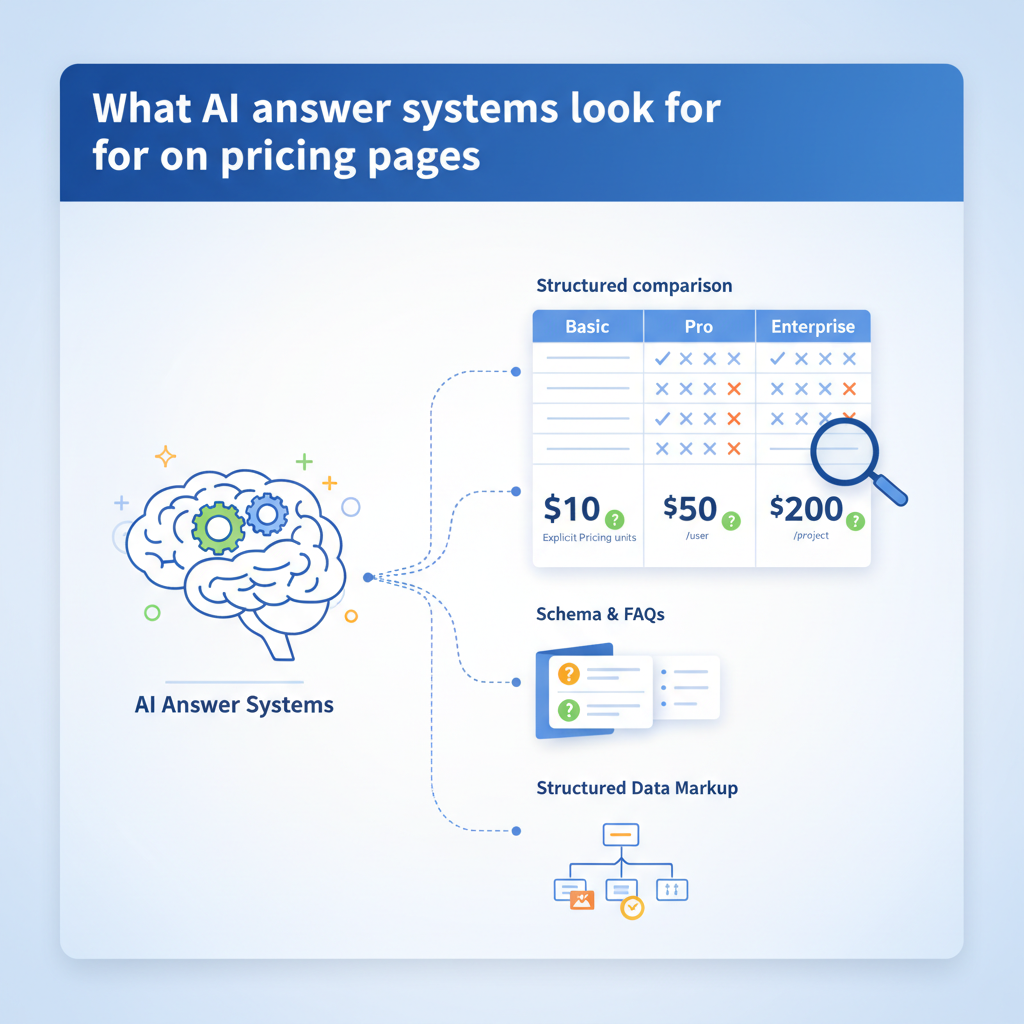
Executive summary — how structured pricing content wins AI answers and improves conversions
You publish a neat pricing page and hear nothing: low clicks from search, unclear trial fit, and stalled trial-to-paid conversions. The problem is predictable: search engines and AI answer systems need explicit, structured signals to extract plan names, exact prices, currencies, and availability. Without those signals your page looks like prose to an AI and like a blind guess to a shopper.
"Quick answer: publish a clear comparison table for humans, add Offer and PriceSpecification JSON-LD with explicit currency and areaServed for AI, and pair that with an FAQ using FAQPage schema. These three elements — visible comparison + pricing page schema lovable + faq schema pricing lovable — increase the chance of appearing in AI answers and improve trial-to-paid conversion pricing page performance, which is essential for effective Conversion SEO for Lovable SaaS."
Definition: "Pricing schema" — structured data (JSON-LD) that describes plan names, prices, currencies, and availability to search engines and AI answer systems.
Quotable guidance: "Including Offer and PriceSpecification JSON-LD with explicit currency and regional availability increases the chance your pricing page is selected for localized AI answers."
Explicit price, currency, and availability are required signals for accurate AI price answers.

When NOT to apply these recommendations
- When your product pricing is custom and quoted only after a phone call; a quote form is better than publicly detailed prices.
- When legal restrictions prevent publishing final prices for certain regions.
- If you cannot keep structured data in sync with product catalog updates in real time; inconsistent data is worse than none.
What AI answer systems look for on pricing pages (clarity, structured comparison, explicit pricing units)
If an AI system must produce a short, factual answer it prefers explicit, verifiable facts: plan name, numeric price, currency symbol or code, billing cadence, and regional availability. For example, a query like "How much does Lovable Pro cost in EUR" expects a response that cites a plan and a price in EUR and ideally mentions whether tax or VAT is included. That means your page needs both visible text and matching structured data.
Actionable checklist for AI signals: show the numeric price next to the plan name; include billing cadence (monthly/annually); write currency codes (USD, EUR) in machine-readable form; and add an availability line like "Available in: United States, EU".
Two short, quotable facts:
"Always include the ISO currency code (e.g., EUR, USD) in both text and JSON-LD."
"List areaServed in Offer to target country-specific AI answers."
Preferred content shapes: comparison tables, clear price markers, FAQs
AI answer systems and featured-snippet extractors favor predictable layouts. A comparison table with one column per plan and rows for price, seats, and top features creates a machine-friendly structure and helps users scan. Include a row that shows billing cadence and another that shows trial length or trial availability.
For example, display exact figures like "Pro — $49.00 USD / month (billed monthly)" as visible text and ensure the same string or numeric values appear in JSON-LD Offer objects. For FAQs, phrase questions as short, searchable queries: "Does Pro include API access?" and answer in one or two sentences. This both helps AI snippet optimization and reduces friction for trial signups.
Best-practice pricing table structure for Lovable (desktop & mobile)
Design for a reader scanning on desktop and tapping on mobile. Desktop can show full-width comparison with three columns. Mobile should stack plans vertically while keeping the price, primary CTA, and a one-line feature summary visible without scrolling. For Lovable's page builder, use semantic HTML: a <table> or a set of ARIA-labeled cards that map to the same data fields in JSON-LD.
| Row | Purpose | Example |
|---|---|---|
| Price row | Primary machine-readable signal | $49.00 USD / month |
| Billing cadence | Clarifies recurring period | Monthly / Annual |
| Seats / limits | Quantifies plan capacity | Up to 5 team members |
Concrete thresholds: show price to two decimal places for currency clarity, and include ISO code. For mobile, ensure the price and CTA remain in the first 480px of vertical space for quicker taps.
Columns, rows, feature flags, and microcopy (what to show/not show)
Columns: limit to 3–4 main plans to reduce decision paralysis. Rows: include price, billing cadence, trial availability, core features, and support level. Use feature flags (checkmarks) only for clear binary features and short microcopy to explain limits: "API calls: 100,000/mo." Avoid vague rows like "Unlimited" unless truly unlimited and documented.
Show terms that affect purchase decisions: cancellation policy, data residency options, and refund window. Do not show internal sales notes, promotional codes that are region-restricted without context, or inconsistency between visible price and structured data.
Accessibility and crawlability tips for Lovable's page builder
Ensure the pricing table is built with semantic elements: <table>, <thead>, <tbody>, and cell headers. If the page builder uses card layout, add ARIA roles (role="table" and role="row"). Keep prices as plain text, not background images, so crawlers and screen readers can read them.
Make a crawlability checklist: server-side render the core pricing HTML where possible; include a link to the FAQ section with an anchor; avoid hiding the price behind JavaScript that requires a user event. For Lovable, exportable data feeds for pricing table structured data make automation safer.
Markup & schema to prioritize — JSON-LD examples for pricing, offers, and FAQ
Prioritize three schema types: Product (or Service) with an embedded Offer, PriceSpecification with currency and billingPeriod, and FAQPage for common objections. The Offer should include price, priceCurrency, priceSpecification, availability, and areaServed for regional queries. That combination signals exact facts to AI answer systems.
Quotable: "PriceSpecification with explicit currency and areaServed increases selection for localized AI answers."
Match visible text and JSON-LD values exactly to avoid AI contradictions.
Example JSON-LD: PricingTable + Offer + FAQ snippets tailored to Lovable
{ "@context": "https://schema.org", "@type": "Product", "name": "Lovable Pro", "offers": { "@type": "Offer", "price": "49.00", "priceCurrency": "USD", "priceSpecification": { "@type": "UnitPriceSpecification", "billingPeriod": "P1M" }, "availability": "https://schema.org/InStock", "areaServed": "US" }
}
{ "@context": "https://schema.org", "@type": "FAQPage", "mainEntity": [ { "@type": "Question", "name": "Does Lovable Pro include API access?", "acceptedAnswer": { "@type": "Answer", "text": "Yes. Lovable Pro includes API access with 100,000 calls per month." } } ]
}FAQ strategy for pricing pages to capture AI snippets and answer common objections
Position your FAQ near the pricing table and keep questions phrased as user queries. Each answer should be one clear sentence plus one short supporting sentence. Use FAQPage JSON-LD that mirrors on-page questions. AI systems pull the first clear declarative sentence, so write that sentence to contain the core fact.
Include objection-focused FAQs such as billing, refunds, feature limits, and trial requirements. Ensure each FAQ answer uses the exact plan names and numeric values that appear in the table and JSON-LD to avoid contradictory snippets.
8 convert-focused FAQ templates that increase trial-to-paid intent
- "How long is the free trial?" — "The free trial lasts 14 days and requires no credit card."
- "What payment methods are accepted?" — "We accept major credit cards and Stripe payments."
- "Can I cancel during the trial?" — "You can cancel at any time during the trial without charge."
- "Do prices include tax or VAT?" — "Prices exclude VAT where applicable; tax is calculated at checkout."
- "Is there an annual discount?" — "Annual billing saves 20% compared to monthly pricing."
- "Does Pro include API access?" — "Pro includes API access with the stated monthly quota."
- "How do I upgrade plans?" — "Upgrade instantly from account settings; billing adjusts pro rata."
- "Is support included?" — "Email support is included; priority support is available on higher tiers."
Regional & GEO considerations — currency, tax, trials, and localization fields
Region matters. AI answers often include locality. Provide separate Offer objects per currency/region (e.g., USD offer with areaServed US and EUR offer with areaServed EU). For tax-sensitive regions show whether prices include VAT or not. If trial availability differs by country, state that explicitly in both visible copy and structured data.
Concrete example: create two Offer objects in JSON-LD: one with priceCurrency "USD" and areaServed "US", another with priceCurrency "EUR" and areaServed "EU". This helps pricing page ai snippet optimization for localized queries.
How to include regional fields in structured data and visible snippets
In Offer, set "priceCurrency": "EUR" or "USD" and add "areaServed": "EU" or "US". Add a visible line near the price: "Price shown in EUR for EU customers; taxes may apply." Keep visible text and structured data synchronized via automated templates or data feeds.
A/B test plan: pricing-copy vs structure; tracking trial-to-paid lift
Test hypotheses separately: A/B test content copy (headline, microcopy, CTAs) in one experiment and structured-data variants (no schema vs schema vs schema with regional offers) in another. Keep experiments independent and run them long enough to capture conversion events: aim for at least 500 trial signups per variant or a statistically sound sample for your baseline conversion rate.
Design the test: Variant A = current page; Variant B = current page + PricingTable structured data and FAQ schema; Variant C = B + regional Offer objects. Track AI-answer impressions and CTR from search consoles or analytics events where available.
Metrics: AI-answer impressions, CTR from AI answers, trial signups, conversion delta
Measure the following key metrics: AI-answer impressions (appearances in AI-generated responses), CTR from AI-driven results, trial signups, and trial-to-paid conversion rate. Example KPIs: increase AI-answer impressions by X, improve CTR by Y percentage points, and increase trial-to-paid conversion pricing page delta by Z. For typical SaaS, track day-30 trial-to-paid conversion as primary success metric.
Implementation steps in Lovable + automation with LovableSEO (data feeds, templates, deploy cadence)
Implement in three steps: (1) model your pricing table in Lovable's page builder using semantic HTML or exportable fields; (2) generate JSON-LD from a canonical data feed (CSV or API) and deploy it with the page template; (3) automate updates with LovableSEO or similar so price changes push to pages nightly. Use versioned templates and a deploy cadence that aligns with pricing changes to avoid stale schema.
Practical note: if your platform supports templates, use placeholders for price, currency, and availability drawn from a single source of truth. This avoids mismatched visible text and structured data, which harms pricing page ai snippet optimization.
How to push updates safely and avoid ranking regressions
Push updates behind a feature flag and test with a small percentage of traffic first. Validate schema with Google's Rich Results Test and monitor search performance for two weeks after rollout. Keep a rollback plan: if AI impressions or organic CTR drop notably, revert the structured-data changes and iterate.
Examples & mini-case: hypothetical before/after showing AI answer capture and conversion lift
Before: a Lovable pricing page with prose prices and no schema; search queries return generic site links and low CTR. After: visible comparison table, Offer JSON-LD with USD and EUR areaServed, and FAQPage schema. Result: AI answers now surface the exact monthly price for queries like "Lovable Pro price EUR" and CTR from those answers improves. Trial signups rise as users see clear pricing and trial terms up front.
Actionable checklist and links to pricing, features, demo, and case studies
Use this checklist when updating a Lovable pricing page to target AI answers and lift trial-to-paid conversion pricing page performance.
- Publish a visible comparison table with plan names, numeric prices, and billing cadence.
- Add Offer + PriceSpecification JSON-LD for each regional/currency variant (include priceCurrency and areaServed).
- Include FAQPage JSON-LD with short, factual answers to purchase objections.
- Keep visible text identical to structured data values; automate updates from a single data feed.
- Run an A/B test separating copy vs structured-data changes and monitor AI impressions, CTR, and trial-to-paid conversion.
- Validate schema with Rich Results Test and stage deploys with rollback capability.
Final note: lovable pricing pages ai answers require explicit, synchronized signals: visible table + pricing page schema lovable + faq schema pricing lovable. When you implement these, you increase the chance of being selected for AI snippets and improve trial-to-paid conversion pricing page outcomes.
Reusable artifacts
Copy-paste checklist (above) and example JSON-LD (above) into your Lovable templates. Use the table structure provided earlier for a mobile-first design.
Ready to Rank Your Lovable App?
This article was automatically published using LovableSEO. Get your Lovable website ranking on Google with AI-powered SEO content.
Get Started