
How to Structure Multilingual FAQ Schema on Lovable Sites for GEO and AI Answers
A guide covering structure Multilingual FAQ Schema on Lovable Sites for GEO and AI Answers.
Why multilingual FAQ schema matters for GEO visibility and AI answers
How should you structure multilingual FAQ schema on Lovable sites to improve geographic relevance and AI answer inclusion? Use page-level localized structured data and clear language/region signals so search engines and AI systems can match questions to the right language and place. For best results, use separate localized URLs with hreflang tags and localized JSON-LD per page when content differs substantially by region.
Multilingual faq schema lovable sites matters because AI answer systems and search result features rely on two things: language identification and reliable context about location. The primary structured-data properties that drive these outcomes are inLanguage (ISO language codes) and explicit region hints such as hreflang and visible place names. A correctly implemented FAQPage in each language increases the chance of snippets, voice answers, and AI answers multilingual responses being pulled from your pages. On Lovable sites, prioritize placing localized JSON-LD near the top of each localized page and ensure visible text includes the same localized place names and administrative divisions used in structured data.
Use language codes and region tags together: inLanguage for content language, hreflang for URL targeting.
Options for implementing multilingual FAQPage: separate URLs vs single URL with inLanguage
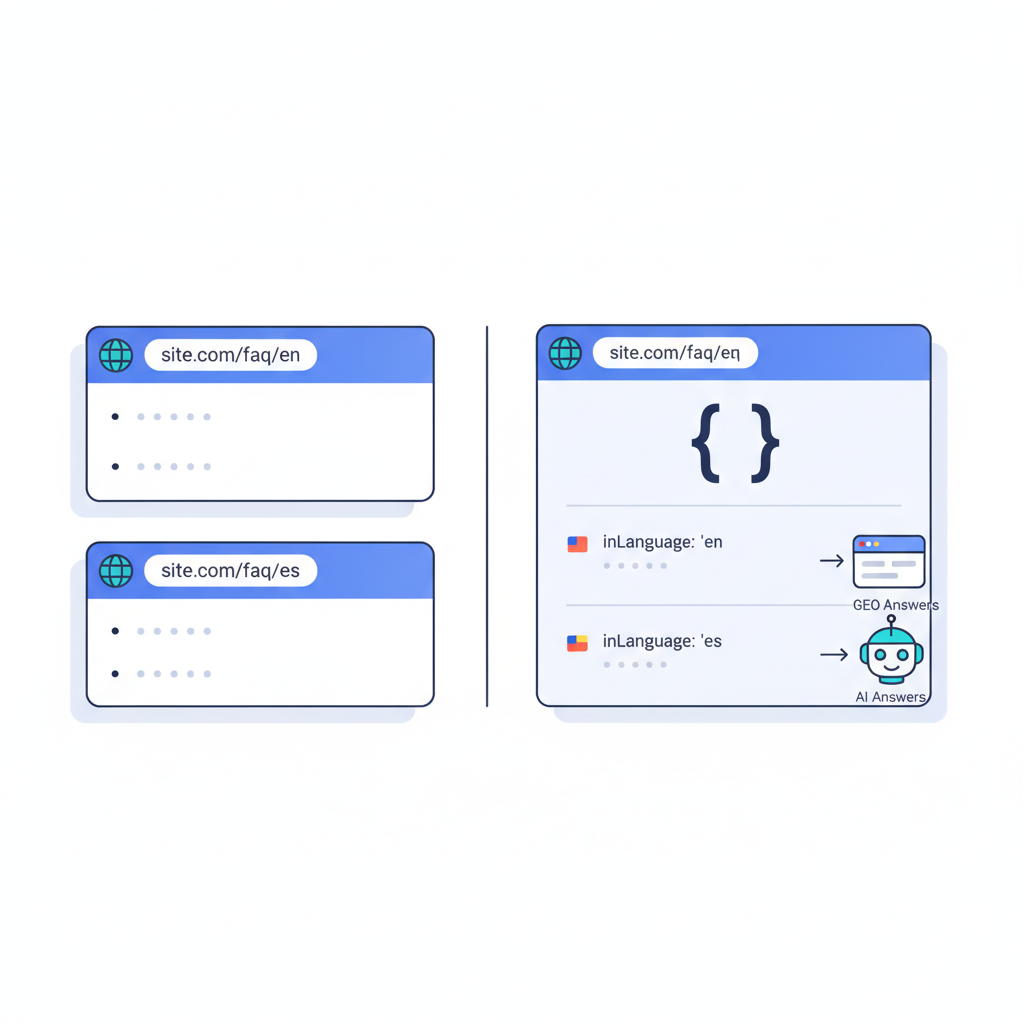
If your localized pages differ by more than small phrasing — local pricing, contact details, or legal text — use separate URLs (example: /fr/faq/ and /en/faq/). That approach allows clean schema hreflang faqpage implementations and precise geographic signals. Use a comparison table below to decide which approach fits your Lovable site.
| Approach | When to use | SEO & AI pros | Operational cons |
|---|---|---|---|
| Separate localized URLs | Different wording, prices, addresses, or legal text | Clear hreflang, easier canonical control, stronger GEO signals | More pages to maintain; requires hreflang map |
| Single URL with inLanguage entries | Short Q&A variants or small translations on one hub page | Fewer pages to maintain; works for compact multilingual hubs | Weaker hreflang signals; harder to target region-specific content |
For minimal sites or small FAQ volumes, a single URL with multiple faqpage inlanguage entries can work. However, remember that schema hreflang faqpage uses URL-level language annotations in search engines; inLanguage alone doesn't communicate canonical URL targeting to crawlers. If you run Lovable sites at scale, implement separate localized URLs and a matching hreflang map for each language/region pair. This favors clear ai answers multilingual selection when the engine must pick one definitive source for a query.
Pros and cons: programmatic scale on Lovable sites
If you need to scale dozens or hundreds of localized FAQs, programmatic generation on Lovable sites can save weeks of manual work. Pros: templates let you inject localized JSON-LD, map languages to ISO codes, and push updates via data feeds. Cons: automated translations can introduce errors, and poor-quality translations reduce trust for AI answer extraction. To effectively manage this process, consider implementing programmatic FAQ hubs that include at least a two-step quality check: automated checks for JSON validity and human review for top queries.
- Pro: Template-based JSON-LD means consistent structure across languages.
- Con: Machine translations without review can create semantic drift in answers.
- Rule of thumb: prioritize human-review for top 50 queries by traffic or business impact.
Concrete JSON-LD patterns: inLanguage, name, acceptedAnswer.text, and hreflang usage
Use JSON-LD blocks that include "@type": "FAQPage"; for each Q&A include "name" and "acceptedAnswer" with "text". Add "inLanguage" at the FAQPage level or inside individual Q&A objects when mixing languages on a single page. Explicitly include language codes (ISO 639-1) such as "en" or "fr-CA" for regional variants. Example pattern for a French page follows.
{ "@context": "https://schema.org", "@type": "FAQPage", "inLanguage": "fr", "mainEntity": [ { "@type": "Question", "name": "Comment puis-je contacter le support ?", "acceptedAnswer": { "@type": "Answer", "text": "Appelez le +33 1 23 45 67 89 ou utilisez le formulaire localisé." } } ]
}
When you use separate URLs, pair this JSON-LD with rel="alternate" hreflang="x" link tags in the page head that map each localized URL. For best results, use separate localized URLs with hreflang tags and localized JSON-LD per page when content differs substantially by region. Quotable fact: "inLanguage uses ISO codes to declare content language; hreflang maps language and region to URLs."
Include inLanguage and visible localized place names in both text and JSON-LD for stronger GEO signals.
Example: separate-URL approach with localized JSON-LD on each page
On a Lovable site, create /en/faq/ and /es/faq/ pages. Each page should contain localized visible content (title, questions, answers) and a matching JSON-LD block with inLanguage set to "en" or "es". Add hreflang tags in the HTML head that point between the English and Spanish FAQ pages. Include localized administrative areas in both the visible address and structured data (for example: "Barcelona, Cataluña" rather than just "Barcelona") to help AI answers multilingual systems map the content to the correct GEO context.
<link rel="alternate" href="https://example.com/en/faq/" hreflang="en" />
<link rel="alternate" href="https://example.com/es/faq/" hreflang="es" />
Implementation note: on Lovable sites, ensure server-side rendering or pre-rendered JSON-LD so crawlers and AI pipelines see the structured data without waiting for client-side scripts.
Example: single-URL with 'inLanguage' and language-specific acceptedAnswer entries (when appropriate)
A single hub URL can host multiple language Q&A pairs if the answers are short and there's limited regional variance. Use inLanguage properties on each Question (or the FAQPage) and mark each acceptedAnswer in its language. This preserves a central hub but reduces hreflang clarity. Use this pattern when you must keep all FAQs on one page for UX reasons and when GEO-specific details are minimal.
{ "@type": "FAQPage", "mainEntity": [ { "@type": "Question", "name": "How do I pay?", "inLanguage": "en", "acceptedAnswer": { "@type": "Answer", "text": "Use credit card or PayPal." } }, { "@type": "Question", "name": "¿Cómo pago?", "inLanguage": "es", "acceptedAnswer": { "@type": "Answer", "text": "Tarjeta o PayPal." } } ]
}
Automating translations and schema insertion with LovableSEO (data feeds, templates, and quality checks)
Use LovableSEO to programmatically inject localized JSON-LD if your Lovable site exposes a template API or accepts data feeds. Workflow: export canonical FAQ entries, translate via your translation pipeline, map ISO language codes, generate JSON-LD templates per locale, and run checks. Required checks: JSON-LD schema validation, language detection confidence (>0.95 if your detector provides scores), and sample human verification for top 50 queries. Keep a change log so you can roll back translations that degrade AI answer quality.
- Feed format: CSV/JSON with fields: id, locale (en, fr-CA), question, answer, place_name, address, phone.
- Template rule: render acceptedAnswer.text under 300 characters for quick snippet extraction.
- Quality gate: human review for any translation flagged by low confidence or automated QA rules.
Handling GEO-specific phrasing and units (address formats, phone numbers, local currencies)
AI systems use local phrasing and units to decide if content matches a user's query. For GEO accuracy, include local phone formats, currency codes (ISO 4217), and address components (street, city, administrative area, postal code) in both visible text and structured data. Example: on a Canadian page, use "fr-CA" inLanguage, show phone as "+1 514-555-0123", and include "province": "Québec" in the JSON-LD location object. Consistency between visible text and structured data improves ai answers multilingual matching.
Preventing duplicate content and canonicalization best practices
When you have multiple localized pages, always set self-referential canonical tags on each localized URL. If content is identical across locales and you must serve one canonical page, use rel=canonical to point to the preferred URL and avoid serving identical FAQPage JSON-LD on many URLs. For separate localized URLs, do not canonicalize them to a single-language page; that would nullify hreflang signals. Decision rule: if textual differences exceed 10% or contact details vary, do not canonicalize — keep separate URLs with hreflang mapping.
Testing multilingual schema and signals for AI-answer inclusion
Test structured data using schema validators and by inspecting rendered HTML in the browser. Run these checks: JSON-LD validator (no errors), language detection match between inLanguage and visible text, and a spot-check of snippet extraction by simulating typical queries. Monitor Search Console or equivalent indexing reports for rich result errors. Additionally, measure AI answer uptake by sampling queries and checking which locale and URL the AI system cites as the source. Track these over time and prioritize fixes where top queries fail to surface the correct localized source.
Launch checklist for multi-language FAQ hub rollout
Use the checklist below to launch a multi-language FAQ hub on Lovable sites and ensure the primary keyword appears in your final communications: multilingual faq schema lovable sites.
- Map locales and ISO codes for all target markets.
- Decide: separate localized URLs or single hub with inLanguage entries.
- Create JSON-LD templates including inLanguage and localized acceptedAnswer.text.
- Implement hreflang link tags when using separate URLs.
- Run automated JSON-LD validation and human review for top 50 queries.
- Deploy and monitor indexing, rich result reports, and AI-answer citations.
| Launch artifact | Owner | Accept criteria |
|---|---|---|
| Localized JSON-LD files | SEO engineer | Schema valid; inLanguage matches visible text |
| Hreflang mapping | Web dev | All locale URLs included; no broken links |
Alt: Diagram showing hreflang and JSON-LD linking languages to pages for GEO targeting and AI extraction
FAQ
What does it mean to structure multilingual faq schema on lovable sites for geo and ai answers?
Structuring multilingual FAQ schema on Lovable sites means publishing language-tagged FAQPage JSON-LD and visible localized content so search engines and AI systems can match answers to a user's language and region.
How do you structure multilingual faq schema on lovable sites for geo and ai answers?
Structure it by choosing either separate localized URLs with hreflang tags and per-page localized JSON-LD or a single hub with inLanguage-marked Q&A entries, include localized place names and units in both text and structured data, validate JSON-LD, and set up quality checks for translations.
Ready to Rank Your Lovable App?
This article was automatically published using LovableSEO. Get your Lovable website ranking on Google with AI-powered SEO content.
Get Started