How to Structure Performance-Based SEO Contracts for Lovable SaaS Clients: KPIs, Payment Triggers, and Caps
A guide covering structure Performance-Based SEO Contracts for Lovable SaaS Clients: KPIs, Payment Triggers, and Caps.
TL;DR
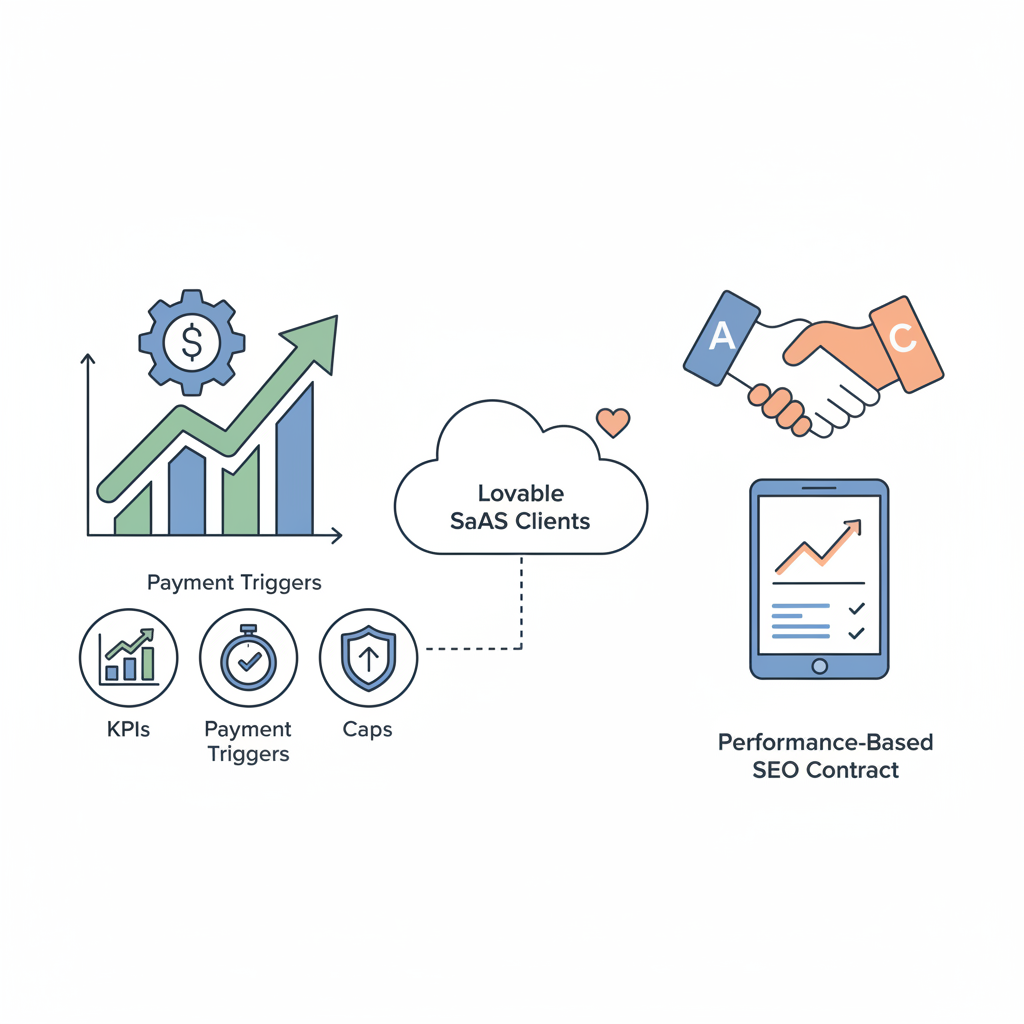
- Performance based seo contracts lovable work when you pick measurable KPIs, protect both sides with caps/floors, and agree attribution sources up front.
- Use a hybrid baseline + bonus model, add AI-answer inclusion as a regional KPI, and track with GA4, GSC, and server logs.
- Include clear payment triggers, dispute rules, and a dashboard SLA to avoid ambiguity.
What is a performance-based SEO contract and why Lovable agencies use them
You're probably staring at a vendor invoice after a quarter of work and asking why organic results and revenue don't map cleanly to payments. Performance based seo contracts lovable flip the risk/reward: the agency earns variable fees tied to predefined outcomes instead of only time-based retainers. That model solves two problems: it aligns incentives between your product, pricing, and marketing teams, and it forces precise measurement for product-led growth pages (product and pricing pages).
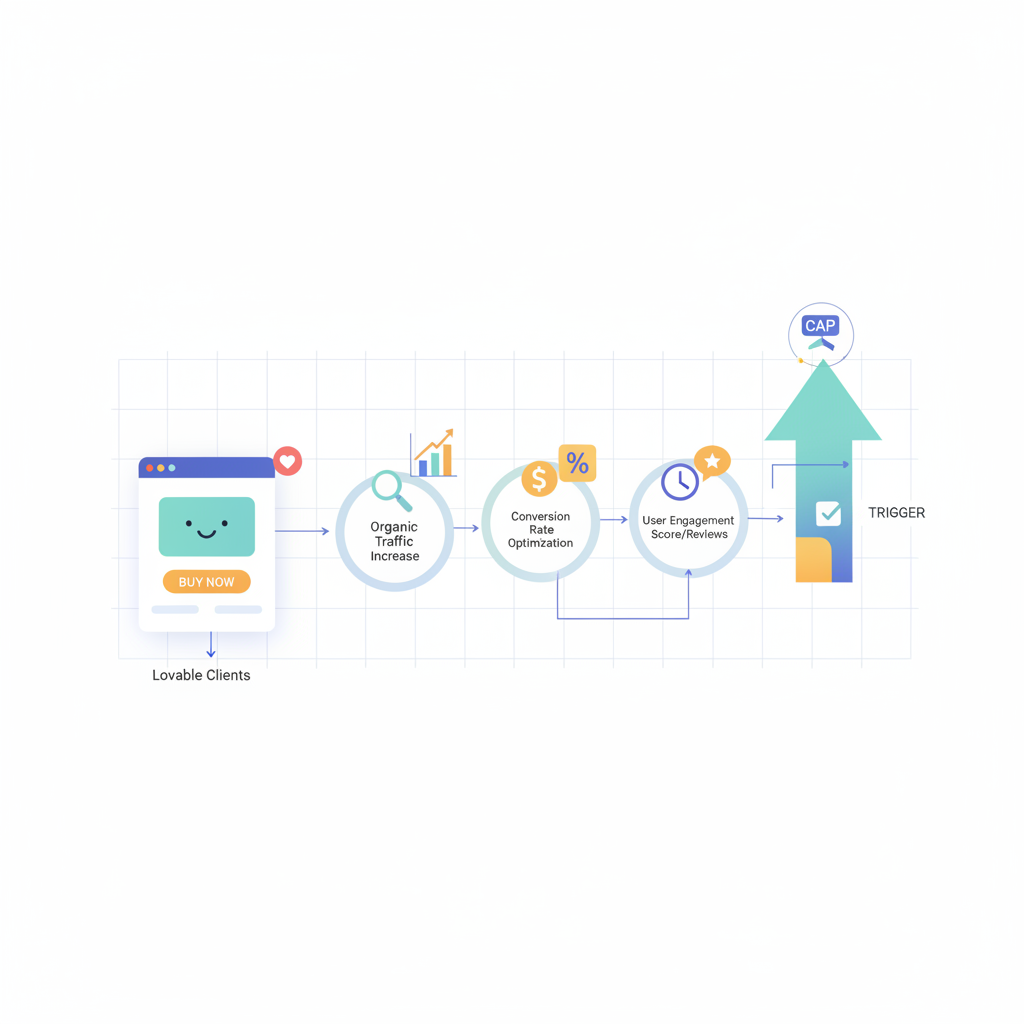
Quick answer: structure the contract around measurable, attributable outcomes (visits, qualified leads, revenue) with baseline guarantees, capped upside, and transparent data sources.
Performance-based SEO contracts are most effective when the client can accept a modest baseline spend, the landing pages are stable, and the product funnels convert at predictable rates. For instance, a mid-market SaaS with stable pricing pages can set a target: a 20% lift in organic trial signups for top-10 branded and unbranded queries in six months, with monthly payments split into a $3k base and $2k performance bonus. This approach aligns well with various pricing models for lovable SEO agencies.
Quotable: "Align fees to outcomes, not hours, and you force measurement that improves product pages and pricing clarity."
Choosing measurable KPIs for Lovable product & pricing pages
Choose KPIs that map to business value and are actionable for both agency and product teams. For Lovable product and pricing pages, prefer: organic trials or demo requests, organic MQLs from product pages, and revenue-attributable signups. Avoid vanity metrics that an agency can’t control, like “total organic sessions” without page-level filters. For more on this, see Lovable seo agency playbook.
- Primary KPIs: organic trial starts (page-level), organic paid conversions (first-touch attribution), AI-answer inclusion rate (see GEO KPI below).
- Supporting KPIs: impressions for target SERP features, top-3 rankings for target keywords, and organic CTR on pricing pages.
- Rejection rule: exclude traffic from paid campaigns, affiliates, and non-targeted geos.
Provide example KPI thresholds so the contract is actionable: for a typical Lovable SaaS pricing page, require a 10–25% increase in organic visits to the pricing page or a 2–5 SERP-feature wins in three months before paying a bonus. Track KPIs at page and keyword sets to avoid surface-level wins that don't deliver signups.
Structure fees around actions that directly move the business: signups, qualified trials, or revenue-linked conversions.
Traffic vs conversions vs rankings — pros and cons
Rankings are easy to measure but easy to game; they don't always convert. Traffic is broader and shows reach but can include low-intent visitors. Conversions map directly to revenue but need careful attribution. For Lovable clients, prioritize conversions when product funnels are stable, otherwise use a hybrid KPI mix.
- Rankings: Useful for tactical milestones (e.g., target keyword in top 5). Pay small milestone fees for durable ranking moves only.
- Traffic: Good early-stage KPI; require page-level filters and exclude low-quality sources. Use as a secondary metric, not the primary payout trigger.
- Conversions: Best for alignment. Define conversion types (trial, demo, paid signup) and attribution windows clearly.
Example decision rule: if conversion volume < 30/month, weight payouts 60% rankings/traffic and 40% conversions until baseline conversion volume grows.
AI-answer inclusion (GEO) as a KPI — how to measure and attribute
AI-answer inclusion is: "AI-answer inclusion rate = % of tracked target pages appearing in AI-generated responses for target queries in a region." Use it as a regional KPI where Lovable content aims to appear in AI responses or SERP features that feed AI answers.
Measurement approach: combine Google Search Console (for impressions/queries), sampled AI response checks (manual or via API), and regional SERP monitoring. Attribution: count a win when the tracked page is cited or used as the primary source in an AI response for a target query in the target GEO.
Sample KPI thresholds: 10–25% increase in organic visits attributed to AI-answer traffic, or 2–5 new AI/SERP-feature citations in three months.
| Region | Payment trigger example | Threshold |
|---|---|---|
| North America | Bonus per AI-feature win | +$500 per tracked AI-citation (max 5) |
| EU | Bonus per AI-feature win (privacy-filtered) | +$400 per tracked AI-citation (max 4) |
Quotable: "AI-answer inclusion rate quantifies how often your pages power AI responses in a region."
Designing payment triggers and timing (monthly vs milestone payouts)
Choose payment cadence to balance cash flow and incentives. Monthly payouts work for incremental KPI progress with rolling targets; milestone payouts suit durable outcomes like sustained top-5 rankings or regional AI-answer inclusion. Mix both when possible: small monthly base, with quarterly milestone bonuses.
- Monthly: base retainer + small variable tied to incremental KPIs (e.g., 5% of monthly target achieved).
- Milestone: one-off payments when a durable threshold is met for 30–90 days (e.g., sustained 20% conversion lift).
- Hybrid: typical Lovable model—40% base monthly, 60% performance distributed as monthly micro-bonuses and quarterly milestone payouts.
Set clear lookback windows (30/60/90 days) and payment lag (paying the month after validation). Define dispute windows: 14 days to raise a data dispute, 30 days to resolve, and escrow for contested amounts when necessary.
Pay small monthly bonuses for progress; reserve larger milestone payouts for durable, validated wins.
Example payment structures (baseline + bonus, split payouts, revenue share)
Three common templates work for Lovable SaaS clients:
- Baseline + bonus: $X/month baseline; $Y per KPI achieved. Example: $2,500 base + $1,500 per 20% conversion lift (capped at $6,000).
- Split payouts: 50% monthly retainer, 50% quarterly performance payout based on aggregated KPIs.
- Revenue share: lower base + small percentage of net new MRR attributable to organic channels (requires strict attribution rules and data sharing).
Decision rule: use revenue share only when the client agrees to provide reliable transaction data and accepts longer contract horizons (≥12 months).
| Structure | Best when | Example cap |
|---|---|---|
| Baseline + bonus | Stable funnels, medium risk tolerance | 3× monthly base |
| Split payouts | Shorter campaigns, clear milestones | 2× monthly base |
| Revenue share | High trust, available revenue data | 10–20% of attributable MRR |
Risk controls: caps, floors, and guaranteed minimums
Risk controls protect both sides. Floors guarantee the agency a minimum payment for work; caps limit client exposure to windfalls or unforeseen attribution quirks. Include clawback language for traffic spikes from one-off events and carve-outs for outages, major algorithm updates, or product changes that materially affect conversions.
- Floor: minimum monthly payment (e.g., 50% of base) if KPI volume falls due to client factors.
- Cap: total performance payout cap per quarter (e.g., 4× base) to limit client exposure.
- Guaranteed minimums: optional—small guaranteed uplift payment if initial baseline is low, phased out after month 3.
Example contract rule: if a ranking improvement results from a Google core update (as verified by Search Console and industry reporting), freeze performance payments for 60 days and re-evaluate targets.
Sample contract language to limit exposure
Use precise clauses that remove ambiguity. Example snippets you can adapt:
Performance payment = verified conversions attributable to organic search (first touch) during the measurement window, minus conversions from paid or affiliate sources. Client will provide GA4 and transaction-level exports for verification. Total quarterly performance payments are capped at 4× monthly base.Include a dispute process: submit data disparity within 14 days, provide raw exports within 7 days of request, and escalate to an independent auditor if unresolved within 30 days.
Attribution and reporting: data sources and dispute resolution
Agree on authoritative data sources: GA4 (configured with proper filters), Google Search Console for query-level visibility, and server logs for crawl and bot filtering. State the primary attribution model (first-touch, last-touch, or data-driven) and specify the conversion lookback window (e.g., 30 days).
- Primary reporting source: GA4 with page-level UTM filters.
- Supplemental: Google Search Console for impressions and query attribution; server logs to exclude bot or crawler traffic.
- Dispute workflow: 14-day notification, exchange exports, 30-day resolution, independent auditor if needed.
Quotable: "Define the data source and attribution model in the SOW; ambiguity is the root cause of most disputes."
Recommended tracking setup for Lovable sites (GA4, GSC, server logs)
Minimum tracking stack for performance-based SEO contracts lovable:
- GA4: events for trial starts, demo requests, and checkout; page_path-level reporting; filters to exclude internal and paid traffic.
- Google Search Console: property per region, query and page reports exported monthly for verification.
- Server logs: weekly exports to validate crawl behavior and detect referral spam or bot traffic inflating sessions.
Checklist: ensure GA4 collects unique event IDs for conversions, map events to revenue where possible, and maintain a monthly export retention policy (90 days minimum). Use consistent naming conventions for UTM and internal campaign parameters.
Case examples: small Lovable SaaS client vs enterprise-level use
Small client (SMB SaaS): short sales cycle, low baseline conversions. Use a conservative hybrid model: $1,500 base + $1,000 quarter bonus for 20% lift in pricing-page trials. Limit contract to 6 months with clear data-sharing obligations.
Enterprise client: higher baseline conversions and stronger data access. Use revenue-share or ambitious milestone payouts: lower base ($3k) + 10% of net new MRR attributable to organic search, with a 12-month lookback and robust audit controls.
Practical tip: require a 30-day onboarding and tracking audit before any performance payments begin; treat that period as part of the baseline to set fair targets.
Implementation checklist and templates (SLA, KPI dashboard, billing triggers)
Copy this checklist when you build a contract and onboarding pack:
- Run a tracking audit (GA4 + GSC + server logs) and export baseline data.
- Agree KPI list, attribution model, lookback windows, and regional scopes.
- Set payment cadence, caps/floors, and dispute timeline.
- Provision a KPI dashboard and shared access (data exports weekly).
- Define onboarding tasks and a 30-day validation window before performance fees start.
Template artifacts provided here: SLA terms (response times, data access), KPI dashboard spec (fields, filters), and billing triggers table. Example image prompt caption (for internal docs): "Dashboard mockup showing attribution filters and regional AI-answer inclusion metrics for verification."
Conclusion: when to recommend performance-based vs mixed models
Recommend performance-based models when the client has stable funnels, can share reliable data, and accepts some payment variability. Use mixed models (base + performance) when data access is partial or conversion volume is low. For new product launches or unstable pricing pages, prefer time-based retainers until you can measure baseline performance reliably.
Quotable: "Performance pay aligns incentives, but only when measurement is clean and both sides accept clear risk controls."
FAQ
What does it mean to structure performance?
Structuring performance means defining measurable outcomes, an attribution model, payment triggers, timing, and risk controls so that payments follow validated, agreed-upon results rather than hours worked.
How do you structure performance?
Structure performance by selecting primary KPIs tied to business outcomes, agreeing on authoritative data sources (GA4, GSC, server logs), creating a payment cadence (baseline + bonuses or revenue share), and adding caps, floors, and a dispute process.
Ready to Rank Your Lovable App?
This article was automatically published using LovableSEO. Get your Lovable website ranking on Google with AI-powered SEO content.
Get Started