

How to Use Structured Data Templates in LovableSEO to Win AI Answers for Lovable Sites
A guide covering use Structured Data Templates in SEOAgent to Win AI Answers for Lovable Sites.
Q: How do you use structured data templates in LovableSEO to win AI answers for Lovable sites?
A: Use structured data templates seoagent to expose concise, machine-readable facts that AI features can surface as answers. Create reusable JSON-LD templates, map tokens to page fields, and emit locality-specific schema to increase inclusion odds for Lovable sites. For more on this, see Programmatic seo lovable sites.
This article walks you through practical, platform-specific steps inside LovableSEO so you can deploy json-ld templates at scale, validate them, and measure AI-answer impact. You’ll find definitions, a short FAQ JSON-LD example, a geo checklist for LocalBusiness, and copy-ready artifacts you can adapt for lovableseo.ai pages, including insights on automated article publishing on lovable sites.
Why structured data templates are essential for AI-answer inclusion
Structured data templates seoagent turn page content into predictable JSON-LD snippets that search systems and AI features can parse and cite. If you publish identical facts in both visible HTML and JSON-LD, AI models can extract a short answer reliably. For Lovable sites, that means answers about product specs, local hours, or how-to steps become eligible for AI-answer snippets when the schema matches the visible content.
Practical example: a FAQ block that contains a one-sentence answer under 50 words and an identical answer inside faq schema seoagent improves the chance an AI will pick that exact phrase. Use templates to avoid manual edits: a single json-ld templates seoagent entry can generate FAQ blocks for hundreds of pages from a database field.
Quotable: "One-sentence answers under 50 words increase AI snippet odds."
Which schema types to prioritize for Lovable sites (FAQ, HowTo, LocalBusiness, Product, QAPage)
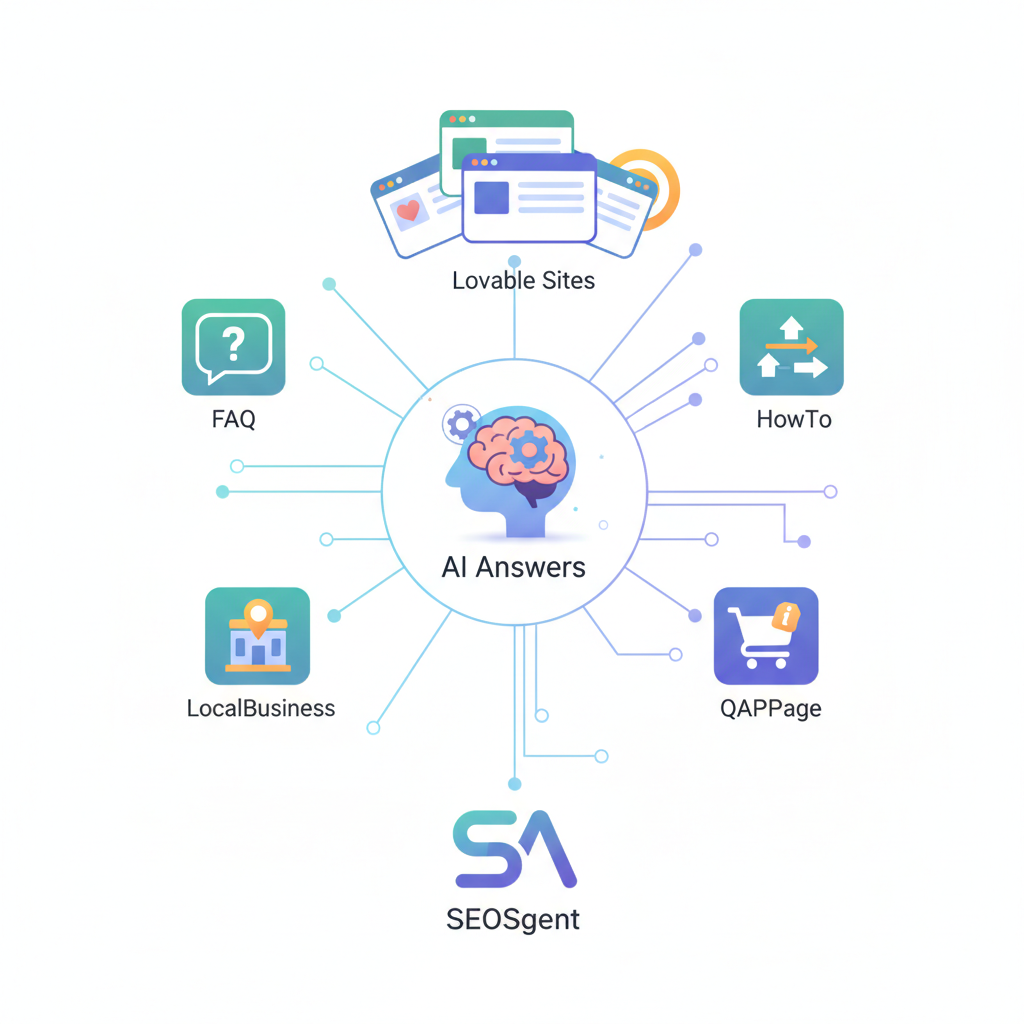
Prioritize schema types that map to common AI question patterns. For lovableseo.ai use cases, focus on: FAQPage, HowTo, LocalBusiness, Product, and QAPage. Each type answers a different user intent: FAQPage supplies direct Q&A, HowTo gives step sequences, LocalBusiness supports geo queries, Product delivers specs and prices, and QAPage handles community Q&A.
Geo checklist for LocalBusiness (copyable):
- Name: visible business name that matches page H1
- Address: streetAddress, addressLocality, postalCode
- Geo: latitude, longitude as numbers
- Same-as: canonical contact URL or knowledge page if available
- Opening hours: standardized RFC-style entries when possible
Use faq schema seoagent for canonical Q&A, and duplicate short answers in visible markup. Use Product schema on category and product pages with key specs in single-sentence facts.
Designing reusable JSON-LD templates in LovableSEO
Design templates as parameterized JSON-LD with named tokens, fallback values, and conditional blocks. Keep a single source-of-truth per content type: one FAQ template, one HowTo template, and one LocalBusiness template. Store templates in LovableSEO's template library so content teams reuse them instead of hand-editing JSON-LD.
For programmatic deployments, produce templates that accept data rows and emit complete JSON-LD objects. That supports schema templates programmatic seo and avoids inconsistent fields across pages.
Templates must produce identical visible text and JSON-LD text for reliable AI citation.
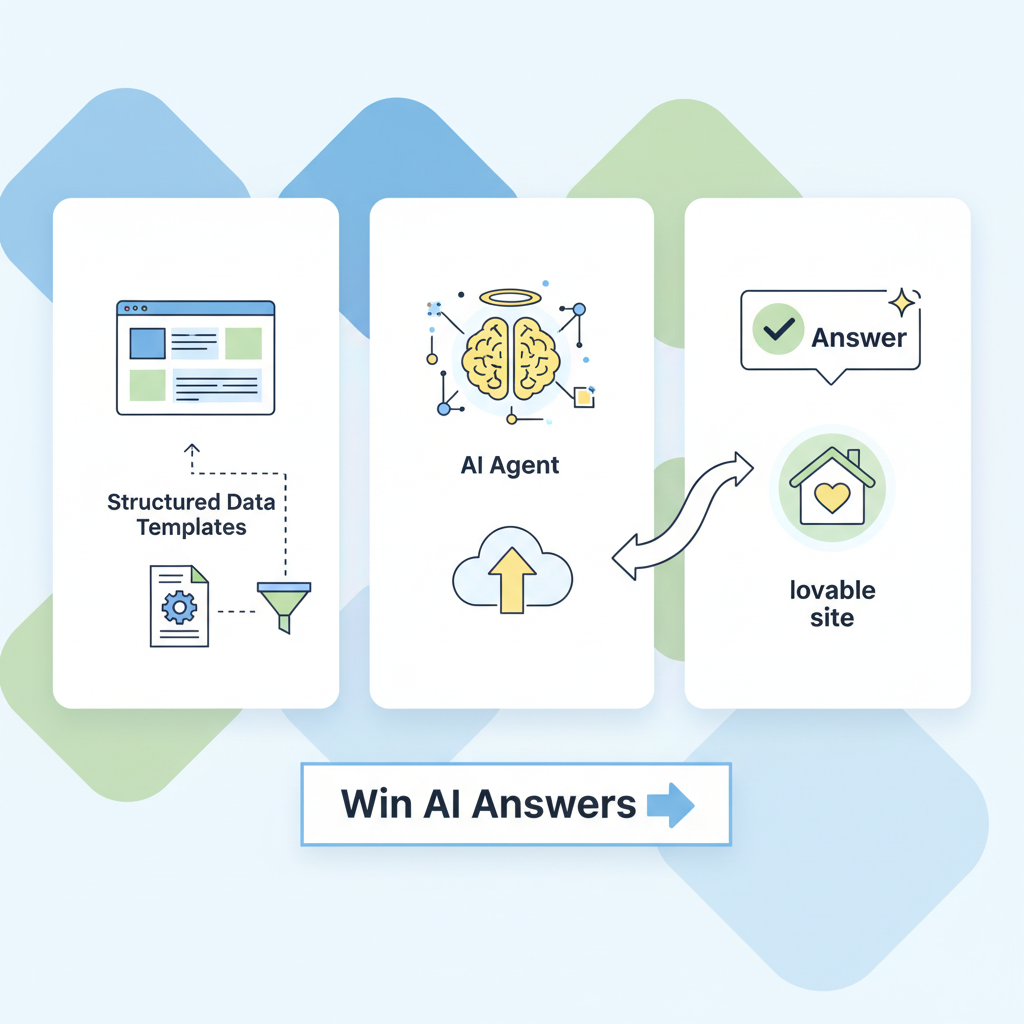
Include these template design rules:
- Explicit token names: {{page_title}}, {{faq_question}}, {{faq_answer}}
- Default fallbacks: use empty-string suppression or fallback text
- Field validation: types for dates, numbers, coordinates
Tokenization: mapping template tokens to content fields
Map tokens to precise content fields in your CMS or API. For example, map {{faq_answer}} to the CMS field faq.answer_plaintext and ensure the same string appears in the visible FAQ element. Token rules should include trimming, HTML-stripping, and a maximum length for AI answers (recommend under 50 words for best snippet odds).
Example token mapping for a product page: {{product_name}} → product.name, {{price}} → product.price.value, {{currency}} → product.price.currency. Keep token names consistent across templates to reduce integration errors.
Conditional fields: when to emit certain schema blocks
Emit schema blocks only when required fields exist. For example, emit aggregateRating only if reviewCount >= 3 and ratingValue is present. In LovableSEO templates, add conditional statements like {% if review_count >= 3 %} ... {% endif %} so pages without reviews don't expose incomplete artifacts.
Conditional logic also supports locale splits: emit a LocalBusiness block for en-US pages with U.S. address fields, and a separate locale-specific schema when you have translated addresses. Separating schema by locale and matching the page's visible content increases inclusion likelihood in localized AI answers.
Step-by-step: Build and test a structured-data template
This section gives a practical workflow you can follow inside LovableSEO or similar platforms. Steps below assume you have page data fields and template storage available.
- Define the content model: list required fields and token names.
- Create JSON-LD template with tokens and conditional blocks.
- Apply template to a small set of staging pages and render JSON-LD.
- Validate with structured data testing tools and fix errors.
- Deploy to production incrementally and monitor Search Console impressions.
Validate templates before scaling to avoid widespread markup errors.
For schema templates programmatic seo, automation is critical: run nightly checks that render each template against a sample of live pages and fail builds with schema errors.
Sample FAQ JSON-LD template and token examples
Below is a compact, quotable FAQ JSON-LD example that you can adapt. Keep answers short (1–2 sentences, <50 words) to improve AI-answer selection.
{ "@context": "https://schema.org", "@type": "FAQPage", "mainEntity": [ { "@type": "Question", "name": "How do I return an item?", "acceptedAnswer": { "@type": "Answer", "text": "Start a return from your orders page and print the prepaid label." } } ]
}
Token examples: {{question_1}} → faq[0].question, {{answer_1}} → faq[0].answer. Use faq schema seoagent in pages where the visible FAQ matches the JSON-LD exactly.
FAQ answers (declarative):
- What does it mean to use structured data templates in seoagent to win ai answers for lovable sites? Using structured data templates seoagent means creating repeatable JSON-LD templates that map CMS fields to schema so AI systems can extract concise facts for answers.
- How do you use structured data templates in seoagent to win ai answers for lovable sites? You create templates, map tokens to content fields, validate JSON-LD, and deploy incrementally while monitoring Search Console for AI-answer impressions.
Sample HowTo and LocalBusiness templates
HowTo templates require an ordered steps array; include step name and short text. LocalBusiness templates require name, address, and geo coordinates. Keep visible step text and JSON-LD steps identical where possible.
{ "@type": "HowTo", "name": "Replace a bicycle tire", "step": [ {"@type": "HowToStep","name": "Remove wheel","text": "Loosen axle nuts and remove wheel."}, {"@type": "HowToStep","name": "Replace tube","text": "Insert new tube and inflate to recommended pressure."} ]
}
Best practices to increase AI-answer odds (concise answers, structured tables, definitions)
AI features prefer short, factual answers and consistent structured data. Use the following checklist and table to decide when to prefer FAQ vs HowTo for an answer.
- Keep answers under 50 words for concise snippets.
- Duplicate the exact answer text in visible HTML and JSON-LD.
- Use structured tables (
tablemarkup) for specs; many AIs extract tabular facts well.
| Feature | FAQ | HowTo |
|---|---|---|
| Best for | Direct Q&A | Step sequences |
| AI snippet style | One-sentence fact | Short step summary |
| Use when | Common questions | Task instructions |
Quotable: "Visible text and JSON-LD must match verbatim for reliable AI citation."
Length, formatting, and placement recommendations
Place schema close to the visible content it describes (same template or page component). For answers, prefer the page body over sidebar or footer. Length guidance: answers <50 words, HowTo steps <30 words each, product specs as short table rows. Keep JSON-LD compact—omit extraneous properties to reduce noise.
QA, validation and GSC testing workflow
QA workflow should include automated validation, manual spot checks, and Search Console monitoring. Validate JSON-LD with Google's Rich Results Test and the structured data report in Search Console. Run a daily job that fetches a sample of pages, parses JSON-LD, and checks for required fields and type mismatches.
Make a triage playbook: fail builds on syntax errors, warn on missing required fields, and flag content mismatches where visible answer and JSON-LD diverge.
Automating schema validation and fallback content
Automate validation in CI: render templates against sample content, run linters, and reject on schema errors. Provide fallback content for missing fields—either suppress the schema block or emit a minimal object with a verified fallback string. For example, if an address is missing, suppress LocalBusiness schema instead of emitting incomplete data.
Measuring impact: tracking impressions, clicks, and AI-answer snippets
Track impressions and clicks for pages with new templates via Google Search Console and your analytics platform. Add custom labels to indicate which template version served the page. Monitor changes in impressions for intent queries and check for AI-answer snippet appearances using keyword-level SERP trackers.
Decision rule example: if a template rollout increases relevant impressions by more than 10% within two weeks, expand rollout; if it introduces schema errors, roll back and fix.
Conclusion: rollout priorities for quickest AI-answer gains
Prioritize quick wins: deploy FAQ templates for high-traffic Q&A pages, add LocalBusiness schema where geo queries matter, and convert product specs into structured tables plus Product schema. Use json-ld templates seoagent and schema templates programmatic seo to scale safely. Monitor Search Console and iterate.
Final quotable guidance: "Start with precise FAQ and LocalBusiness templates, and match visible text to JSON-LD for the fastest AI-answer gains with LovableSEO."
Ready to Rank Your Lovable App?
This article was automatically published using LovableSEO. Get your Lovable website ranking on Google with AI-powered SEO content.
Get Started