

Programmatic SEO for Lovable Sites: Scale Content and Win AI Answers Without WordPress
A guide covering programmatic SEO for Lovable Sites: Scale Content and Win AI Answers Without WordPress.

TL;DR
- Programmatic SEO uses templates + data to generate many unique pages quickly; on Lovable sites it must pair tokens, schema, and QA to avoid thin content.
- Use programmatic SEO when you have verifiable data, repeatable page patterns, and measurement; avoid it for unique brand storytelling or one-off pages.
- LovableSEO and lovableseo.ai streamline template creation, batch publishing, sitemaps, and AI-answer optimization at scale.
What is Programmatic SEO and Why It Matters for Lovable Sites
A product manager at a regional SaaS company once needed 3,000 city-specific deployment pages in 30 days. Manually writing each page would have taken months and inconsistent quality; a template plus verified city data delivered consistent, searchable pages in weeks. That result shows the core trade-off: speed and coverage versus risk of thin or duplicate pages.
Programmatic SEO for lovable sites is the practice of combining content templates and structured datasets to create many search-optimized pages automatically. On Lovable platforms, that means using a template engine that accepts variable tokens (for example, {city}, {product}, {feature}) and emitting pages that include human-readable copy, unique facts, and machine-readable schema. For more on this, see Programmatic seo vs manual lovable guide.
Programmatic SEO uses templates and structured data to scale content production while preserving answer-focused snippets that AI models often extract for direct answers.
Why this matters: search engines and AI-driven answer systems reward pages that deliver clear, concise answers and accurate metadata. For lovableseo.ai customers, programmatic SEO is a lever to increase page velocity and local visibility without spinning up a large content team. But it requires guardrails: canonicalization, sampling-based QA, and schema that proves uniqueness.
Actionable takeaway: before you generate pages, catalog the data fields you can reliably populate (e.g., address, opening hours, product availability). If you can't produce verifiable, unique values for those fields, pause programmatic publishing.
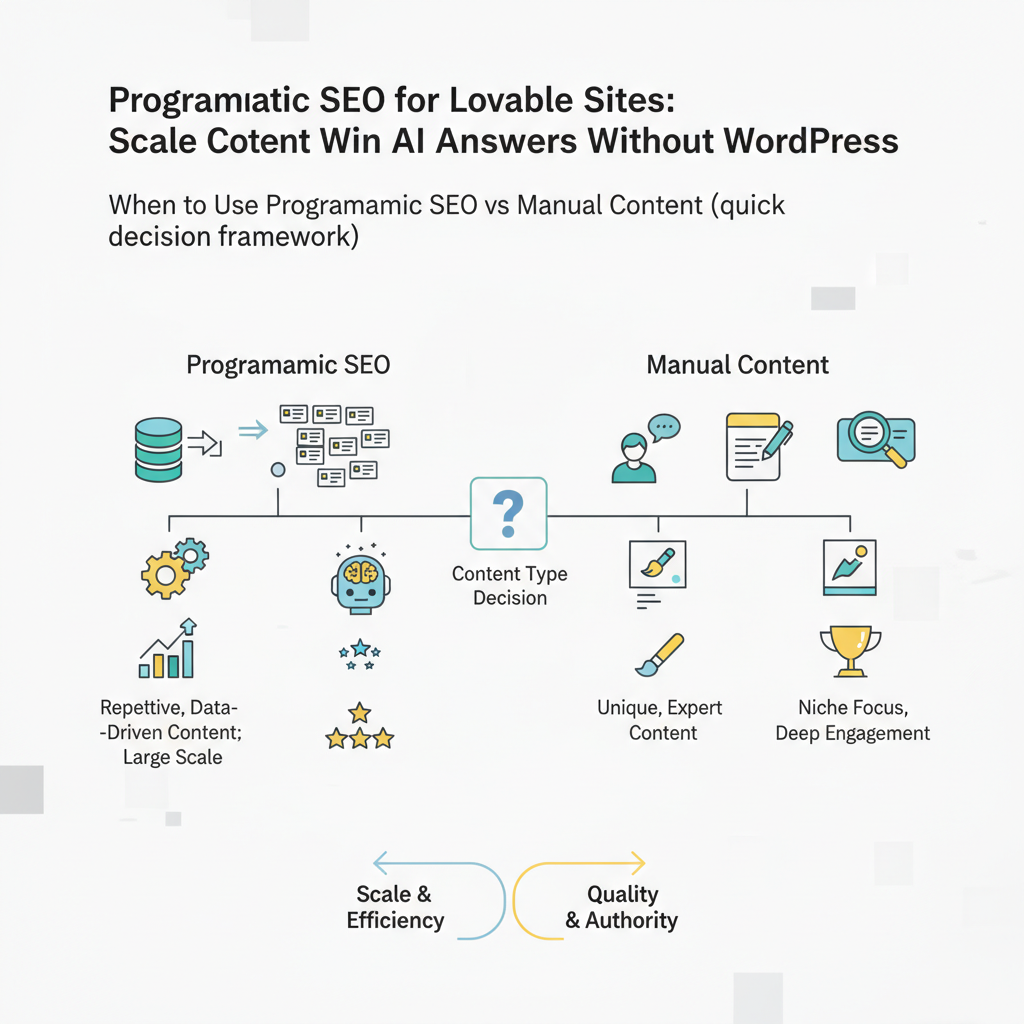
When to Use Programmatic SEO vs Manual Content (quick decision framework)
If you need fast coverage for repeatable queries—product + location pages, price comparisons, service availability—programmatic SEO is a fit. If you need narrative-driven pages, long-form thought leadership, or bespoke product launches, write manually. Use the following decision framework:
- Data availability: Programmatic — reliable dataset covering hundreds of items. Manual — single or small set with no structured source.
- Search intent: Programmatic — transactional, local, or factual queries. Manual — informational, narrative, or brand-building queries.
- Quality risk: Programmatic — moderate if templates lack unique facts. Manual — low but slower and costlier.
Concrete decision rule: if you can answer these three questions with data, programmatic is viable: 1) Can you produce a unique fact for each generated page? 2) Is there measurable search demand per item? 3) Can you automate schema and metadata reliably? If all three are yes, proceed.
Programmatic pages must present at least one verifiable fact per page to avoid being filtered as thin content.
Example: a directory that has a full address, hours, and a verified phone for each location is a strong programmatic candidate because those values provide unique, indexable signals. A business that only varies a city name without unique facts is not.
Checklist for the programmatic decision (copyable):
- Dataset completeness >= 90% for required tokens (address, hours, availability)
- Min search volume per template cluster > 50 monthly searches (typical threshold)
- Canonical plan for duplicates and pagination
- Testing plan to sample 1% of pages for manual review monthly
Actionable takeaway: produce a short scoring table across pages — data completeness (0–5), demand (0–5), uniqueness (0–5). Only move templates to production where score >= 10 out of 15.
Core Components of a Programmatic SEO Strategy on Lovable
Without well-defined components, programmatic efforts produce many low-value pages fast. For Lovable sites, build these core components intentionally: dataset model, content templates, metadata patterns, sitemap strategy, canonical rules, internal linking logic, structured data templates, and QA pipelines. Each must be explicit, versioned, and measurable.
Dataset model: define the canonical dataset schema (for example: id, slug_token, city, state, postal_code, address, phone, hours, product_list, price_point, last_verified). Keep a single source of truth (CSV, database, or API endpoint). Store a verification timestamp for each row; pages with stale data should be flagged.
Content templates: design templates that mix static copy with tokens and conditional blocks. For example, a service template might render a 1–2 sentence answer-ready lead (for AI-answer optimization), a three-bullet feature list, and a localized FAQ block. On Lovable, ensure templates can be previewed per token set before publishing.
Metadata & URL rules: adopt predictable URL patterns, see next H3. Create rules for canonical tags and noindex for low-value pages (e.g., incomplete data or duplicates). Generate XML sitemaps in batches with priority and changefreq tags that reflect real update cadence.
Internal linking: build topic silos so generated pages link to hub pages (region landing pages, product category pages). That helps distribute authority and gives crawlers a logical crawl path.
Measurement: instrument page-level metrics—organic clicks, impressions, time on page, bounce rate, and a thinness score (word count + unique facts). For lovableseo.ai users, export these metrics into dashboards and enforce a removal policy for pages that fail minimum performance within a defined window.
Content templates and variable tokens (city, product, feature)
Templates need a controlled token system. Define token names ({city}, {state}, {postal_code}, {product_name}, {feature_x}) and data types. Implement conditional rendering: "if {product_in_stock} then show stock message." Keep lead sentences concise and answer-oriented — one to two lines that an AI can extract as a direct answer.
Example template snippet (conceptual): "{product_name} in {city}—{product_name} is available at {store_name} in {city}, {state}. Call {phone} to confirm same-day pickup." That single sentence provides location, product, and contact facts useful for SERP features and AI answers.
Actionable takeaway: create a token registry document that maps each token to its source, update cadence, and a fallback value for missing data. Use fallbacks sparingly to avoid creating false uniqueness.
Scalable metadata & URL patterns
Adopt consistent URL patterns that encode hierarchy and remain readable: example pattern /services/{service-slug}/{city}-{state}. Keep slug lengths reasonable (under 100 characters) and avoid unnecessary query strings for indexable pages. For metadata, generate title templates and meta descriptions that include the primary token and an action-oriented verb: e.g., "{Product} in {City} — same-day service".
Concrete thresholds and examples:
- Title length: aim for 50–60 characters for primary messages.
- Meta description: keep between 120–155 characters with a concise answer or call-to-action.
- URL depth: prefer 2–3 path segments for programmatic pages.
Actionable takeaway: create a metadata generator that takes tokenized values and outputs title, description, and canonical URL; preview five representative pages per template before publishing batch runs.
Automated internal linking and topic silos
Automated linking rules keep generated pages discoverable. For Lovable sites, configure link templates so each programmatic page links to one category hub, one city hub, and the primary product hub — no more than three contextual outbound internal links in the hero area to avoid dilution.
Example: a generated page for "door repair in {city}" links to: 1) the service category page ("door repair"), 2) {city} service hub ("services in {city}"), and 3) a FAQ or resource that answers a common question. These links create topical clusters and help crawlers understand relationships.
Actionable takeaway: enforce a maximum of 3 strong internal links in the opening 200 words and generate a site graph export monthly to spot orphaned pages.
How LovableSEO Enables Programmatic Workflows on Lovable Sites
LovableSEO is designed to handle programmatic publishing workflows commonly used on Lovable sites. It connects structured datasets to templates, supports batch preview and validation, and schedules publishing. For teams using lovableseo.ai, LovableSEO-like capabilities accelerate rollout while enforcing guardrails that reduce the risk of thin content.
Key LovableSEO capabilities relevant to Lovable workflows (described as common platform features):
- Template library: Create, version, and preview templates with tokens and conditional logic.
- Batch publishing: Push thousands of pages in controlled batches with progress logs and per-item validation.
- Publishing schedules: Stagger publishing for crawl budget management and testing.
- Schema injection: Map dataset fields to structured data templates (LocalBusiness, Product, FAQPage).
- Rollback and staging: Preview pages in staging and roll back batches that fail QA checks.
Example workflow using LovableSEO concepts: import a CSV of 2,400 store rows, select the 'local-store' template, map tokens (address, phone, hours), run a 1% sampling QA, then schedule publishing in 12 daily batches to avoid crawl spikes. That workflow balances page velocity and quality control.
Always stage programmatic batches and sample 1%–5% of pages for manual review before wide release.
Actionable takeaway: define batch sizes based on your crawl budget and server capacity — a practical rule is 5–10% of weekly crawl allowance per day. If you don't know your crawl budget, start small: 100–500 pages/day and monitor indexing behavior.
Automatic article publishing & scheduling
Automated publishing should include staging, incremental rollout, and monitoring hooks. On Lovable platforms, schedule jobs that publish in windows that match regional traffic patterns; avoid publishing thousands of pages on a single day because search engines may treat that as manipulation.
Example scheduling plan: publish a pilot of 100 pages on day 1, 500 pages/day for week 1, and increase only if indexing and performance meet predefined KPIs. Integrate automatic alerts for spike in 404s, server errors, or pages flagged as thin.
Actionable takeaway: implement an automated gating rule that stops publishing if thin-page rate > 10% in the current batch.
Data-driven template creation and batch publishing
Templates should be driven by data: analyze search queries and user intent clusters, then design templates that answer those intents. Batch publishing requires mapping dataset fields to tokens and providing fallback content when values are missing.
Example: analyze top queries for "{product} near {city}" and design a template that includes a one-line answer to the most common question, a short list of features, and a FAQ. Use A/B testing to compare two lead sentence styles across batches.
Actionable takeaway: maintain a template version history and run A/B tests that rotate templates across similar page groups to determine which layout produces better clicks and lower bounce rates.
Generating sitemaps and pagination for scale
Generating sitemaps for tens of thousands of pages requires batching and index sitemaps. Produce sitemaps partitioned by date, template type, or region. Use sitemap index files to avoid single-file size limits. Include lastmod timestamps and only expose high-quality pages. Employ pagination with rel="next"/"prev" where applicable and avoid infinite indexable parameterized pages.
Concrete artifact: create an index sitemap that references per-region sitemaps, each containing up to 50,000 URLs. Update sitemaps nightly and submit index updates to Google Search Console when significant batches publish.
Actionable takeaway: implement sitemap automation in your publishing pipeline so new sitemaps are created and old ones removed as pages get deindexed or consolidated.
Structured data, FAQ, and AI-answer optimization at scale
Structured data is a differentiator for AI-answer optimization. AI models and search features often extract short, authoritative sentences and structured blocks from pages. Programmatic pages must present concise, verifiable answer sentences and include schema that clarifies entity type and local facts.
Best practice: produce a one-line answer snippet at the top of each programmatic page. Follow it with an FAQ block using schema.org/FAQPage markup. For local pages, include LocalBusiness schema with address, geo-coordinates, opening hours, and a verified telephone number.
Quotable definition: "Programmatic SEO uses templates and structured data to scale content production while preserving answer-focused snippets that AI models often extract for direct answers."
Template-driven FAQPage and local schema
FAQ blocks should map to a small, curated set of common questions. Generate answers from factual tokens only—avoid speculative language. For example, an FAQ item could be: "Q: Do you offer same-day pickup in {city}? A: Yes. Same-day pickup is available at {store_name} when ordered before {cutoff_time}." Wrap this block in FAQPage schema so search engines can use it for rich results.
Local schema example (fields to include): name, address, telephone, openingHoursSpecification, geo coordinates, priceRange, and sameAs (for verified profiles). For lovableseo.ai workflows, map dataset fields directly into JSON-LD templates to ensure consistent structured data across thousands of pages.
Actionable takeaway: require at least three schema fields (address, telephone, geo) before publishing a local page; otherwise hold the page in staging.
Creating concise answer snippets for AI and SERP features
Create a single, human-edited template field called answer_snippet that renders a one- or two-sentence reply to the most common query. Short, definitive sentences are more likely to be surfaced by AI answer boxes and featured snippets. Keep them factual and include numbers or names when available.
Example snippet: "{Store_name} in {city} offers {product} repair with same-day service; call {phone} to book." That sentence answers the who, what, and how quickly—attributes AI systems favor.
Actionable takeaway: limit snippet length to 20–30 words and place it as the first visible element in the page HTML to improve extraction likelihood.
Localizing programmatic pages for GEO visibility
Localization is more than inserting a city token. It requires locally relevant content: local landmarks, neighborhood names, localized hours, currency formats, and contact details. For geo visibility, include explicit tokens for {city}, {state}, {postal_code}, local phone number format, and a verifiable address. Add location-specific microcopy that an AI or user would expect.
Don't generate a localized page unless you can supply at least one verifiable local attribute beyond the city name. For example, listing a local partnership, a store's unique hours, or product availability makes the page unique and valuable.
Actionable takeaway: maintain a location data quality report and block publishing for rows that are missing three or more core local fields.
Tokenizing city/region, currencies, contact details
Tokenization must respect locale formats. For currencies, render a token {price_local} that formats numbers and currency symbols per locale. For phone numbers, use an international format token and a display format token. For addresses, split tokens into street_address, city, region, postal_code, and country to avoid parsing errors in schema insertion.
Example: a dataset row for Paris would include postal_code as 75001, price_local as €45.00, and phone as +33 1 23 45 67 89. Map these to template placeholders and preview them in language and region contexts.
Actionable takeaway: add a localization check in your pipeline that validates currency formats, postal codes, and phone patterns using simple regex per country.
Best practices for local schema and address data
Local schema should be complete and accurate. Use geo coordinates where possible since they improve local pack matching. Validate addresses against a postal API or a verification step. For opening hours, use the hourly format required by schema.org and include exceptions for holidays if known.
Actionable takeaway: require address verification for 90%+ of local pages. For the remaining 10%, mark pages as limited-info and add noindex until verification is completed.
Quality control: content templates, sampling, and A/B testing
Quality control prevents a programmatic rollout from becoming a liability. Build a three-layer QA system: automated validation checks, human sampling, and performance-driven pruning. Automated checks include token completeness, schema validity, and SEO metadata tests. Human sampling inspects readability and factual correctness in a percent of pages. Performance-driven pruning removes or consolidates low-performing pages.
Automated checks (examples):
- Token completeness: no missing critical tokens (address, phone).
- Schema validity: JSON-LD must pass Google’s structured data testing rules.
- Length checks: minimum lead sentence length and minimum content word count (e.g., lead + 200 words of supporting content).
Human sampling: sample 1%–5% of pages per batch, inspect for factual accuracy and natural phrasing, and log issues. Use those findings to refine templates and dataset mappings.
A/B testing: run controlled experiments comparing two template variants. Track click-through rate, time on page, and conversion events. Use statistical thresholds (e.g., 95% confidence) before declaring a winner and rolling it out.
Human review checkpoints and guardrails
Human checkpoints should exist at two stages: pre-publish and post-publish sampling. Pre-publish reviewers verify token rendering for edge cases and confirm no accidental exposure of private data. Post-publish reviewers sample pages for search behavior and content quality.
Example guardrails: a "safety hold" on publishing if more than 2% of sampled pages reveal placeholder tokens or incorrect fallbacks, and an automatic unpublish trigger for pages that receive excessive manual reports.
Actionable takeaway: appoint a rotating reviewer team and require a documented sign-off for each new template version.
Metrics and instrumentation to catch thin pages
Track these metrics at page level: organic impressions, clicks, average position, bounce rate, time on page, and a thinness score (word count, unique tokens present). Define thresholds that trigger remediation:
- Thinness score < 2 triggers review.
- CTR below 0.5% for pages intended to capture transactional queries triggers title/meta rework.
- Time on page < 30 seconds with high bounce triggers content augmentation or consolidation.
Actionable takeaway: build a dashboard that highlights pages failing any threshold and auto-enqueue them for human review or temporary noindexing.
Migration and technical considerations (Lovable-specific constraints)
When migrating programmatic pages into a Lovable-powered site, consider platform limits: maximum URL count, custom schema injection capabilities, and template engine limitations. If Lovable restricts certain HTML or JSON-LD placements, adapt templates to use allowed injection points. Also verify server performance and caching behavior to handle large numbers of pages.
Technical checklist for migration:
- Confirm platform allows programmatic route generation and supports canonical tags.
- Verify ability to inject JSON-LD and structured markup per page.
- Test page render times; aim for P95 under 1,000ms for generated pages (for typical SaaS setups, target under 500ms when possible).
- Plan redirects and canonical mappings for consolidated or retired pages.
Examples of platform constraints and mitigations: if the platform limits sitemap size, implement an external sitemap generator and upload index files. If the platform lacks dynamic JSON-LD slots, pre-render schema into static HTML field during publishing. When server templates cause slow rendering at scale, use a CDN or pre-generate static HTML for published pages.
Actionable takeaway: run a small-scale migration pilot of 200–500 pages to validate all technical assumptions before a full rollout.
Step-by-step 90-day rollout plan to maximize net-new organic traffic
Here's a practical 90-day plan organized into weekly milestones. The goal is to move from planning to measurable traffic gains while keeping quality under control.
| Week | Primary objectives | Deliverables |
|---|---|---|
| 1–2 | Data & template design | Token registry, dataset validation script, two template drafts |
| 3–4 | Staging and QA automation | Staging site, automated token checks, schema templates |
| 5–6 | Pilot publish | Publish 200–500 pages, sample QA, initial sitemap |
| 7–9 | Iterate and expand | Fix templates, publish 1,000–2,000 pages in batches |
| 10–12 | Scale and measurement | Publish remainder, monitor KPIs, start pruning low performers |
Key KPIs to monitor weekly: indexing ratio (indexed pages / published pages), organic clicks, and thinness incidents per batch. Adjust cadence if indexing ratio falls below expected values or thinness incidents exceed 5%.
Week-by-week publishing and testing cadence
Week 1–2: finalize datasets, build templates, and set up QA checks. Week 3: pilot publish 200 pages and collect manual QA feedback. Week 4–6: iterate templates based on pilot and publish incremental batches of 500–1,000 pages. Week 7–10: run A/B tests across template variants and monitor keyword rankings. Week 11–12: full-scale publish (remaining pages) and begin consolidation of low performers.
Actionable takeaway: commit to a weekly retrospective to decide whether to accelerate, pause, or rollback publishing based on objective KPIs.
Case examples & sample templates (copy-ready snippets)
Below are concrete template snippets and a sample checklist you can copy into your Lovable workflow. These are intentionally concise and designed to be programmatically filled by tokens.
Sample one-line answer snippet (template)
"{product_name} in {city}: {product_name} is available at {store_name} in {city}; call {phone} for same-day pickup."
Sample FAQ block (HTML/JSON-LD conceptual)
{ "@context": "https://schema.org", "@type": "FAQPage", "mainEntity": [ {"@type": "Question","name": "Do you offer same-day service in {city}?","acceptedAnswer": {"@type": "Answer","text": "Yes. Same-day service is available at {store_name} when ordered before {cutoff_time}."}}, {"@type": "Question","name": "What are your hours in {city}?","acceptedAnswer": {"@type": "Answer","text": "{opening_hours}"}} ]
}
Launch checklist (copyable)
- Dataset validated: 95%+ completeness
- Template previewed for 10 edge-case rows
- Schema JSON-LD validated
- Sitemap entry created and indexed
- 1%–5% sampling QA passed
Actionable takeaway: store these snippets centrally and require sign-off before batch publishes.
Conclusion and next steps (link to demo/pricing/signup)
Programmatic SEO for lovable sites is a high-leverage approach when you have reliable data and a strong QA pipeline. Use templates that prioritize concise answer snippets, inject complete local schema, and publish in measured batches. Tools like LovableSEO and platforms like lovableseo.ai provide the automation and controls—batch publishing, schema mapping, and preview staging—that reduce risk and increase velocity.
Quotable summary: "Programmatic SEO scales repeatable, answer-focused pages while requiring strict data and QA guardrails to preserve quality."
Next steps you can take today:
- Create a token registry and validate your dataset for completeness.
- Draft one template with a 20–30 word answer_snippet and an FAQ block.
- Run a pilot of 200 pages with manual QA and monitor indexing over two weeks.
Image prompts (alt_text):
- "Workflow diagram showing template, dataset, QA, and publishing stages for programmatic pages"
- "Sitemap index structure illustrating per-region sitemaps and batch publishing"
FAQ
What is programmatic seo for lovable sites?
Programmatic SEO for lovable sites is the practice of using templates and structured datasets on the Lovable platform to generate many unique, search-optimized pages automatically.
How does programmatic seo for lovable sites work?
It works by mapping verified dataset fields to tokenized templates, injecting structured data (like LocalBusiness and FAQPage), staging and validating pages, then publishing in controlled batches while monitoring performance and pruning low-quality pages.
Ready to Rank Your Lovable App?
This article was automatically published using LovableSEO. Get your Lovable website ranking on Google with AI-powered SEO content.
Get Started