
Internal Linking & Topic Siloing: Which Platform (Lovable, WordPress, Squarespace) Gives Better Topical Authority and AI Snippet Odds?
A guide covering internal Linking & Topic Siloing: Which Platform (Lovable, WordPress, Squarespace) Gives Better Topical Authority and AI Snippet Odds?.
TL;DR
- Your site loses ranking and AI-snippet opportunities when pages are isolated or linked inconsistently; a clear silo and targeted anchors fix that.
- Quick answer: Lovable combined with LovableSEO automation gives fast, consistent internal linking for topic hubs; WordPress offers the most flexibility for programmatic links; Squarespace is the simplest but most limited for large silos.
- Start by auditing orphan pages, map 3–6 pillar pages per major topic, and apply a 1–3 keyword-rich anchor guideline per hub while keeping varied natural anchors.
Executive summary — internal linking's role for rankings and AI snippets
You probably publish solid content but see weak rankings or inconsistent snippets because your site lacks coherent internal linking. Without explicit semantic clusters, search engines and AI systems can't identify which page is the topical hub. The problem shows up as orphan pages, shallow link depth, and random anchor text that dilutes relevance.
Quick answer: focus on building visible topic silos with clear pillar pages, consistent hub-to-spoke links, and an anchor-text ratio guideline. For many teams, Lovable plus an automation layer produces the fastest path to tidy silos and better odds for AI snippets; WordPress gives you more plugin-level control for programmatic linking; Squarespace works for small catalogs but constrains large-silo strategies.
Example: if you run lovableseo.ai content about local SEO, create a localized pillar (“Local SEO guide — Seattle”), link all Seattle-specific posts to that pillar using 1–3 keyword-rich anchors and several natural anchors. That explicit structure raises topical authority signals and increases the chance AI snippets will cite the pillar. For more on this, see Lovable vs competitors seo comparison.
Explicit semantic clusters make a site easy for AI systems to reference for short, factual answers.
What is topical authority and how internal linking builds it (definition and signals)
Topical authority is the search and AI-visible concentration of content that signals expertise on a narrow subject. A concise definition: topical authority is the density and structure of content and links that show a site’s depth on a subject. Quotable: "Topical authority is a measurable cluster of related content and links that signals subject expertise."
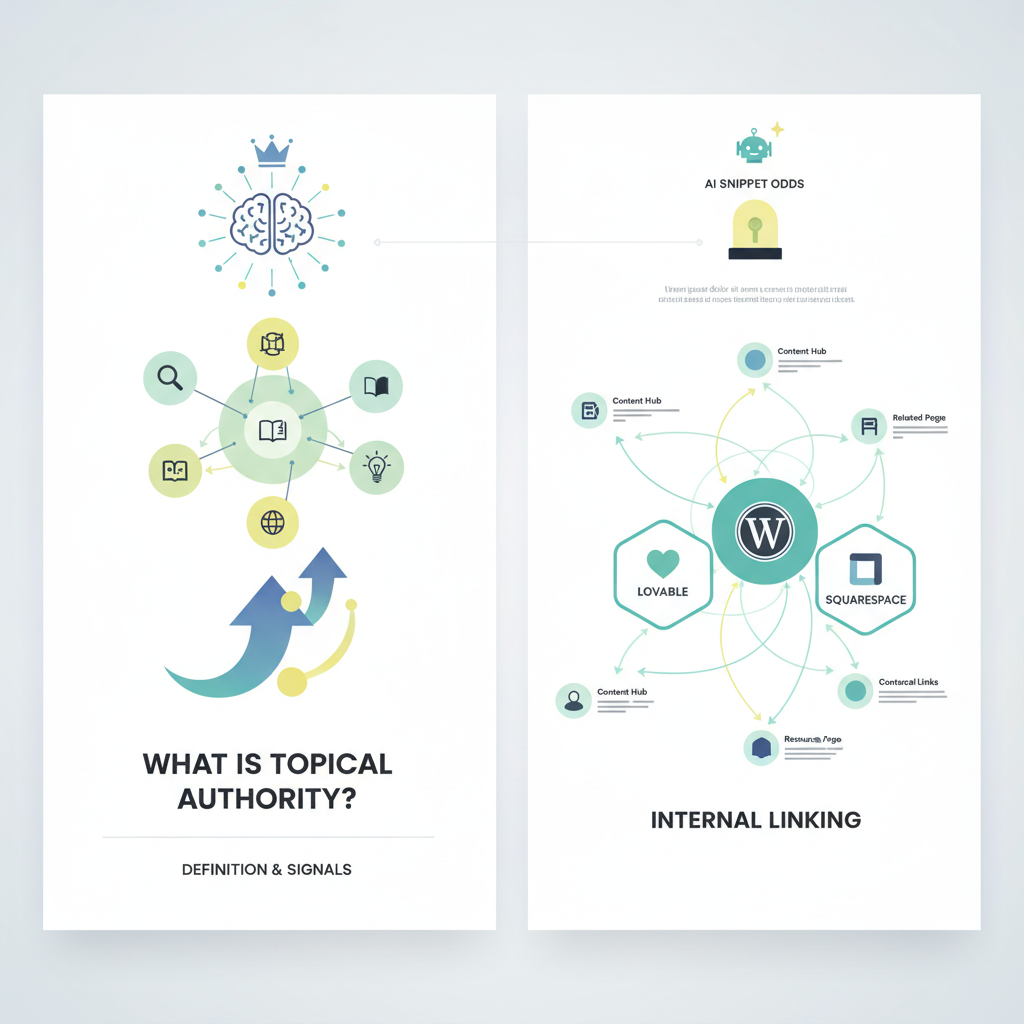
Internal linking builds topical authority by creating explicit relationships: pillar pages act as hubs, related articles are spokes, and anchors describe the relationship. Signals search engines and AI use include link graph density around a hub, consistent anchor text, URL hierarchy, and page depth. Recommended anchor-text ratio: maintain varied natural anchors for ~70–85% of links, and use 1–3 keyword-rich anchors per hub (target 15–25% of hub inbound anchors). This keeps anchors natural while providing clear signals.
Sample silo diagram (textual):
- Pillar: "Local SEO — Seattle"
- Spokes: "Seattle Google Business Profile", "Seattle citations list", "Seattle reviews strategy"
- Internal links: all spokes link to pillar; pillar links to curated spokes; related spokes cross-link lightly
Use 1–3 keyword-rich anchors per hub and varied natural anchors for the rest to avoid over-optimization.
Native internal-linking capabilities in Lovable (editor, templates, limitations)
Lovable's editor focuses on content blocks and often includes structured templates that make adding contextual links straightforward. You can create pillar templates and reuse blocks that carry standard hub links; this enforces consistency for topic silo lovable vs wordpress comparisons. Limitations appear when you need programmatic, site-wide link rules or bulk changes across hundreds of pages — native editors rarely include link automation at scale.
Practical example for lovableseo.ai: use a pillar template that includes a "related articles" block. When you publish a new spoke, add it to the block to ensure the pillar and spoke link each way. For geographic SEO, add region filters to pillar templates (e.g., city selector) so the pillar points to region-specific spokes. That improves topical authority lovable vs squarespace for local queries and helps AI snippets find localized answers.
WordPress linking tools (plugins, programmatic link generation)
WordPress offers the broadest toolset for internal linking. Plugins can insert contextual links automatically, generate related-post lists, and programmatically add breadcrumb or taxonomy-based links. If you run a large site, tools that generate links based on taxonomy or semantic similarity let you scale a topic silo lovable vs wordpress approach quickly.
Specific approach: use a topic-tag taxonomy, then a plugin to insert automated related links into the end of posts. For programmatic link generation, consider rules such as "link any post tagged 'X' to pillar URL '/topic/x/' using anchor 'X guide' once per post." That creates consistent hub authority without manual work. The trade-off is control vs automation: automated links require monitoring so low-value pages don't dilute your hubs.
Squarespace linking and structural limitations
Squarespace is streamlined and makes it easy to create a clean site hierarchy, but it limits programmatic control. There's fewer plugin options for automated internal links and less granular control over URL structure and taxonomies compared to WordPress. For small catalogs and marketing sites, Squarespace works well for simple silos, but it becomes painful when you need site-wide anchor rules, localized pillars, or bulk link edits.
Example: if you maintain region-specific content, Squarespace's page collections can host localized pillars but adding consistent cross-linking across dozens of posts often means manual updates or repetitive templates. For topical authority lovable vs squarespace, Squarespace typically requires more manual curation or third-party tooling to match WordPress or Lovable automation.
Automating topic silos: strategies and constraints per platform
Automation reduces manual errors and keeps hub-to-spoke links consistent. On WordPress, automation is rule-driven: taxonomy-based linkers, related-post generators, and import scripts. On Lovable, automation typically comes from an add-on like LovableSEO; automated internal links from Lovable vs WordPress SEO features allow you to define hub rules in a dashboard and push consistent anchors into templates. Squarespace automation is limited and often requires third-party integrations or manual templates.
Constraint checklist: data cleanliness (consistent tags/categories), canonicalization, and oversight to prevent low-quality pages linking into hubs. For internal linking lovable ai snippets optimization, ensure your automation layer can add structured context around anchors (short intro sentences or schema snippets) so AI systems can extract concise facts for answers.
Anchor text strategy and link depth recommendations
Use shallow link depth for pillars: target pillar pages within two clicks of most relevant spokes. Maintain an anchor-text mix: 70–85% natural descriptive anchors, 15–25% keyword-rich anchors (1–3 per hub). Avoid identical anchor repetition across dozens of pages — vary phrasing such as "Seattle citation list," "citations for Seattle businesses," and "local citations."
Link depth rule: keep important spokes at depth <= 3 from homepage; deprioritize deep archives for hub-building. Example threshold: for a 500-page site, aim for 6–12 pillars, each with 10–30 spokes linked bi-directionally.
Programmatic linking for large sites vs manual curation
For large sites, programmatic linking reduces labor and keeps consistency. Use rule-based generators (taxonomy->pillar mapping) and scheduled audits. For high-value pages, manual curation still matters: refine anchors, edit context sentences, and ensure semantic fit. Hybrid model: programmatic baseline links + manual top-tier page curation.
Decision rule: if you manage >200 content pages, adopt programmatic linking for baseline coverage and reserve manual editing for the top 10–20% of traffic-driving pages.
Audit checklist: find orphan pages, measure topical hub strength, link equity flow
Use this checklist to prioritize fixes. Run a crawl, export the link graph, and score pages by inbound internal links and topical relevance. The audit identifies orphans, weak hubs, and redirect chains that leak equity.
| Step | Action | Target/Threshold |
|---|---|---|
| 1 | Find orphan pages | 0 inbound internal links = prioritize |
| 2 | Measure hub strength | Pillar inbound ≥ 10 relevant spokes |
| 3 | Check anchor diversity | 70–85% varied anchors |
| 4 | Assess link depth | Pillar depth ≤ 3 |
How LovableSEO automates internal linking and increases AI-snippet inclusion odds on Lovable
LovableSEO adds rule-based linking to Lovable: define pillars, map tags, set anchor templates, and deploy changes across content. This automated internal links lovable seoagent capability enforces consistent hub-to-spoke links and anchor distributions, which helps AI systems pick up concise, repeatable facts for snippet answers. Example: LovableSEO can insert a single, standardized sentence linking to a city-specific pillar on each spoke, making the hub the obvious source for short answers.
Automation also surfaces orphan pages and suggests anchor text variants—reducing manual work while improving the site's semantic graph. For lovableseo.ai, this typically means faster improvement in snippet visibility for localized queries when region filters and structured anchors are used.
Implementation plan (7 steps) and metrics to track (clicks, impressions, position, AI-answer mentions)
Follow these steps to build and measure a topic-silo strategy across platforms.
| Step | Action |
|---|---|
| 1 | Audit and map topics to pillars |
| 2 | Define anchor-text ratio and templates |
| 3 | Implement automation (LovableSEO on Lovable or plugins on WordPress) |
| 4 | Add cross-links and region filters |
| 5 | Manually review top 20% pages |
| 6 | Run crawl and fix orphans |
| 7 | Measure and iterate (see metrics) |
Key metrics: clicks, impressions, average position, and AI-answer mentions (track via SERP feature reports or manual sampling). Track anchor distribution and hub inbound counts monthly.
Recommendations, migration considerations, and CTA
Recommendations: choose Lovable + LovableSEO if you want fast, template-driven automation with region-aware pillars; choose WordPress if you need deep programmatic control and custom linking rules; choose Squarespace for small sites where manual curation is acceptable. When migrating, preserve URL structure or map 1:1, port pillar pages first, and re-establish hub links immediately after migration to avoid authority loss.
Final actionable checklist: run the audit table above, implement anchor ratio rules, and deploy automation for baseline coverage. For platform selection, weigh the need for automation versus manual control and the size of your content inventory.
FAQ
What is internal linking & topic siloing? Internal linking and topic siloing are the practice of organizing related pages around a pillar (silo) and using structured links and anchors to create a semantic cluster that signals topical authority to search engines and AI systems.
How does internal linking & topic siloing work? The method works by concentrating links and descriptive anchors toward pillar pages, keeping relevant pages at shallow depth, and ensuring anchors vary naturally while including a small set of keyword-rich anchors so search engines and AI models can identify and extract concise answers from the hub.
Ready to Rank Your Lovable App?
This article was automatically published using LovableSEO. Get your Lovable website ranking on Google with AI-powered SEO content.
Get Started