Retainer vs Fixed-Fee vs Performance SEO for Lovable Agencies: A Decision Framework + Simple Pricing Calculator
A guide covering retainer vs Fixed-Fee vs Performance SEO for Lovable Agencies: A Decision Framework + Simple Pricing Calculator.
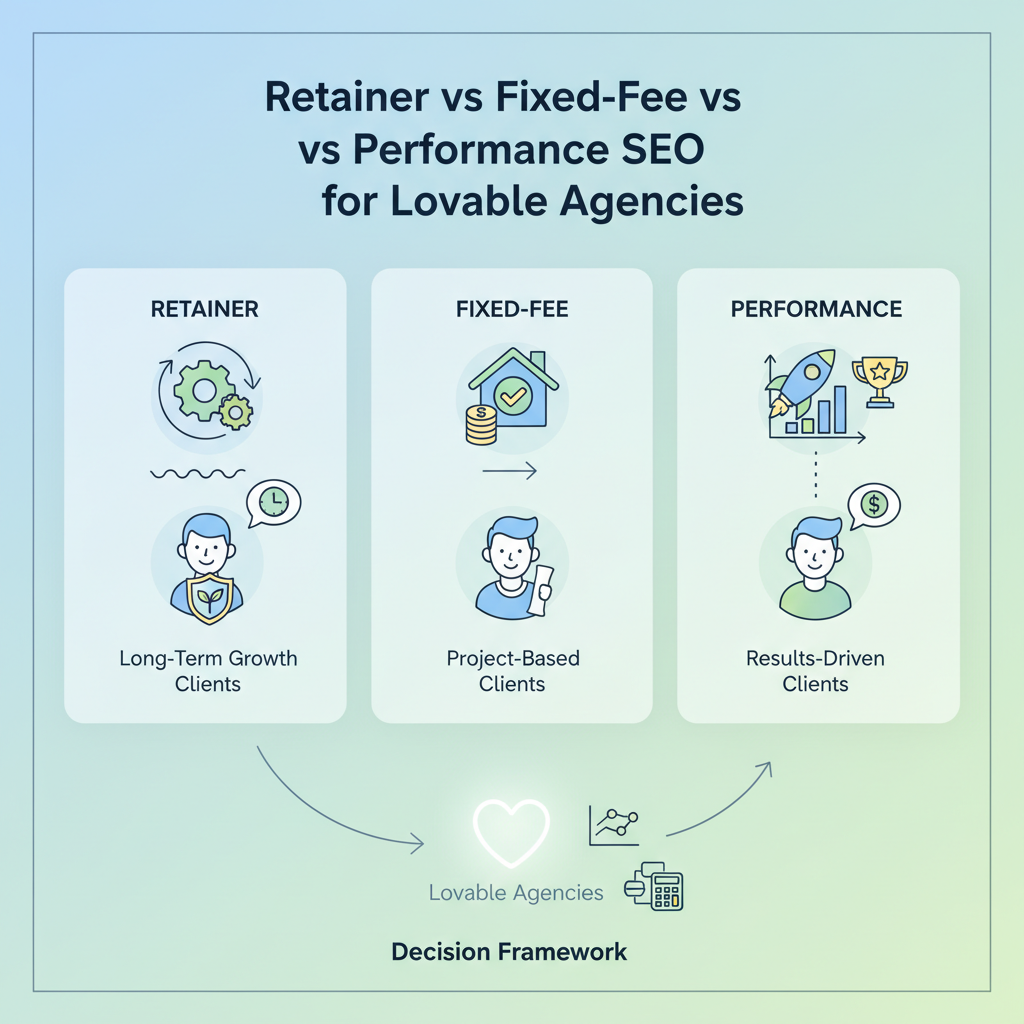
TL;DR
- Retainers buy ongoing capacity and predictability; use them for continuously evolving sites and multi-channel programs.
- Fixed-fee works for clearly scoped deliverables — use scope templates and acceptance criteria to avoid scope creep.
- Performance models transfer risk but require reliable attribution; reserve them for measurable conversion-driven goals.
- Decision matrix and reproducible pricing formula provided: (Estimated hours × hourly rate) ± risk premium = suggested price.
If you manage SEO projects on Lovable, this guide compares retainer vs fixed fee vs performance SEO lovable so you can pick the model that fits each client. You’ll find concise definitions, a GEO-aware decision matrix, a reproducible pricing calculator, checklist artifacts, and two SaaS examples tailored for lovableseo.ai workflows.
Overview — three common pricing models and how they map to Lovable client needs
Definition: Retainer — a recurring monthly agreement that secures a set of hours or outcomes for ongoing SEO work. Definition: Fixed-fee — a one-time price for a defined deliverable set (e.g., site migration, siloed content program). Definition: Performance — payment tied to agreed KPIs such as organic MRR, new trials, or ranked keywords.
Retainers are best when you need steady output: weekly content, technical fixes, and iterative A/B tests that feed Lovable’s automation and analytics. Fixed-fee fits discrete projects that map to predictable outputs: bulk content builds using Lovable’s structured-data templates, or a 3-month technical remediation. Performance suits clients with reliable attribution (server-side event tracking, clear funnels) and controllable conversion points.
Example: an early-stage SaaS might accept a fixed-fee for an initial content hub build, then move to a small retainer for growth. A regionally focused local SaaS might prefer a retainer to manage multi-region content and local-schema tasks that Lovable can deploy continuously.
Charge for certainty: price the guaranteed hours first, then price upside separately.
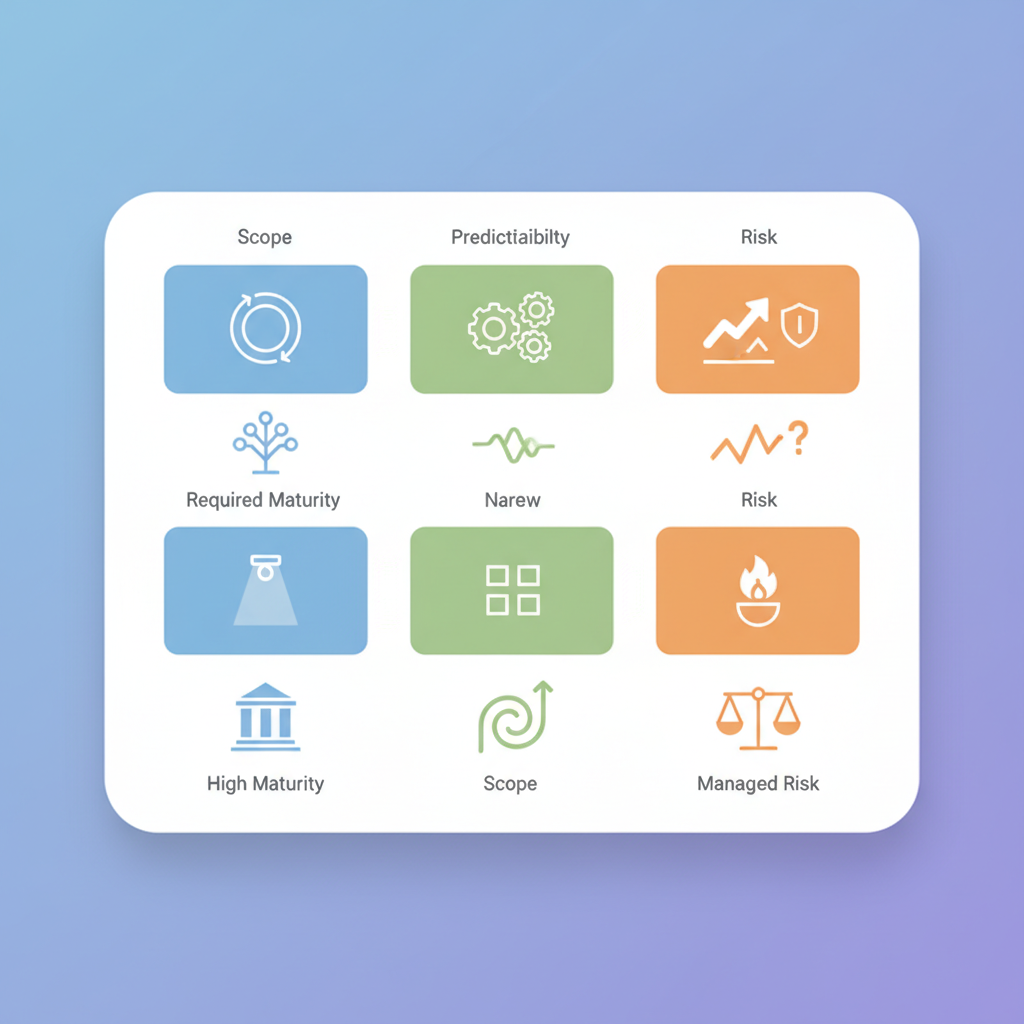
Comparative matrix (scope, risk, predictability, required maturity)
This decision matrix helps you weigh scope, vendor risk, and client maturity across GEO-aware signals like local search demand and multi-region needs. Use it to pick a model that matches the client’s analytics maturity and the platform features Lovable offers.
| Model | Scope | Risk to vendor | Predictability | Required client maturity |
|---|---|---|---|---|
| Retainer | Ongoing, variable | Low–medium | High | Medium (basic analytics, content process) |
| Fixed-fee | Tightly scoped deliverables | Medium | Medium | Low–medium (clear acceptance criteria) |
| Performance | Outcome-focused | High | Low–variable | High (server-side tracking, stable funnels) |
GEO-aware signals: if local search demand is fragmented (many locales), prefer retainers because updates scale across regions; if the client is single-region with clear seasonal demand, fixed-fee campaigns for seasonal pages can work well. For multi-region clients with replicated funnels and unified analytics, performance models become feasible if attribution is strong.
Alt text: Map showing multi-region SEO signals and local-search demand for pricing decisions (illustrates geo-aware model choice)
Retainers — when to use and implementation tips
Use retainers for continuous work: content velocity, technical maintenance, backlink outreach cadence, and experiments that require repeatable cycles. Implementation tips: define monthly deliverables in a scope-of-work, include a monthly KPI dashboard, and set minimum and rollover hours. For Lovable clients, bundle automation tasks (structured-data updates, FAQ schema pushes, content template deployments) into the retainer so your team can deploy through the platform without repeated scoping.
Operational checklist: 1) agree on core deliverables and response SLAs; 2) log hours in a shared dashboard; 3) run quarterly strategy sessions to reallocate hours. Pricing rule of thumb: estimate baseline monthly hours, multiply by your hourly rate, then add a 10–25% continuity premium for scheduling certainty.
Guarantee availability, not outcomes: sell hours and processes, not promises on rankings.
Fixed-fee — ideal client profiles and scope templates
Fixed-fee contracts suit clients needing a one-off project: site migrations, large content migrations into Lovable’s CMS, or a defined link-building sprint. Ideal clients have decision clarity, acceptance criteria, and the internal ability to apply deliverables (e.g., they can publish content or QA migrations).
Scope template example: deliverable list, acceptance criteria (page count, schema validated, performance targets), timeline, revision limits, and a contingency clause for out-of-scope items. For Lovable deployments, include a technical acceptance step requiring schema validation and search-preview checks. Price by estimating total hours × hourly rate, then add a fixed risk buffer (5–15%) to cover scope creep.
Performance — risk allocation and attribution best practices
Performance SEO transfers upside and downside. Use it only when you can attribute organic traffic to conversions reliably. Required setup: unified analytics with server-side events, consistent UTM and landing page rules, and a shared conversions baseline. Adopt a clear attribution window and conversion lookback (e.g., 30 days) and agree on what counts as a qualified conversion (trial, demo request, paid sign-up).
Risk allocation: cap vendor downside with a minimum monthly retainer for base costs, then pay a bonus or revenue share above the baseline. Attribution best practice: use first-touch vs last-touch scenarios in the contract and publish sample calculations so both parties see how payouts are computed. For the best seo pricing model for saas, opt for hybrid performance only when LTV and conversion funnels are stable.
Decision framework: 6 questions to recommend a pricing model
Answer these quickly during discovery to recommend a model:
- Do you have reliable server-side conversion tracking? (Yes → performance possible)
- Is the scope a one-off deliverable or ongoing work? (One-off → fixed-fee)
- Does the client require predictable monthly capacity? (Yes → retainer)
- Is the client multi-region or local-only? (Multi-region → retainer)
- Can stakeholders agree on acceptance criteria and lookback windows? (No → avoid performance)
- What is the client’s cash runway and risk tolerance? (Low runway → fixed-fee or low retainer)
Use these answers to map to models: if more than three answers favor predictability and continuous updates, recommend a retainer. If scope and acceptance are crystal clear, recommend fixed-fee. If analytics maturity is high and the client accepts risk, propose performance or hybrid.
Step-by-step pricing calculator walkthrough (inputs, outputs, and examples)
Calculator formula (reproducible): (Estimated hours × hourly rate) ± risk premium = suggested price. Inputs: estimated hours, blended hourly rate, risk premium percentage, minimum retainer (if applicable), and expected upside share (for performance).
- Estimate hours for deliverables or monthly work (example: 40 hours/month).
- Choose a blended hourly rate (example: $120/hr).
- Apply risk premium (example: +15% for fixed-fee one-off work).
- Calculate: (40 × 120) × 1.15 = $5,520 suggested price for the month or project phase.
Artifact: launch checklist you can copy — 1) confirm analytics and attribution, 2) set acceptance criteria, 3) agree timeline and payment terms, 4) define rollback/ownership of content, 5) technical acceptance on Lovable’s schema validator.
| Input | Example value | Result |
|---|---|---|
| Estimated hours | 40 | 40 × $120 = $4,800 |
| Risk premium | +15% | $4,800 × 1.15 = $5,520 |
Use the seo pricing calculator lovable logic to run quick quotes during sales calls; store common presets (hourly blends, premia) for repeatability. For more on this, see Lovable seo agency playbook.
Example 1: early-stage SaaS on Lovable (low budget, growth focus)
Profile: seed-stage SaaS, low traffic, single conversion (trial), limited budget. Recommendation: fixed-fee for an initial content hub (20 pillar pages + 40 cluster pages) to prove concept, then a small retainer for iterative optimization. Use the calculator to price the initial build and set a three-month measurement window. For an early-stage client, the best seo pricing model for saas typically pairs fixed deliverables with a short retainer to iterate on learnings.
Example 2: established SaaS with steady traffic (conversion-driven)
Profile: Series B SaaS with stable traffic, mature analytics, and predictable LTV. Recommendation: hybrid model — modest retainer to cover base operations, plus a performance bonus tied to new trial signups credited to organic channels. Structure payouts quarterly with shared dashboards. This configuration reduces vendor risk while aligning incentives for growth teams using Lovable’s structured data and content templates.
Hybrid models and negotiation playbook (mixing retainer + bonus)
Combine a base retainer with performance bonuses to balance predictability and upside. Negotiation playbook: start with a baseline retainer that covers fixed costs, then define KPIs and payout tiers (e.g., $X per qualified trial above baseline). Include caps and floors: a minimum monthly fee and a maximum payout to avoid perverse incentives.
Negotiation tips: present three options (low retainer + high performance share, medium retainer + medium share, high retainer + low share). Include worked examples that show payouts at different performance levels. For lovable agency pricing decision, showing math wins deals faster than promises.
Sales & proposal templates tuned for Lovable features (structured data, AI-answer potential)
Proposal essentials: executive summary, scope and acceptance criteria, pricing calculation, measurement plan, and deployment checklist. Add a technical appendix that lists structured-data tasks (FAQ/schema, product schema, breadcrumb schema), sample AI-answer snippets (featured snippet-ready headings), and a roll-out plan for multi-region pages.
Quote-ready sentences to include: "We will publish X pages using Lovable templates and validate schema with your production snapshot." Use the seo pricing models comparison section in proposals to justify your model choice with the decision matrix and the calculator example included above.
Conclusion and next steps — link to signup, pricing page, and demo request
Choose retainers for predictability, fixed-fees for tightly-scoped deliverables, and performance models where attribution is reliable and goals are measurable. Use the reproducible pricing formula: (Estimated hours × hourly rate) ± risk premium = suggested price, and adapt premia by client maturity and geographic complexity.
Next steps: run the calculator with real hour estimates, choose a trial engagement format (fixed-fee pilot or one-month retainer), and document acceptance criteria in the proposal. For lovable agency pricing decision, show both the math and a short case study during the pitch.
FAQ
What is retainer vs fixed? A retainer is a recurring monthly contract buying capacity and availability; a fixed contract is a one-time price for a clearly scoped deliverable.
How does retainer vs fixed work? Retainers bill regularly for a block of hours or ongoing services, while fixed agreements define deliverables, acceptance criteria, and a single payment schedule for the agreed scope.
Quotable takeaway: "Choose retainers for predictability, fixed-fees for tightly-scoped deliverables, and performance models where attribution is reliable and goals are measurable."
Ready to Rank Your Lovable App?
This article was automatically published using LovableSEO. Get your Lovable website ranking on Google with AI-powered SEO content.
Get Started