
Scaling Localized FAQ Hubs on Lovable: Template Checklist, Localization Workflow, and Signals to Win AI Answers
A guide covering scaling Localized FAQ Hubs on Lovable: Template Checklist, Localization Workflow, and Signals to Win AI Answers.
TL;DR
- Start programmatic FAQ hubs when local demand and support variance grow across many locales.
- Use a rigid template: locale IDs, short answer, expanded answer, exact locality strings, and JSON-LD with @language.
- Measure AI-answer wins per locale using localized queries and GSC impressions segmented by location.
If your site serves many cities, postal codes, or regions and support requests repeat with slight local variation, you face poor coverage, high manual cost, and missed AI answer opportunities. The primary fix is a repeatable, data-driven approach: build programmatic localized FAQ hubs on Lovable that use structured feeds, locale-aware templates, and AI-answer signals to increase chances of featured answers.
When to scale localized FAQ hubs (signals that justify programmatic scaling)
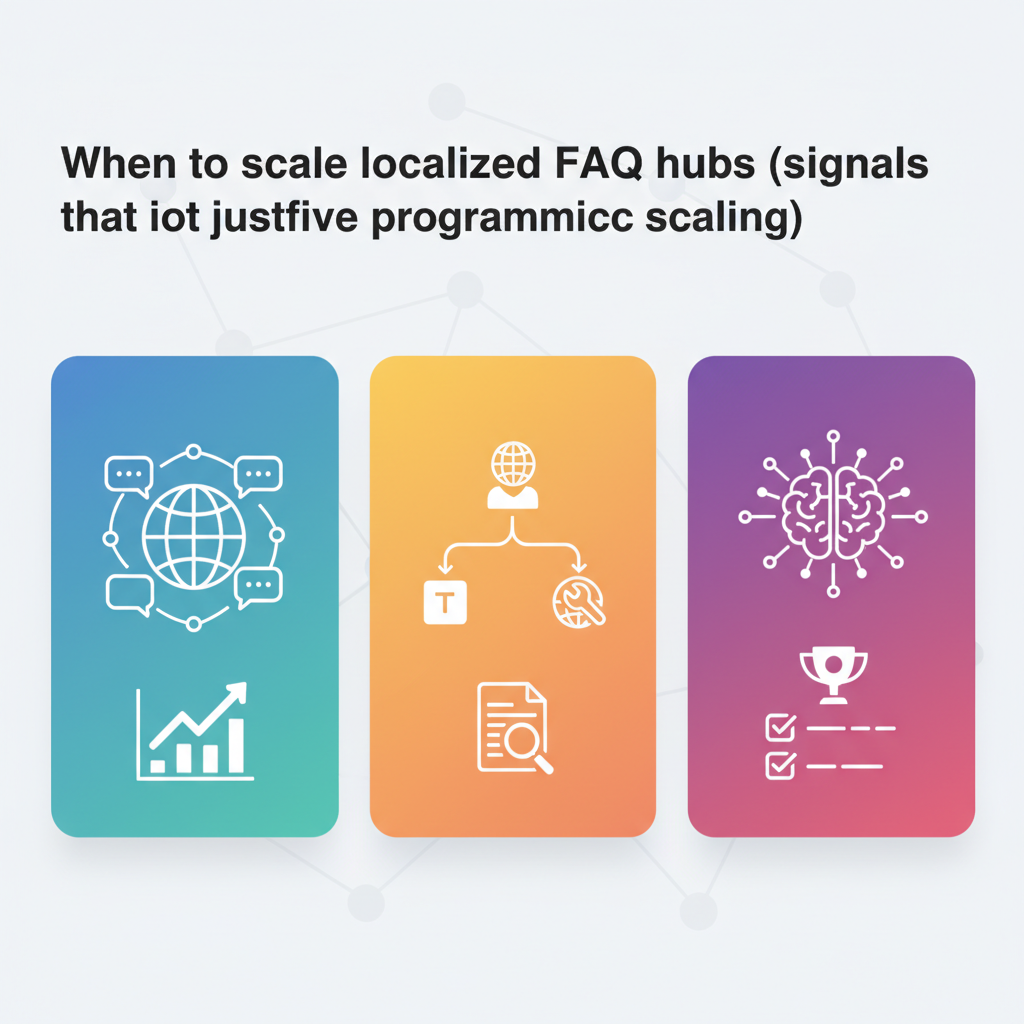
Scale when you see concrete signals that manual pages won’t keep pace. Typical signals: more than 50 unique locality-based queries per month, repeated support tickets that differ only by city or ZIP, and search console impressions showing location-targeted queries with low click-through rate. For lovableseo.ai users, another signal is a steady stream of locale-specific keyword suggestions in the platform's keyword report that lack matching pages.
Example decision rule: if three or more support topics repeat across 25+ locales, treat that cluster as a candidate for programmatic pages. Programmatic localized FAQs are appropriate when content differences are factual (hours, address, service radius), not when nuance or legal language demands bespoke copy. To effectively scale these FAQs, consider implementing programmatic FAQ hubs that prioritize locales by revenue, search volume, and operational accuracy.
Quotable: "Scale programmatically when the same question repeats in 25+ locales."
Template fields every localized FAQ needs
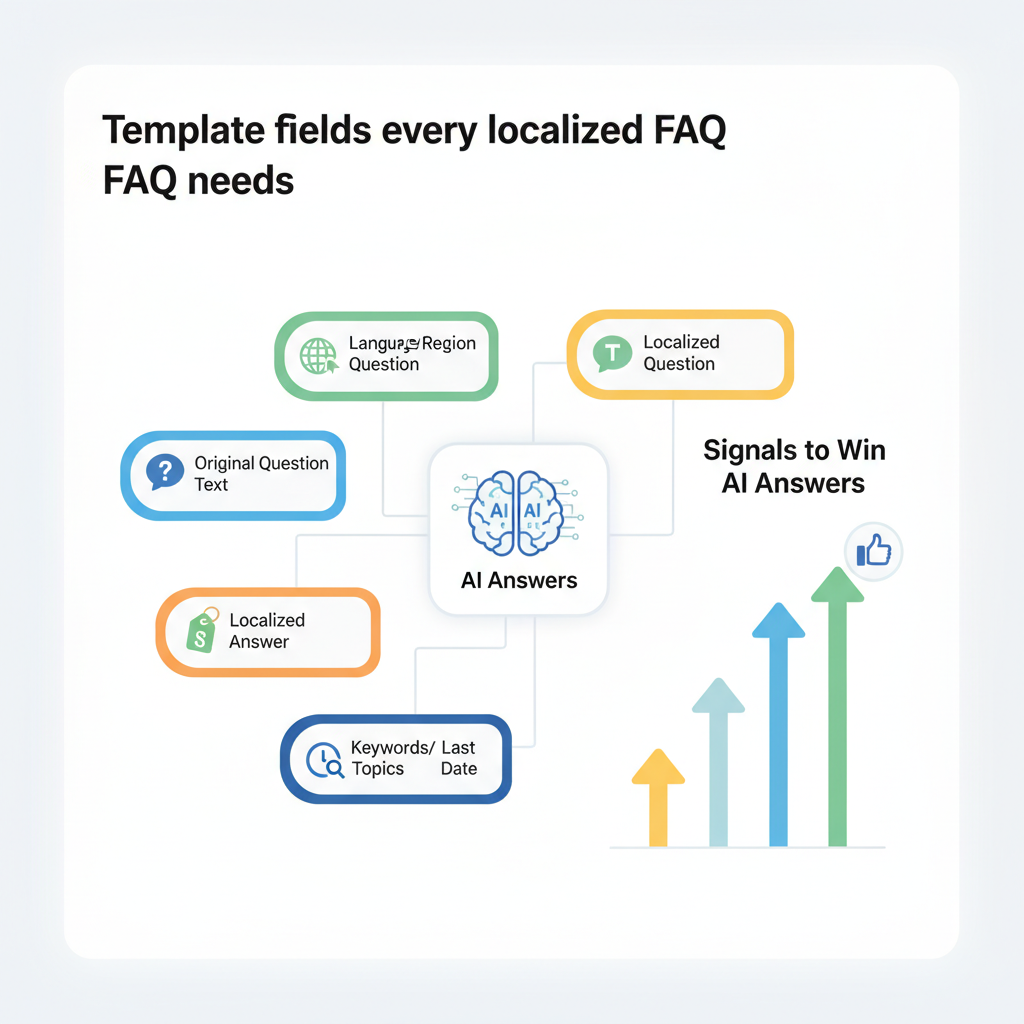
A consistent template prevents errors and boosts AI-answer odds. Every localized FAQ entry should include: locale identifier, short answer (1–2 sentences), expanded answer (50–120 words), canonical URL, exact locality strings, address, hours, service_area radius, contact fields, primary_language, and JSON-LD snippet. These are the minimum 'facts' AI systems prefer for direct answers.
Example localized faq templates: for a plumbing service in Lovable, a row in your feed might include: locale_city="Springfield", locale_region="IL", short_answer="Yes—emergency service available 24/7.", expanded_answer="We dispatch within 60 minutes for Springfield, IL; standard call-out fee applied after 8pm.", service_radius_km=50, phone_localized="217-xxx-xxxx". Keep labels consistent across feeds and CMS fields to avoid mapping errors.
Quotable checklist: For each locale include: short answer (1–2 sentences), expanded answer (50–120 words), exact locality strings, and structured FAQ JSON-LD with locale-specific @language.
Locale identifiers (city, region, country) and canonical rules
Define 'locale' clearly: a locale can be a city, metro area, postal code, or country depending on targeting granularity. Use a deterministic identifier scheme such as country_code:region_code:city_slug or ISO country + postal code. Canonical rules must prevent duplicate content: canonicalize to the most specific page when content is truly unique (e.g., /faq/springfield-il/), and use rel=canonical to a regional hub when content is identical across many postal codes.
Practical rule: if the only difference is address fields, generate unique pages but canonicalize duplicates back to a hub after adding at least a 50–100 word locale-specific sentence. For lovableseo.ai feeds, include locale_key and canonical_url fields to control indexing behavior programmatically.
Localized addresses, service areas, hours, and contact fields
Include precise contact and operational data per locale. Required fields: formatted_address, latitude, longitude, service_area_radius_km (or miles), hours_json (weekday opening hours), local_phone, and email_contact. For multi-site businesses include site_id and whether the location is appointment-only.
Example: formatted_address="123 Market St, Springfield, IL 62701", hours_json="{Mon-Fri:08:00-18:00, Sat:09:00-14:00}", service_area_km=30. These fields feed both visible copy and structured data, which helps local search and AI agents extract precise facts.
Short answer vs expanded answer fields for AI consumption
Provide two answer fields per question. Short answer: one or two clear sentences suitable for featured snippets or voice replies. Expanded answer: 50–120 words with specifics, examples, and next steps. The short answer should directly respond to the question; the expanded answer should include locality strings and structured facts (hours, fee thresholds, policy exceptions).
Example: Q: "Do you offer weekend service in Springfield?" short_answer: "Yes—weekend service is available for Springfield residents." expanded_answer: "Weekend service runs 9am–5pm with an additional weekend fee of $50; book online or call the Springfield support line at 217-xxx-xxxx." This split increases the chance an AI picks the short answer and then cites the expanded answer for context.
Localization workflow for scale
A scalable workflow separates content generation, translation, and publishing. Step 1: source-of-truth feed creation (CSV or DB). Step 2: template population and automated QA. Step 3: translation or transcreation. Step 4: staging preview per locale. Step 5: controlled publish. Automate mapping from feed fields to Lovable templates, then run a validation pass that checks required fields and structured data output.
Example workflow for lovableseo.ai customers: export localized keyword clusters, map to FAQ templates, populate CSV with locale keys and content fields, push to staging via API, preview rendered pages, then publish in batches. Use small batches (50–200 pages) during initial rollout to monitor crawl and indexing behavior.
Source of truth (CSV/CSV+localization keys vs CMS entries)
Use a single source of truth. For large scale, a columnar CSV or database keyed by locale is easiest to version and audit. Include localization keys for repeatable copy fragments and a content_id for each Q&A. For smaller operations, CMS entries per locale are fine but become brittle at scale.
Decision rule: if you expect >200 localized pages, choose a feed-based source of truth (CSV + localization keys) with automated import to Lovable. This supports diffs, rollback, and programmatic updates like seasonal hours or holiday closures.
Translation vs transcreation: quality vs speed tradeoffs
Translation converts text literally; transcreation adapts tone, idioms, and local expectations. For factual fields (address, hours) translation is sufficient. For customer-facing marketing language and policy explanations, transcreation improves clarity and conversion but costs more and takes longer.
Rule of thumb: translate short answers and structured facts automatically, then transcreate expanded answers for your top 50–100 locales by traffic or revenue. For the rest, use high-quality machine translation followed by a quick native-speaker QA pass.
QA checklist for localized variants
Use a strict QA checklist before publish: required fields present, short and expanded answers pass length checks, JSON-LD validates, phone number formats correct, canonical tags set, and locale strings match search intent. Run automated checks and a human spot-check for 5% of pages.
Checklist (numbered): 1) locale_key present, 2) short_answer 10–30 words, 3) expanded_answer 50–120 words, 4) address & hours formatted, 5) JSON-LD valid. Mark pages that fail and prevent publish until fixed.
Generating data feeds and templated pages on Lovable
Lovable supports templated page generation from structured feeds. Build a CSV or JSON feed with the template fields described earlier and map each column into the Lovable FAQ template. Implement a staging step where a preview URL is generated for 10–20 locales so product and SEO can review rendered markup and structured data output before bulk publish.
Example: create feed columns site_id, locale_key, canonical_url, question_slug, short_answer, expanded_answer, address, hours, phone, geo_lat, geo_lng, language_code. Use the Lovable import tool or API to push changes and run a validation pass that checks output HTML and JSON-LD for each previewed page.
feed structure examples and required fields for AI signals
Feed fields that send positive AI signals: question_id, short_answer, expanded_answer, language_code, exact_locality_string, canonical_url, faq_schema_json, timestamp_last_updated, service_area_km. Include geo coordinates and formatted address so AI systems can map queries to real-world locations.
Example feed row: {"question_id":"faq-123","locale_key":"springfield-il","short_answer":"Yes—24/7 service.","expanded_answer":"We respond within 60 minutes in Springfield; after-hours fee applies.","language_code":"en-US","formatted_address":"123 Market St, Springfield, IL","geo_lat":39.78,"geo_lng":-89.64,"faq_schema_json":"{...}"}.
Structured-data and geo signals that increase AI-answer odds
Structured data and explicit geo facts help AI systems pick your answer. Include FAQPage JSON-LD per page, plus LocalBusiness/Service schema with geo coordinates, address, and openingHours. The JSON-LD must reflect locale-specific @language where appropriate.
Quotable: "Include FAQPage JSON-LD and exact geo coordinates to improve AI answer extraction."
recommended FAQ JSON-LD fields and localized meta
Recommended JSON-LD keys: @context, @type: FAQPage, mainEntity (Question/Answer pairs), language, url, datePublished, and author. For LocalBusiness include name, address, geo {latitude, longitude}, openingHoursSpecification, telephone. Set localized meta tags: hreflang where appropriate and meta description that includes the exact locality string.
Example meta: <meta name="description" content="Emergency plumbing service in Springfield, IL — 24/7 response and local rates.">
Publishing cadence, throttling, and crawl budget considerations
Publish in controlled batches to avoid crawl overloading. Recommended cadence: start with 50–200 pages per week while monitoring crawl stats and indexation. If you see high crawl rates but low indexation, slow down and improve signal density (add unique locality sentences, JSON-LD). Use sitemaps segmented by publish date to guide crawlers.
Throttling rule: if GSC shows crawl errors increase by 30% after a batch, pause and audit. For lovableseo.ai clients, use the platform's staging to preview headers and robots rules before releasing large batches.
Measuring success and iterating (locale-level KPIs)
Track locale-level KPIs: impressions and clicks by location (GSC), AI-answer win rate by running localized test queries, organic conversions per locale, and indexation rate per batch. Measure AI-answer win rate by storing a list of target queries per locale and checking whether search results return your short answer or FAQ snippet.
Example KPIs: target 20% increase in locale impressions within 90 days, 10% CTR from FAQ pages, and AI-answer win rate >15% on prioritized locales. Iterate content and structured data based on failing locales and retest after updates.
Sample implementation checklist and quick wins
Use this launch checklist: 1) identify top 50 locales, 2) create feed with required fields, 3) populate short and expanded answers, 4) validate JSON-LD and hreflang, 5) publish 50–200 pages to staging, 6) run QA, 7) publish first batch, 8) monitor GSC and AI-answer tests. Quick wins: add exact locality strings to short answers and include geo coordinates in JSON-LD.
Quotable: "Add exact locality strings to short answers to win more AI answers."
FAQ
What is scaling localized faq hubs on lovable? Scaling localized FAQ hubs on Lovable is the process of programmatically generating and publishing many locale-specific FAQ pages using structured feeds and templates to serve city-, region-, or postal-code-level queries.
How does scaling localized faq hubs on lovable work? Scaling on Lovable works by defining a template, creating a feed keyed by locale, populating short and expanded answers plus required locale fields, validating JSON-LD, and publishing in controlled batches while monitoring locale-level KPIs and AI-answer signals.
Ready to Rank Your Lovable App?
This article was automatically published using LovableSEO. Get your Lovable website ranking on Google with AI-powered SEO content.
Get Started