Where to Place CTAs & Microcopy on Lovable Feature Pages to Lift Trial Signups (and Improve AI Answer Odds)
A guide covering where to Place CTAs & Microcopy on Lovable Feature Pages to Lift Trial Signups (and Improve AI Answer Odds).
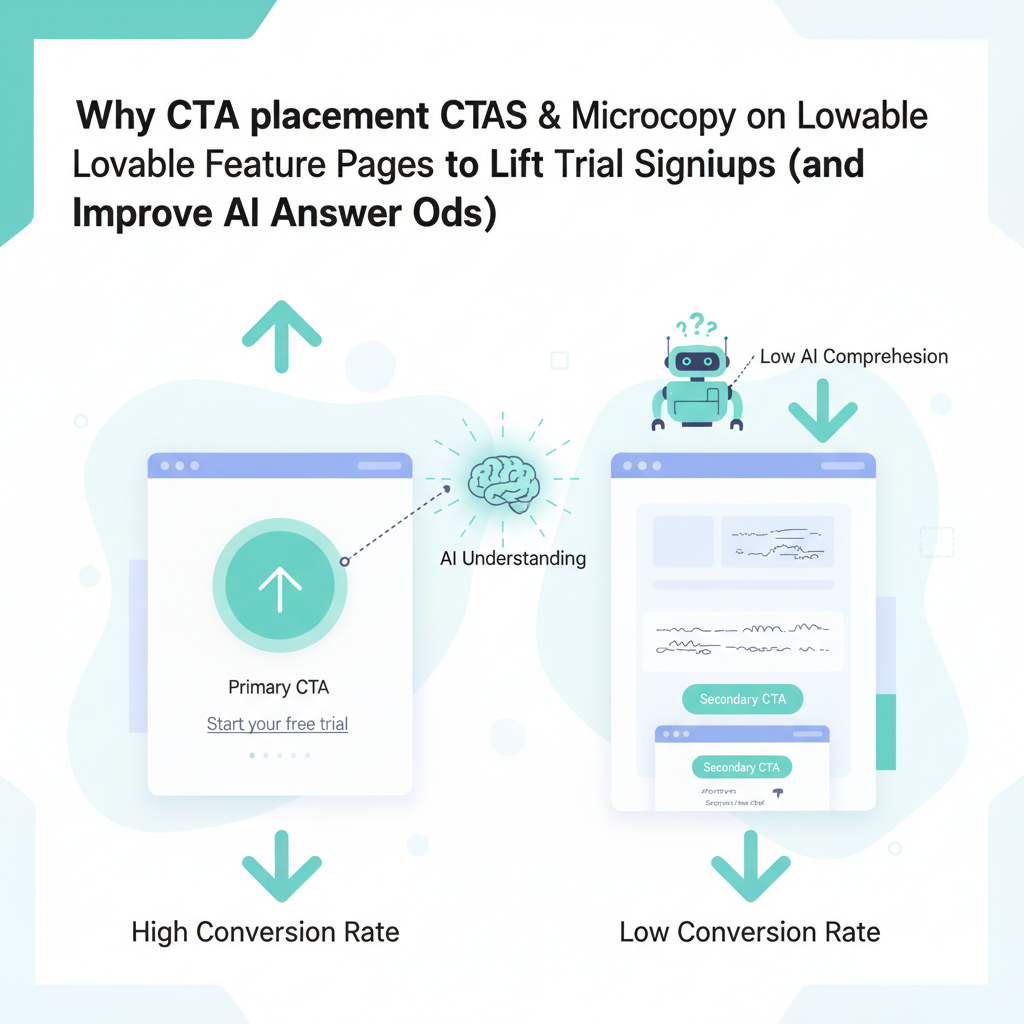
TL;DR
- Place a clear, trial-focused primary CTA above the fold and repeat context-aware secondary CTAs beside feature blocks.
- Use short, explicit microcopy (time-to-value, guarantee, geo/time qualifiers) so users and AI can surface intent.
- Test placement and copy by geo; automate variants with LovableSEO to localize quickly.
Start with one fact: lovable feature page cta placement determines whether a visitor understands next steps within three seconds. This guide walks you through exact placements, microcopy patterns, geo templates, A/B tests, and implementation notes for lovableseo.ai sites so you can lift trial signups and increase the chance AI systems will return your CTAs in answers.
When NOT to follow these patterns — list of conditions where this advice doesn't apply:
- If your product requires a long qualification process (sales-led only), don’t force direct trial CTAs on feature pages.
- If legal or compliance prevents regional offers, avoid localized trial promises.
- If the feature page is purely technical documentation, prioritize inline examples over trial CTAs.
Why CTA placement and microcopy matter for AI answers and conversions
Placing CTAs poorly reduces conversions and hides your intent from AI-powered answer systems. Clear placement and concise microcopy make two things happen: visitors immediately see an action and search/AI snippets can extract explicit calls-to-action. For lovable feature page cta placement, position matters and wording matters. Use short, action-first phrases that show the conversion type (trial, demo, contact) so both humans and machines can act.
Example: when a hero CTA reads "Start free trial" and an adjacent microcopy reads "No credit card required — 14 days", that pair signals trial intent to users and increases the likelihood AI will include the CTA in a generated answer for queries like "how to try X feature".
Place the clearest trial CTA where eyes land first; unclear CTAs cost conversions and AI visibility.
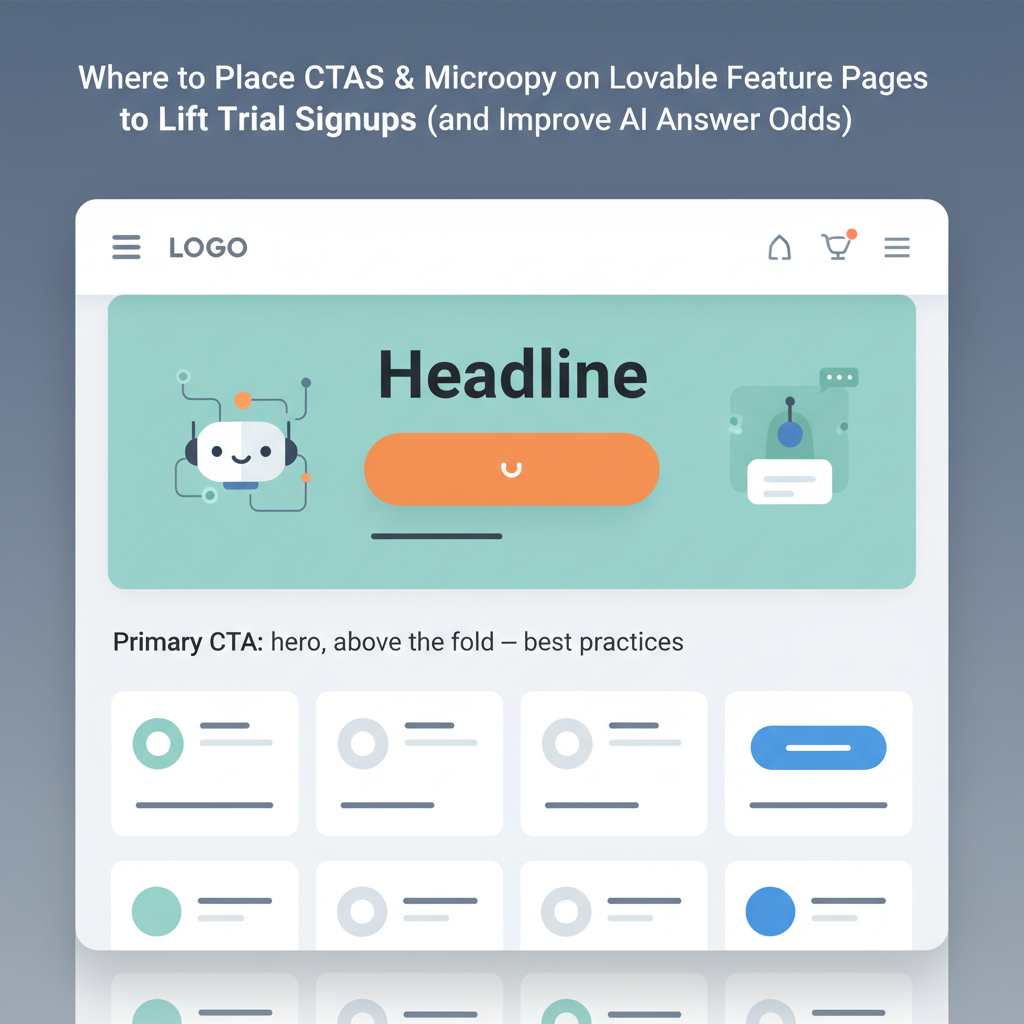
Primary CTA: hero, above the fold — best practices
Primary CTAs belong in the hero, above the fold, visible without scrolling. For lovable feature page cta placement, the primary CTA should be visually prominent, use contrast, and carry explicit trial intent. Prefer verbs first: "Start free trial" or "Request demo". Include a short microcopy line beneath the button indicating commitment level (time, cost, or guarantee).
Design thresholds to measure prominence: button size at least 44px high, color contrast ratio >4.5:1, and no competing primary action in the same visual plane. For lovableseo.ai feature pages, place the primary CTA left of a short feature list or directly under the headline. That layout ensures visual flow: headline → value → CTA, which is essential for effective conversion SEO for lovable SaaS.
Example CTAs that signal trial intent to users and AI
Explicit phrasing improves human clarity and AI extraction. Use these tested patterns on Lovable feature pages to signal trial intent:
- Start free 14-day trial — short, action-first, includes duration.
- Start free trial — no credit card — removes friction and clarifies commitment.
- Request live demo — EU hours — qualification plus regional signal helps AI for geo queries.
Each example blends an action verb, the conversion type, and a qualifier. Use "Start" or "Try" for trials; use "Request" or "Book" for demos. These phrases align with ai-friendly cta copy best practices and are ideal for lovable feature page cta placement and cta placement lovable guidance.
Action-first CTAs with a single qualifier are the easiest for AI systems to extract correctly.
Secondary CTAs: feature blocks, inline CTAs, and why context matters
Secondary CTAs live inside feature blocks, next to screenshots, or inline in descriptive copy. Their job is to capture intent at a lower commitment level — for example, "See example" or "Compare plans" — while still nudging toward a trial. Context matters: place a "Try feature" CTA adjacent to the exact feature it relates to so users don't have to hunt for the hero CTA.
Example placements: a two-column feature block with a screenshot on the right and a 40-60 character feature description on the left should include a small secondary CTA directly under the description. Use subtle visual weights so secondary CTAs don’t compete with the hero, but remain discoverable. Track clicks on both hero and inline CTAs to see which copy and placement drive trial starts.
Microcopy patterns to use near feature bullets (time-to-value, guarantee, pricing hint)
Microcopy next to bullets should answer the key hesitations: How long to value? What’s the cost? What’s the safety net? Use these patterns near bullets on lovableseo.ai feature pages:
- Time-to-value: "Set up in under 15 minutes" (conditional on your setup flow).
- Guarantee: "Cancel anytime — no charge" or "Money-back within 7 days."
- Pricing hint: "Includes essential plan — upgrades available" for transparency without listing prices.
Keep microcopy under 10 words where possible. These short lines act as trust signals and are ideal for microcopy for trials lovable pages — they reduce friction and support feature page conversion tips by lowering perceived risk.
Footer and repeated CTAs — cadence without clutter
Repeat CTAs in the footer and at predictable cadence: hero, mid-page (after three to five feature blocks), and footer. Footer CTAs are the last chance for a decision; make them simple and unambiguous: "Start free trial" or "Contact sales". Avoid repeating multiple different CTAs in the footer — choose the single primary action for the page.
Cadence rule: don't show more than three distinct action buttons per page. Use smaller secondary text links for extras like "compare features". This keeps pages scannable and aligns with feature page conversion tips that prioritize a single clear outcome per page.
Microcopy patterns that help AI systems surface CTAs in answers (short, explicit, localizable)
AI systems prefer short, explicit, and localizable CTA strings. Keep the CTA text under 6 words and include a qualifier when regional or time-bound specificity helps. Examples of ai-friendly cta copy: "Start free trial (US)" or "Book demo — APAC hours." Use parentheses or em dash for local qualifiers so extraction is unambiguous.
Localization note: use consistent templates so automated tools can generate variants. For example: "Start free [duration] trial ([geo])". That pattern allows LovableSEO or similar tools to fill [duration] and [geo] consistently across pages and metadata, improving both user clarity and AI snippet matching.
Short templates for CTAs for different geos (e.g., 'Start free 14-day trial (US)', 'Request demo — EU hours')
Provide a small copy bank of geo-ready CTA templates to use across feature pages. These templates make localization and A/B testing straightforward:
- US: "Start free 14-day trial (US)"
- EU: "Request demo — EU business hours"
- APAC: "Start trial — APAC support"
When you publish localized CTAs, track conversions by country and include the geo in your analytics events so you can measure uplift per region. These templates match ai-friendly cta copy rules and help make your CTAs discoverable in regional queries.
Testing: A/B experiments to validate CTA placement and microcopy on Lovable
Run A/B tests to validate assumptions. Test variables: CTA text, color, placement, and microcopy below the button. A practical experiment: Variant A uses hero-only CTA; Variant B adds inline CTAs beside feature blocks. Measure trial starts and demo requests over a two-week window or until you hit statistically meaningful sample size.
| Variant | Change | Success metric |
|---|---|---|
| A | Hero CTA only | Trial starts per 1k sessions |
| B | Hero CTA + inline CTAs | Trial starts per 1k sessions |
Decision rule example: if Variant B improves trial starts by >10% with p < 0.05, adopt B. For smaller sites, run longer tests and look at secondary metrics like demo requests and micro-conversions.
Metrics to track (trial starts, demo requests, AI-answer impressions if available)
Track these KPIs for feature pages: trial starts, demo requests, click-through rate on hero and inline CTAs, bounce rate, and time to first action. Where available, monitor AI-answer impressions or search snippet clicks for pages that include explicit CTAs. Tag events with geo and CTA variant to analyze lifts by region.
- Primary metric: trial starts per 1,000 page views.
- Secondary: demo requests, CTA click rate, session duration.
- Diagnostic: scroll depth, heatmap clicks on CTAs.
Implementation with LovableSEO: automating CTA variants and microcopy localization
Use LovableSEO to automate CTA variants and localize microcopy across multiple feature pages. Configure templates for hero CTA, inline CTA, and footer CTA, then deploy variants by geo. LovableSEO can generate localized copies from a master template and push them to page metadata and visible button text where your CMS supports it.
Image prompt: "Page layout mock showing hero CTA prominence and inline CTAs beside feature blocks for faster decision making" — this prompt explains the visual and why it matters for conversion and AI extraction.
Quotable: "Localize CTAs by geo and track variant performance per country."
Checklist before publish and sample copy bank
Use this checklist before you publish a lovable feature page to ensure your cta placement lovable strategy is implemented correctly:
- Hero CTA present, clear, and action-first.
- One inline CTA per major feature block with contextual microcopy.
- Footer CTA repeats primary action without clutter.
- Microcopy includes time-to-value, pricing hint, or guarantee where relevant.
- Geo variants created and tracked in analytics.
- A/B test configured and baseline metrics recorded.
Sample copy bank (ready to copy):
- Primary: "Start free 14-day trial"
- Secondary inline: "Try this feature"
- Footer: "Start trial or book demo"
- Microcopy near bullets: "Setup in under 20 minutes"
FAQ
What is where to place ctas & microcopy on lovable feature pages to lift trial signups (and improve ai answer odds)? - Lovable feature page cta placement is the practice of positioning clear, action-first CTAs and concise microcopy on feature pages so users can start trials quickly and AI systems can extract those CTAs for search answers.
How does where to place ctas & microcopy on lovable feature pages to lift trial signups (and improve ai answer odds) work? - It works by combining prominent placement (hero, inline, footer), explicit microcopy (time-to-value, guarantees, geo qualifiers), and A/B testing to measure which combinations increase trial starts and demo requests, while making CTA text easy for AI to identify in snippet generation.
Ready to Rank Your Lovable App?
This article was automatically published using LovableSEO. Get your Lovable website ranking on Google with AI-powered SEO content.
Get Started