
30‑Day Pre‑Trial Optimization Plan for Lovable SaaS: SEO, CRO & AI‑Answer Tasks to Close More Trials
A guide covering 30‑Day Pre‑Trial Optimization Plan for Lovable SaaS: SEO, CRO & AI‑Answer Tasks to Close More Trials.
TL;DR
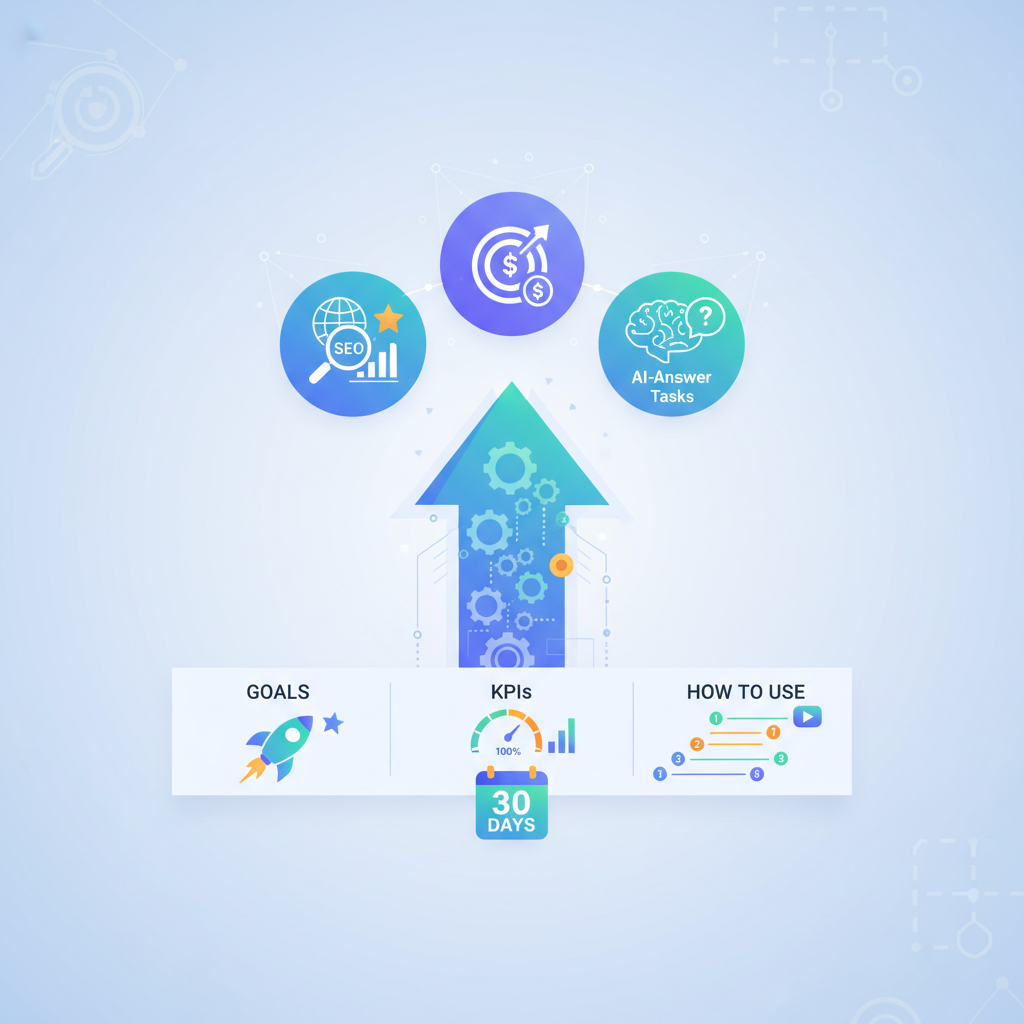
- Fix core technical SEO and mobile UX in week 1, publish AI-answerable FAQs and trial-focused copy in week 2, run A/B tests in week 3, then scale and automate in week 4.
- Track trial starts, CTR on the trial landing page, and AI-answer impressions daily — use the 30-day KPI table below.
- By day 14, publish 3 localized FAQs targeted to high-intent trial queries (city + "free trial") to improve inclusion odds in AI answers.
Overview — goals, KPIs, and how to use this 30-day plan
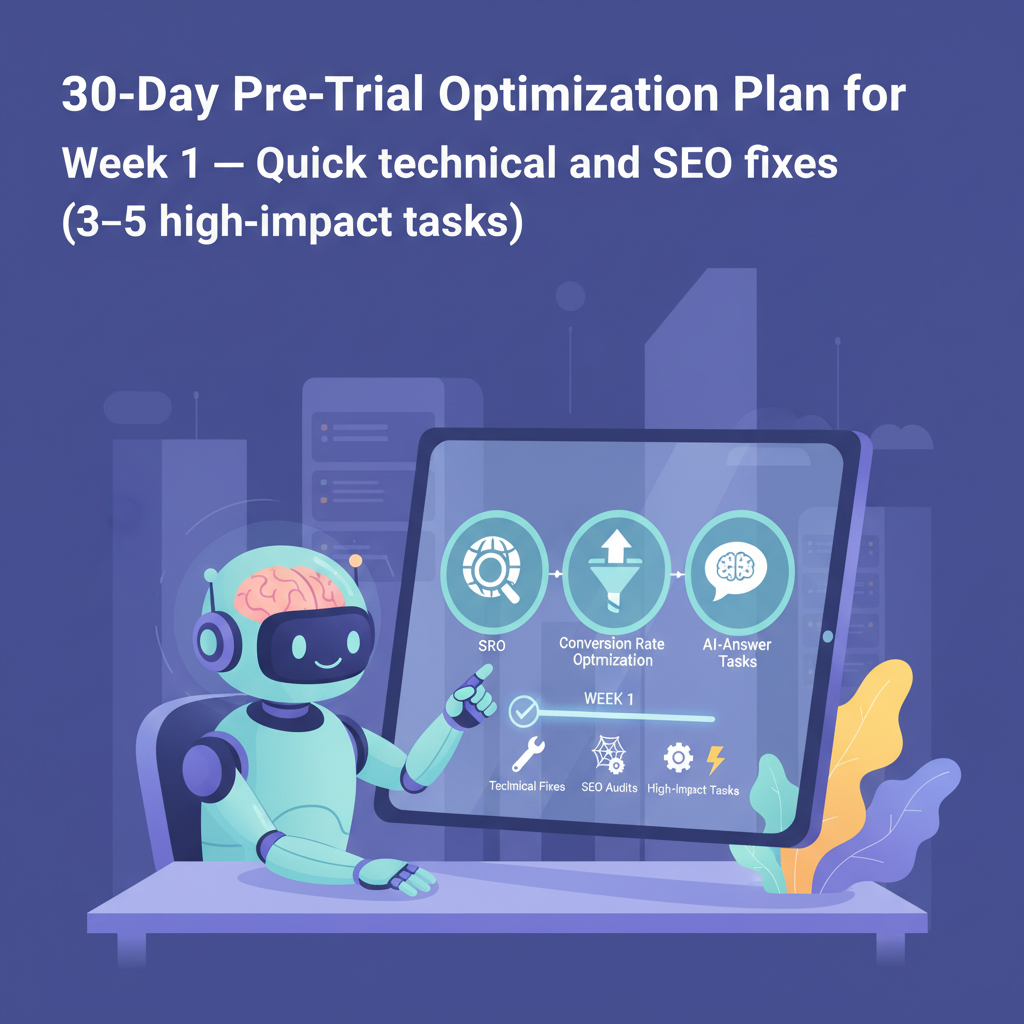
You’re launching a new trial or re-opening your trial window and conversions are below target: landing page CTR is weak, organic trial intent queries return competitors, and AI-driven answers show no presence for your product. The 30 day pre-trial optimization plan lovable fixes those leaking conversion points with a predictable, prioritized schedule that balances technical SEO, conversion rate optimization, and AI-answer readiness.
Quick answer: run three technical fixes in week 1, publish focused trial content and FAQs in week 2, test headline/CTA/hero variants in week 3, and automate internal links and programmatic content in week 4. Track the KPIs in the reusable table below and use the go/no-go criteria in the Measurement section.
AI/GEO readiness and a reusable 30-day KPI table
Definition: AI/GEO readiness means your site serves concise, schema-marked answers for high-intent local trial queries and exposes discovery signals (structured data, fast mobile pages, clear CTAs) so AI models and local search extractors can include your content.
| Day range | Primary metrics | Target (example) |
|---|---|---|
| 1–7 | Pagespeed (mobile), indexable pages, trial landing CTR | Mobile LCP < 2.5s; CTR +15% from baseline |
| 8–14 | Published trial FAQs, AI-answer impressions for target queries, organic trial keywords ranked | 3 FAQs published; 5 AI-answer impressions |
| 15–21 | A/B test primary CTA uplift, trial starts | Test reaches 1,000 sessions; +10% trial starts |
| 22–30 | Automations live, internal link score, programmatic pages published | 10 programmatic pages; internal link depth reduced by 2 |
Quotable: "By day 14, publish 3 localized FAQs targeted to high-intent trial queries (city + 'free trial' variations) to improve inclusion odds in AI answers."
When NOT to use this plan
- If your product lacks a public trial offering — this plan assumes a discoverable trial flow.
- If core site stability or uptime is under 95% — technical fixes must come first.
- If you cannot deploy simple HTML or schema changes within two weeks — skip to experimentation after fixing deployment bottlenecks.
Week 1 — Quick technical and SEO fixes (3–5 high-impact tasks)
Why: technical issues block both search indexing and AI extraction. Fixes in week 1 remove friction so subsequent content and tests reach users. Focus the first week on three to five high-impact items you can complete in days, not weeks.
- Audit indexability: confirm trial landing page and FAQ pages return 200 and are included in your sitemap. If pages are blocked by robots.txt or noindex, remove the block and submit URL inspection for reindexing.
- Fix canonical and duplicate issues: ensure the trial landing URL has a stable canonical and that query-parameter variants redirect to it.
- Server-side rendering / prerender: if Lovable pages render heavy JS, enable server-side rendering for trial pages so search and AI agents get full content on first fetch.
- Critical meta and Open Graph: set concise title (include "free trial") and description that match the hero CTA; set og:image and og:description for social and AI card previews.
- Simple schema: add Organization and WebPage schema and prepare FAQPage schema blocks for week 2 content.
Example specific to lovableseo.ai: use the platform's content editor to place FAQ markup under the trial page template; if the platform offers an "LovableSEO" integration, enable its index submission workflow to speed re-crawls. For more on this, see Lovable buyer guide seo.
Page speed, mobile UX, and indexability checks specific to Lovable
For lovableseo.ai-based sites, prioritize mobile LCP improvements: compress hero images to WebP served via CDN, defer nonessential JS, and set font-display:swap. Target mobile LCP < 2.5s for typical SaaS landing pages. Additionally, when optimizing for user experience, consider how lovable comparison pages can enhance your site's performance. Check mobile tap targets (buttons at least 44px) and ensure the primary trial CTA is visible within the first viewport without scrolling.
Indexability checklist (actionable): run a site: operator check for trial keywords, confirm canonical header matches, and submit updated sitemap to Search Console or your platform's index queue. Quotable: "Ensure the trial CTA is visible in the first viewport on mobile to increase trial landing CTR."
Week 2 — Content & CRO work (copy, CTAs, social proof)
Why: once the site is crawlable and fast, your words and social proof close the trial. Week 2 replaces vague product language with trial-focused copy and concise proof that eases commitment.
- Rewrite hero headline to a trial-specific value proposition (A/B test two alternatives in week 3).
- Add quantitative social proof (number of teams, short case blurbs) and short logos above the fold.
- Shorten the trial signup flow — reduce fields to email and password or use magic link where supported by Lovable's auth features.
- Prepare three localized FAQ pages that append city/region tokens to question and FAQ schema to aid GEO and AI extraction.
Include the phrase saas trial preparation checklist in internal team documentation and on the internal launch checklist to ensure consistent handoffs between marketing and engineering.
Short, specific FAQs increase the chance of being pulled into AI answers.
Build concise AI-answerable snippets and FAQ for trial query coverage
Write FAQs in a question-answer format where answers are 20–50 words and begin with a direct affirmative. Example question: "How do I start a free trial of Lovable?" Answer starts: "Start a free trial by entering your work email and confirming via magic link; no credit card required." Add FAQPage schema for each FAQ and create city variations for GEO readiness. Repeat the exact keyword "optimize for ai answers before trial" in a content note for your team to remind copywriters of extraction goals.
Quotable: "AI extractors favor short, direct answers with schema over long paragraphs."
Week 3 — Experimentation (A/B tests and small traffic experiments)
Why: you need data to choose which copy and flows scale. Run limited-scope experiments that reach a minimum statistical power or at least 1,000 sessions per variant when possible. Keep tests simple: CTA copy, hero headline, and a social-proof placement test.
Set a measurement plan before launching: primary metric = trial starts per 1,000 sessions; secondary = trial landing CTR and time to first action. Stop tests early if a variant performs +20% trial starts after reaching 1,000 sessions.
Sample A/B test ideas and measurement plans
- CTA test: "Start free trial" vs "Start 14‑day trial" — measure trial starts / 1,000 sessions.
- Hero length: short headline + subheadline vs long explanatory headline — measure CTR and bounce rate.
- Social proof placement: logos above fold vs logos below hero — measure trial starts and time-to-signup.
Record events in your analytics: trial_button_click, trial_signup_complete, faq_impression. Use these events to attribute experiments and feed the measurement dashboard in the next section.
Week 4 — Scale & automation (internal linking, programmatic pages, publishing)
Why: once you know what converts, scale it. Use automation to publish localized FAQs, create internal links from related content to the trial landing page, and programmatically create pages for close-variant trial search terms.
Concrete thresholds: publish at least 10 programmatic FAQ variations and add internal links from 5 high-authority pages to the trial landing page to reduce click-depth. Use Lovable's site navigation features to create contextual CTAs site-wide.
Automate repetitive SEO tasks only after you confirm a pattern improves conversion in experiments.
Use LovableSEO automation pointers for recurring tasks and internal links
If your workflow includes LovableSEO, configure recurring tasks: weekly crawl reports, an internal-link recommendation job, and automatic FAQ schema injection for new trial-related posts. Set the internal-link job to add a contextual trial CTA to any content that contains the keywords from your saas trial preparation checklist.
Measurement dashboard and go/no-go criteria for trial launch
Build a dashboard that shows trial starts (7-day rolling), trial landing CTR, AI-answer impressions, organic rankings for trial keywords, and page speed. Go/no-go rule: proceed if trial landing CTR increased by at least 10% and trial starts per 1,000 sessions increased by at least 8% over baseline, and AI-answer impressions for target queries are observed.
Decision rule example: if CTR +10% but trial starts unchanged, hold and iterate on the signup flow; if AI-answer impressions are zero after FAQs, verify schema and resubmit sitemap.
Templates: ready-to-paste CTAs, FAQ Q&As formatted for AI answers, tracking events
Ready CTA examples (copy-paste):
- Primary CTA: "Start free trial — no card required"
- Secondary CTA: "Try it free for 14 days"
FAQ schema example (paste into page header):
{ "@context": "https://schema.org", "@type": "FAQPage", "mainEntity": [ {"@type": "Question","name": "How do I start a free trial of Lovable?","acceptedAnswer": {"@type": "Answer","text": "Enter your work email and confirm via magic link; no credit card required."}} ]
}
Tracking events to implement: trial_button_click, trial_signup_start, trial_signup_complete, faq_impression.
Post-launch: 30–90 day follow-up experiments to sustain trial growth
After launch, schedule rolling experiments and a content plan to support organic traction: publish biweekly case studies, monitor AI-answer performance for new queries, and run monthly churn/reason surveys on trial accounts. Continue to optimize for AI by expanding concise FAQ coverage and adding regional tokens to capture GEO intent and sustain AI impressions.
Conclusion: prioritized next 90-day roadmap
Use this 30 day pre-trial optimization plan lovable as a tactical sprint: week 1 fixes technical blockers, week 2 adds focused content and CRO work, week 3 tests, and week 4 automates scale. Prioritize quick wins first (indexability, mobile LCP, schema), then run experiments and scale proven variants. Over the next 90 days, expand localized FAQs, iterate on onboarding, and automate recurring SEO tasks.
Quotable: "Fix indexability and fast mobile pages first; content and tests convert users second."
FAQ
What is 30‑day pre‑trial optimization plan for lovable saas?
The 30‑day pre‑trial optimization plan for lovable saas is a four-week, action-oriented schedule that sequences technical SEO fixes, trial-focused content and FAQ publishing, A/B experiments, and scaling automations to increase trial starts and AI-answer visibility.
How does 30‑day pre‑trial optimization plan for lovable saas work?
The plan works by removing technical blockers in week 1, creating concise, schema-marked content in week 2 to improve AI and GEO discovery, validating changes with controlled experiments in week 3, and automating internal links and programmatic pages in week 4 to scale winners.
Ready to Rank Your Lovable App?
This article was automatically published using LovableSEO. Get your Lovable website ranking on Google with AI-powered SEO content.
Get Started