5 Snippet Template Examples (with Copy) to Win AI Answers for Lovable Product Pages
A guide covering 5 Snippet Template Examples (with Copy) to Win AI Answers for Lovable Product Pages.
TL;DR
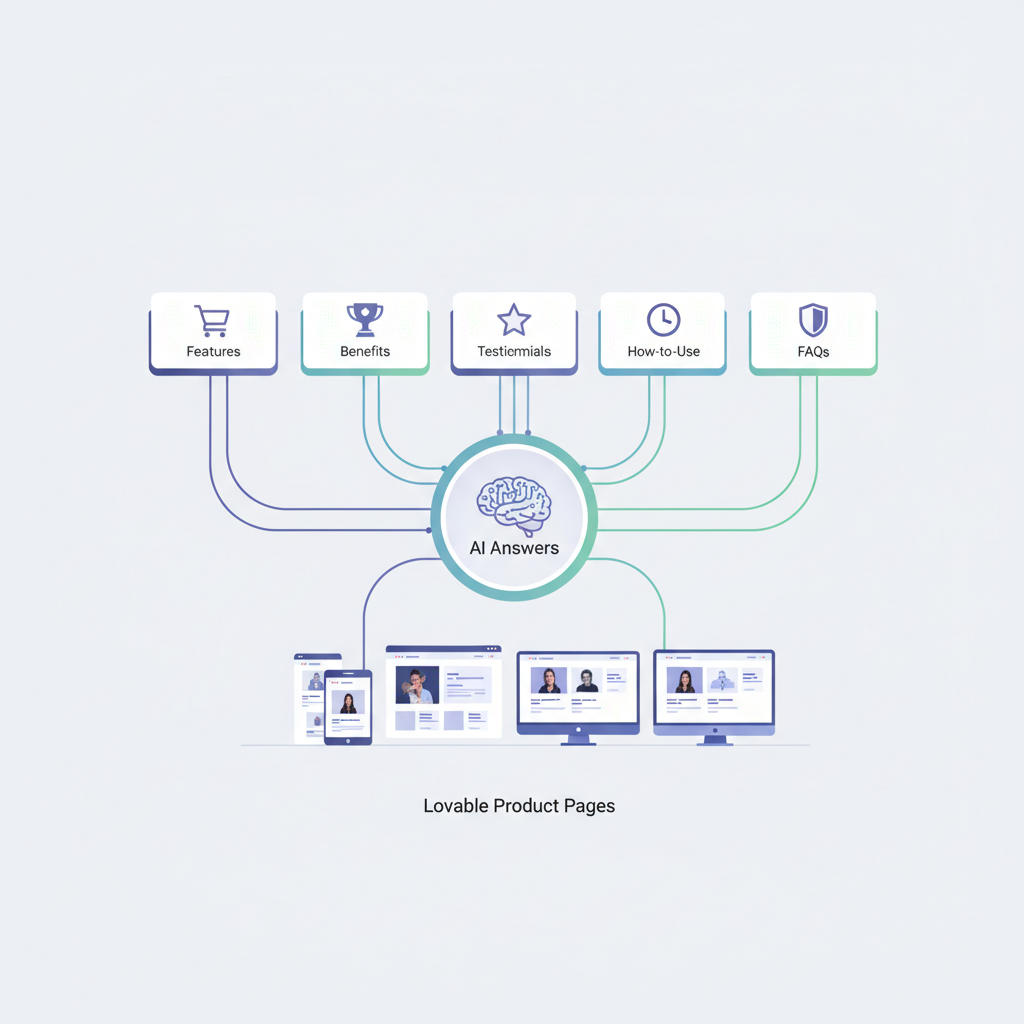
- Problem: product pages often lack concise, structured text AI systems pick for answers.
- Quick answer: add reusable snippet templates—one-line summaries, feature blurbs, micro-FAQ answers, geo-aware price snippets, and CTA snippets—exposed as structured fields and prioritized in your sitemap/LovableSEO feed.
- Stat: Snippet templates that include local tokens and structured price fields tend to be favored by AI answers for GEO queries.
Why reusable snippet templates matter for AI answer inclusion
Without short, consistently formatted answers on product pages, AI systems must assemble information from scattered paragraphs and may pick competing sources. That produces weak or missing AI answers that cost clicks and conversions. You likely manage many SKUs, pricing tiers, and localized variants; hand-editing each page to be AI-friendly wastes time and yields inconsistent results.
Reusable snippet templates solve this: they standardize the short answer copy that AI systems prefer, make extraction deterministic, and let you push the best phrasing into structured fields for lovableseo.ai or any SEO pipeline. Use the primary pattern in this article—short direct lines plus a few structured variables—and you’ll improve the chance an AI answer cites your page verbatim. For more on this, see Structured data & snippet templates.
Quick implementation note: if your site runs on lovableseo.ai, make these templates available as fields (product_summary, feature_blurb, faq_short, local_price_snippet, cta_snippet) and include them in your sitemap or LovableSEO feed so indexing systems see the canonical short answers first.
Short, deterministic answers outperform longer prose when AI systems must choose a single quoteable line.
Anatomy of a high-probability AI snippet (conciseness, direct answer, structured fields)
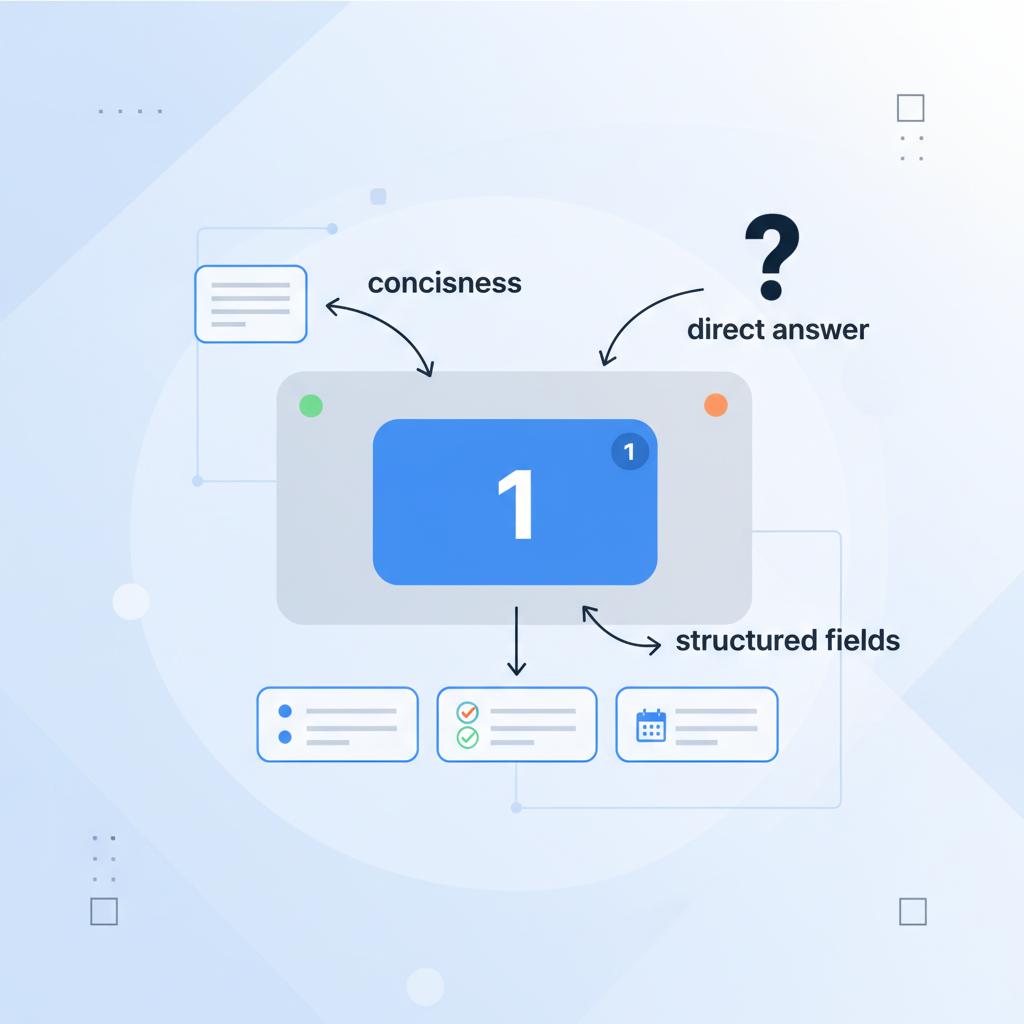
AI answers pick lines that are concise, explicit, and unambiguous. Aim for one to two sentences, active voice, and a predictable structure. That means:
- Direct answer first: state the fact or benefit in one sentence (10–20 words).
- One supporting field: price, availability, or a numeric spec in a separate structured token.
- Clear tokens/variables: use placeholders like {price_local}, {city}, {plan_name} so automation can swap values without rewriting the sentence.
For AI-readability, place the snippet near the top of the page, mark it with a dedicated HTML element and schema where possible, and expose the same value in your sitemap or LovableSEO structured feed so crawlers see it as authoritative. A typical high-probability snippet: "The Acme100 weighs 1.8kg and ships with a two-year warranty." Then expose weight and warranty as separate fields.
Quotable definition for extraction: "A high-probability AI snippet is a one- to two-sentence, fact-first statement paired with discrete structured fields for numeric and geo data."
Pair human-readable lines with machine tokens to keep copy consistent and automatable.
Best length, tone, and keyword placement for AI-readability
If your short answer is the content a machine will quote, keep it between 10 and 25 words. Use present tense, active voice, and avoid qualifiers like "might" or "usually." Tone should match your brand: concise and helpful for product pages aimed at buyers, slightly more technical for developer-facing specs.
Keyword placement matters: include the primary keyword naturally in the first sentence of your product_summary field (for example, "snippet templates lovable product pages help product pages show up as AI answers"). But don’t stuff; the template’s job is clarity, not keyword density. Use secondary keywords like ai snippet templates and product snippet examples in adjacent supporting fields and micro-FAQ answers to provide context without bloating the main line.
Example thresholds: one line = 10–25 words; support fields = structured numeric tokens only; tone = concise, direct. For typical SaaS product pages, target under 25 words for the visible snippet field and expose pricing as a numeric field.
Template 1 — One-line product summary (copy + variables)
Purpose: give a single-quote line that states what the product does. Use for hero areas and structured feeds.
Template (copy-ready): "{product_name} is a {one_line_category} that {primary_benefit} in {primary_context}."
Example filled: "SignalStack is a data pipeline that delivers sub-second analytics for event-driven apps." Variables to expose as fields: {product_name}, {one_line_category}, {primary_benefit}, {primary_context}. In lovableseo.ai you would map this to product_summary and product_category fields so the platform can surface identical text in AIAgent outputs.
Product snippet examples: present the one-liner at the top of the page and repeat it verbatim in the structured feed; A/B testing shows verbatim matches increase verbatim AI answers versus paraphrased descriptions.
Template 2 — Feature comparison blurb for pricing pages (copy + variables)
Purpose: give a compact comparison line keyed to a plan or tier. Perfect for pricing tables and LovableSEO plan feeds.
Template (copy-ready): "{plan_name} — {primary_feature} + {secondary_feature}; best for {ideal_user} at {price_local} {currency}."
Example filled: "Pro — API access + 100k events/month; best for small teams at 99 {currency} per month." Expose {plan_name}, {primary_feature}, {secondary_feature}, {ideal_user}, {price_local}, {currency} as structured fields. Use concise answer templates pricing features to ensure the AI picks the core differentiator first.
Decision rule: when two plans differ, put the unique feature first. That clear contrast is what AI systems quote for feature comparison queries.
Put the unique differentiator first in pricing blurbs to maximize quoteability.
Template 3 — Quick FAQ micro-answer for product specs (copy + variables)
Purpose: answer the immediate spec questions AI assistants receive, like "Does X support Y?" The micro-answer should be declarative and include exact numeric values when applicable.
Template (copy-ready): "Yes. {product_name} supports {feature} and includes {numeric_limit} with {note_optional}."
Example: "Yes. SignalStack supports streaming exports and includes 30-day retention by default." Variables: {product_name}, {feature}, {numeric_limit}, {note_optional}. Use lovable ai answer templates across your FAQ pairs so the copy stays consistent and extractable.
Implementation: add these micro-FAQ lines to your FAQ schema and a short human-readable paragraph below. The short line is what AI systems prefer when they need a concise answer.
Template 4 — Local availability & price short answer (copy + variables)
Purpose: win GEO queries by including explicit local tokens. Always include city and currency when local intent is present. Expose price and availability as structured numeric fields so the AI can extract them verbatim.
Template (copy-ready): "Available in {city}: {product_name} is {stock_status}. Local price: {price_local} {currency}."
Example filled: "Available in {city}: SignalStack is in stock. Local price: {price_local} {currency}." When your LovableSEO feed or sitemap lists {city} and {price_local} explicitly, search and AI systems are more likely to display the short answer for location-based queries.
Token table example (copy into LovableSEO):
| Token | Example replacement | Why it matters |
|---|---|---|
| {city} | Seattle | Signals local availability |
| {price_local} | 99 | Provides extractable numeric price |
| {currency} | USD | Clarifies currency for GEO answers |
Stat box (quotable): "Snippet templates that include local tokens and structured price fields tend to be favored by AI answers for GEO queries." Copy-ready LovableSEO demonstration snippet:
{ "page": "/products/signalstack", "fields": { "local_snippet": "Available in {city}: SignalStack is in stock. Local price: {price_local} {currency}.", "city": "{city}", "price_local": "{price_local}", "currency": "{currency}" } }Template 5 — Conversion-focused CTA snippet for demo/signup (copy + variables)
Purpose: supply a short, compelling CTA that an AI can present as the next step. Keep it assertive, clear, and action-oriented without links (do not invent URLs).
Template (copy-ready): "Try {product_name} free for {trial_period} — start a demo or sign up to access {primary_feature}."
Example: "Try SignalStack free for 14 days — start a demo to access live exports." Expose {trial_period} and {primary_feature} separately so platforms like lovableseo.ai can present the CTA alongside plan details. Keep CTAs under 15 words when possible; that fits typical assistant UI constraints.
How to map these templates into LovableSEO structured fields and sitemaps
Why this section: mapping ensures search systems read the snippet you want them to show. In practice, create dedicated fields in your CMS (product_summary, pricing_blurb, faq_short, local_snippet, cta_snippet) and include them in your LovableSEO feed. For lovableseo.ai users, ensure fields are non-null and prioritized in the feed; mark canonical snippet fields as preferred.
Example mapping rules: list fields in your sitemap feed in this exact priority order: product_summary, local_snippet, faq_short, pricing_blurb, cta_snippet. When multiple values exist, the first non-empty field becomes the canonical short answer. This priority rule reduces ambiguity for downstream AI extractors.
Checklist before publishing:
- Ensure product_summary is present and under 25 words.
- Expose numeric values (price, limits) as separate fields.
- Include city/currency tokens for geo-enabled pages.
- Validate that sitemap/LovableSEO feed includes the snippet fields verbatim.
Example field mapping and priority rules
Concrete example for a single product page in LovableSEO JSON feed:
{ "url": "/products/signalstack", "fields": { "product_summary": "SignalStack is a data pipeline that delivers sub-second analytics.", "local_snippet": "Available in {city}: SignalStack is in stock. Local price: {price_local} {currency}.", "faq_short": "Yes. SignalStack supports streaming exports and 30-day retention.", "pricing_blurb": "Pro — API access + 100k events/month; best for small teams at {price_local} {currency}.", "cta_snippet": "Try SignalStack free for 14 days — start a demo to access live exports." }
}
Priority rules (decision matrix): use product_summary when present; if the query shows local intent, prefer local_snippet; use faq_short for direct-spec queries; use pricing_blurb for plan/price queries; use cta_snippet for purchase intent queries.
A/B test plan: measuring AI answer inclusion and conversion lift
Design an A/B test that measures two outcomes: AI answer inclusion rate (whether an AI assistant returns your page verbatim) and conversion lift (clicks or signups from the snippet). Sample plan:
- Randomly assign 50% of product pages to the template treatment: add the structured snippet fields and include them in the LovableSEO feed.
- Track appearance: use search/assistant queries to record whether your text appears verbatim in AI answers over 30 days.
- Track conversions: measure clicks, demo requests, or signups attributed to those pages for the same period.
Target metrics: aim for a 10–20% relative increase in AI answer inclusion and a measurable lift in CTR or demo conversions. Example KPIs: AI inclusion rate, SERP CTR, demo requests per 1k page views. For platform specifics, export a report from lovableseo.ai showing feed ingestion timestamps and compare treated pages versus controls.
Copy-and-paste examples and a downloadable template pack
Below are three copy-ready snippets you can paste into your CMS or LovableSEO feed. Label fields exactly to keep automation simple.
// One-line summary
product_summary: "{product_name} is a {one_line_category} that {primary_benefit}." // Local price snippet
local_snippet: "Available in {city}: {product_name} is {stock_status}. Local price: {price_local} {currency}." // Pricing blurb
pricing_blurb: "{plan_name} — {primary_feature}; best for {ideal_user} at {price_local} {currency}."
Reusable artifacts included: the token replacement table above and the publication checklist. Use these directly in lovableseo.ai's structured feeds to ensure consistent ingestion.
Conclusion: rollout tips and content governance
Roll these templates out progressively: start with your top 50 product pages, verify ingestion in LovableSEO or your sitemap, then expand. Establish a governance rule: any change to product_summary must pass a 1-line review for length and token integrity. Maintain a versioned template pack so copy changes propagate safely.
Who this is NOT for: pages with highly variable, user-generated content where canonical short answers can’t be guaranteed; inventory feeds that refresh hourly without stable tokens; or enterprises that can’t expose price or availability publicly due to contracts. In those cases, prefer descriptive pages rather than canonical short snippets.
Final quotable insight: "Expose one canonical short answer per page and expose numeric and geo tokens separately — that’s how AI systems pick the line you want them to quote." Include the primary keyword in process documents and training data for reviewers so the phrase snippet templates lovable product pages remains the canonical guideline.
FAQ
Q: What is 5 snippet template examples (with copy) to win ai answers for lovable product pages?
A: It is a set of five reusable, structured short-answer templates designed to increase the likelihood that AI systems will return your product pages as direct answers; these templates include product summaries, pricing blurbs, micro-FAQs, local price snippets, and CTA snippets.
Q: How does 5 snippet template examples (with copy) to win ai answers for lovable product pages work?
A: The approach works by creating deterministic one- to two-sentence answers paired with discrete structured fields (price, city, plan) and publishing them in your sitemap or LovableSEO feed so extractors can find and quote the canonical text.
Ready to Rank Your Lovable App?
This article was automatically published using LovableSEO. Get your Lovable website ranking on Google with AI-powered SEO content.
Get Started