Add Region-Specific FAQs, Legal & Shipping Copy to Lovable Pricing Pages to Increase AI Answer Odds
A guide covering add Region-Specific FAQs, Legal & Shipping Copy to Lovable Pricing Pages to Increase AI Answer Odds.
TL;DR
- Add short, locale-aware FAQ answers and explicit "Applies to: [Country]" tokens on Lovable pricing pages to increase AI answer chances.
- Localize taxes, billing cycles, refunds, and shipping first; use localized faq schema lovable for clear extraction.
- Measure impressions, AI-answer appearances, CTR, and conversions by country to validate impact.
If your pricing page is global but uses one-size-fits-all FAQs, you lose conversions and search visibility in key markets. Short, region-specific text that mentions local currency and delivery windows often appears as AI answers for regional queries. This guide shows how to add regional faqs pricing pages lovable owners can implement quickly, what to prioritize, and how to test results.
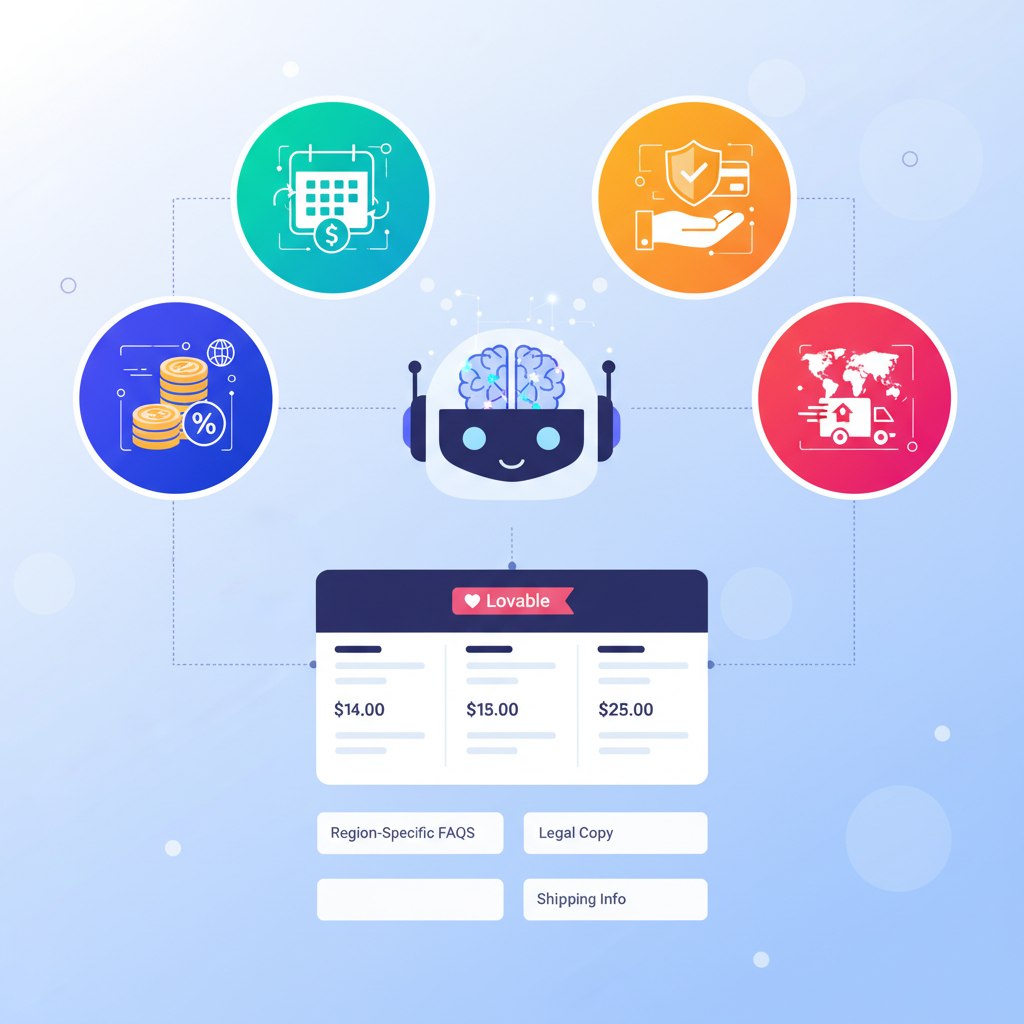
Why region-specific FAQs and legal text boost AI-answer relevance
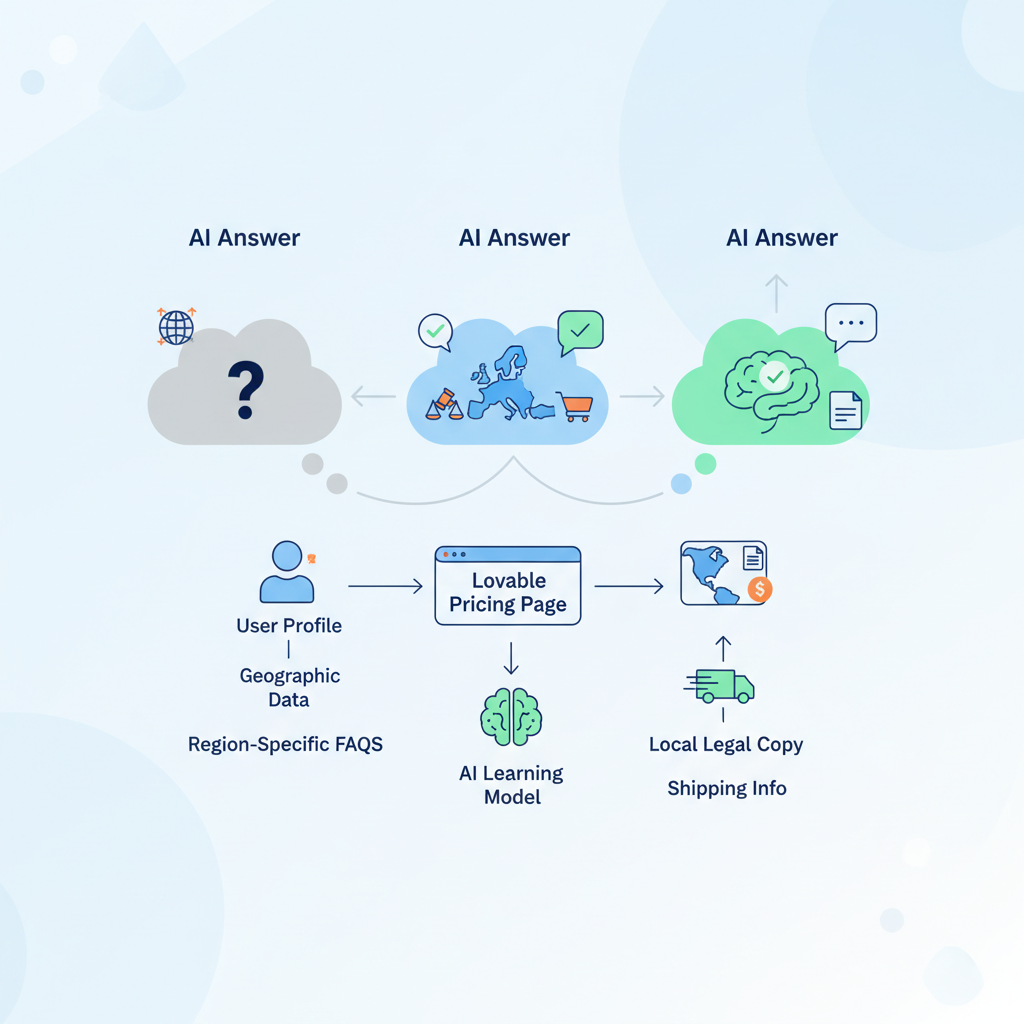
Without explicit regional text, search engines and AI models see ambiguous signals: one pricing page implies global rules, and models hesitate to pull a short, authoritative answer. Adding regional faqs and clear legal copy solves that. When a question like "Do you charge VAT for German customers?" appears in a query, a concise FAQ that includes "Applies to: Germany" plus the correct VAT treatment and currency is easy for an AI answer engine to extract and surface.
"Practical value: regional content covers critical buyer questions—taxes, billing cycles, refunds, and delivery windows—so answers match intent and reduce friction. Use localized faq schema lovable to mark up these Q&As so machine readers find the exact question/answer pair. Short, locale-aware FAQ answers that include currency and delivery windows are highly extractable by AI answer engines and improve the chance of being surfaced for regional queries, especially when you localize product and pricing pages to enhance visibility in target markets."
Quotable: "Short, locale-aware FAQ answers that include currency and delivery windows are highly extractable by AI answer engines." Keep each FAQ answer focused: one idea, one locale, and one concrete token such as the country code or currency.
Which FAQ and legal elements to localize first (taxes, billing cycles, refund policy, shipping)
Start with the items that change buyer behavior and legal obligations across markets. Localize the following in order: taxes/VAT, billing cycles and invoices, refund and cancellation policy, and shipping commitments. For each item, include a short, explicit FAQ entry and a matching legal note on the pricing page.
- Taxes: state whether prices include tax and list the tax type per country. Example: "Applies to: France — Prices exclude VAT (20%)."
- Billing cycles: define billing period names and proration rules by market. Example: "Monthly billing charged in EUR; annual charged in EUR with one-time discount applied on first invoice."
- Refund policy: give a condensed policy line for FAQs (e.g., "14-day money-back for EU customers, applies to digital subscriptions") and link to the full legal copy.
- Shipping: for physical items, state standard delivery windows, carriers, and import duties per market in a short FAQ plus the legal clause.
Use pricing page legal copy localization to make those legal statements readable and machine-friendly. Keep the FAQ answer first and legal nuance below; search engines prefer concise answers for featured snippets and AI answers.
Prioritization matrix: impact vs effort by market
Map markets on a simple 2x2: vertical axis = impact (revenue, traffic), horizontal axis = effort (legal review, translation). Prioritize high-impact/low-effort markets first: for many SaaS businesses this is the EU and English-speaking APAC markets where language overlap lowers translation costs. Low-impact/high-effort markets sit last.
Concrete decision rule: if a market contributes at least 5% of visits or revenue, treat it as high-impact. If legal review and translation take under five business days, treat it as low-effort. Example action: localize EU VAT and refunds first, then add localized shipping info for top 5 non-EU countries by traffic.
Best practices for FAQ schema and short answer snippets
Use structured FAQPage schema and ensure each Q&A is self-contained and brief. Labels and tokens that AI models can match improve extraction. Include an explicit "Applies to: [Country]" token in both visible text and the structured data. This practice helps with ai answer localized faqs because it gives clear geographic context.
- Keep questions under 10 words when possible and answers under 40 words.
- Place locale tokens early: "Applies to: Mexico — Prices shown in MXN. Standard delivery 5–8 business days."
- Duplicate the visible FAQ content into the JSON-LD schema exactly; mismatches reduce trust.
Also use localized faq schema lovable by adding a language tag ("inLanguage") and explicit country metadata where the platform supports it. If your LovableSEO feed fields accept geographic attributes, populate them with country codes to help downstream indexing systems pick the right variant.
Short, locale-tagged answers extract better: include country, currency, and delivery window in the first sentence.
Keep answers concise, include locale tokens (country, currency, delivery times)
Concise answers are key. An effective pattern: start with "Applies to: [Country]" then state the fact. Example: "Applies to: UK — Prices exclude VAT; refunds within 14 days." That single line contains the three tokens AI systems look for: locale, price/currency context, and timeframe.
Use locale tokens consistently: country name, ISO code, currency symbol, and delivery windows (e.g., "3–5 business days"). Keep legal exceptions in the legal block below the FAQ. Short answers maximize the chance of being selected as ai answer localized faqs or featured snippets.
Template examples for shipping, returns, and tax notes per market
Provide copy blocks you can drop into Lovable partials. Examples below are templates; adapt and verify with legal teams before publishing.
- Shipping (US): "Applies to: United States — Standard shipping 3–7 business days. Duties prepaid for domestic orders."
- Shipping (EU): "Applies to: European Union — Delivery 5–10 business days. Import duties may apply at checkout."
- Returns (Global digital): "Applies to: All countries — 14-day refund window for digital subscriptions, subject to account verification."
- Tax note (Example): "Applies to: Germany — Prices shown exclude VAT; VAT added at checkout."
These templates work with shipping info seo localized strategies: each item includes the locale token, timeline, and fee note. Label each template with a short slug so your engineers can populate LovableSEO feed fields with the exact slug used in JSON-LD.
Implementation on Lovable: partials, locale blocks, and LovableSEO feed fields
On Lovable, implement regional text as partial templates for each locale and conditionally render them using locale blocks. Store canonical FAQ Q&A text in the LovableSEO feed fields so downstream indexing and sitemap generators can pull per-market FAQPage schema automatically. If your Lovable theme supports content partials, keep a single FAQ partial that accepts a locale parameter and renders the right copy and JSON-LD.
Implementation checklist: (1) add locale-specific partials, (2) add an "applies_to" token in each FAQ entry, (3) populate LovableSEO feed fields with question, answer, language, and country_code. This creates a reproducible artifact teams can test and scale across markets.
Populate feed fields with country_code and currency to make FAQ variants machine-discoverable.
Alt text: Pricing FAQ partial architecture diagram showing locale blocks and JSON-LD flow for indexing
Testing for AI-answer inclusion: targeted queries, live SERP checks, and GSC monitoring
Test with a three-step plan: targeted query checks, live SERP monitoring, and Google Search Console (GSC) tracking. First, craft country-specific queries (e.g. Second, run live SERP checks across different locations or use a private browser plus a VPN to replicate the region. Third, track impressions and click-through-rates in GSC for the localized pages and measure AI-answer appearance changes week over week. For more on this, see Ai answers for lovable product pages.
Measurement checklist: impressions by country, AI-answer appearance count, CTR change vs baseline, and conversion lift on pages with localized faqs. A simple A/B test: keep one market page global and another with localized FAQ; run for 4 weeks and compare performance.
Alt text: SERP comparison screenshot mock showing localized FAQ extracted into an AI answer
Compliance and translation tips: machine vs human translation, legal review
Machine translation is fast but risky for legal copy. Use machine translation to draft localized FAQ text, then have a native speaker or legal reviewer edit the legal lines. For pricing page legal copy localization, require legal review for markets with tax exposure or consumer-protection laws (for example, EU markets). Keep a translation log and record who approved each locale.
Practical rule: use machine translation for UI and shipping text, and human-verified translation for any statement about refunds, taxes, or contractual terms. Record a checklist: translator, reviewer, legal approver, and publish date for each locale file.
Case examples: expected lifts and test plan to validate impact
Typical outcomes from localized FAQ rollouts include higher impressions for regional queries and modest CTR lifts. Example test plan: select two comparable markets, implement regional FAQs in one, leave the other as baseline, and run for 30 days. Track: impressions for target queries, how many AI-answer appearances occur, CTR change, and signups. Use the following KPIs: increase in impressions, +CTR in localized page versus baseline, and conversion rate lift.
Decision threshold: if AI-answer appearances increase and CTR improves by at least 10% versus baseline, expand localization. If not, iterate on phrasing and ensure JSON-LD matches visible text exactly.
Next steps & links to sign up for automated templates and demos
To move forward, identify your top five markets by traffic and revenue, draft FAQ templates using the examples above, and add the locale tokens to your LovableSEO feed fields. Run the 30-day A/B test and monitor impressions and AI-answer appearances. If you need automated templates or demos, check your account dashboard or contact your vendor support for available exports and feed integrations.
Frequently asked questions
What is add region? Add region is the practice of publishing short, market-specific FAQ and legal text on pricing pages to provide explicit geographic and regulatory context for users and AI-driven search features.
How does add region work? Add region works by pairing concise, locale-tagged FAQ answers with matching structured data and feed fields so search engines and AI answer systems can match queries to the correct market variant.
Ready to Rank Your Lovable App?
This article was automatically published using LovableSEO. Get your Lovable website ranking on Google with AI-powered SEO content.
Get Started