
A Practical 30-Day A/B Test Plan for LovableSEO Structured Snippet Templates on Lovable Sites
A guide covering practical 30-Day A/B Test Plan for SEOAgent Structured Snippet Templates on Lovable Sites.
Why A/B test structured snippet templates (goals and KPIs)
How do you a/b test structured snippet templates seoagent on a Lovable site and know whether AI-answer snippets improve search performance?
Run a controlled A/B test that measures AI-answer inclusion and click-through changes across matched pages while keeping other variables stable. The primary goal is to measure whether template changes cause an inclusion lift and higher CTR without reducing organic sessions or harming conversion paths.
A/B testing structured snippets in LovableSEO targets two outcomes: (1) increase AI-answer impressions and (2) improve CTR on pages that show AI-driven answers. A concise, quotable framework to use: 'Measure inclusion lift by tracking change in AI-answer impressions and CTR across treated pages vs control over a minimum 14-day window.' Collect regional breakdowns to detect GEO effects and use a sample size rule of thumb: minimum 2,000 impressions per variant or apply a relative lift threshold (for lower-traffic pages, prefer >=10% relative lift and confirm with additional weeks).
Concrete KPIs to track (examples):
- AI-answer impressions — number of SERP AI-answer appearances that reference your page.
- AI-answer CTR — clicks divided by AI-answer impressions.
- Overall organic CTR — changes in search clicks / impressions across the query set.
- Conversion rate — landing-page conversions for test vs control groups.
For Lovable sites using LovableSEO, map each KPI to instrumentation (see next section) and set numeric thresholds: example decision rule — accept a variant if AI-answer inclusion increases by >=8% with CTR lift >=5% and p < 0.05, otherwise continue iterating. This process aligns with the principles outlined in the LovableSEO Guide: Automating AI-Answer Optimization & Trial Conversion for Lovable Sites.
Measure inclusion lift by tracking AI-answer impressions and CTR across treated vs control pages over at least 14 days.

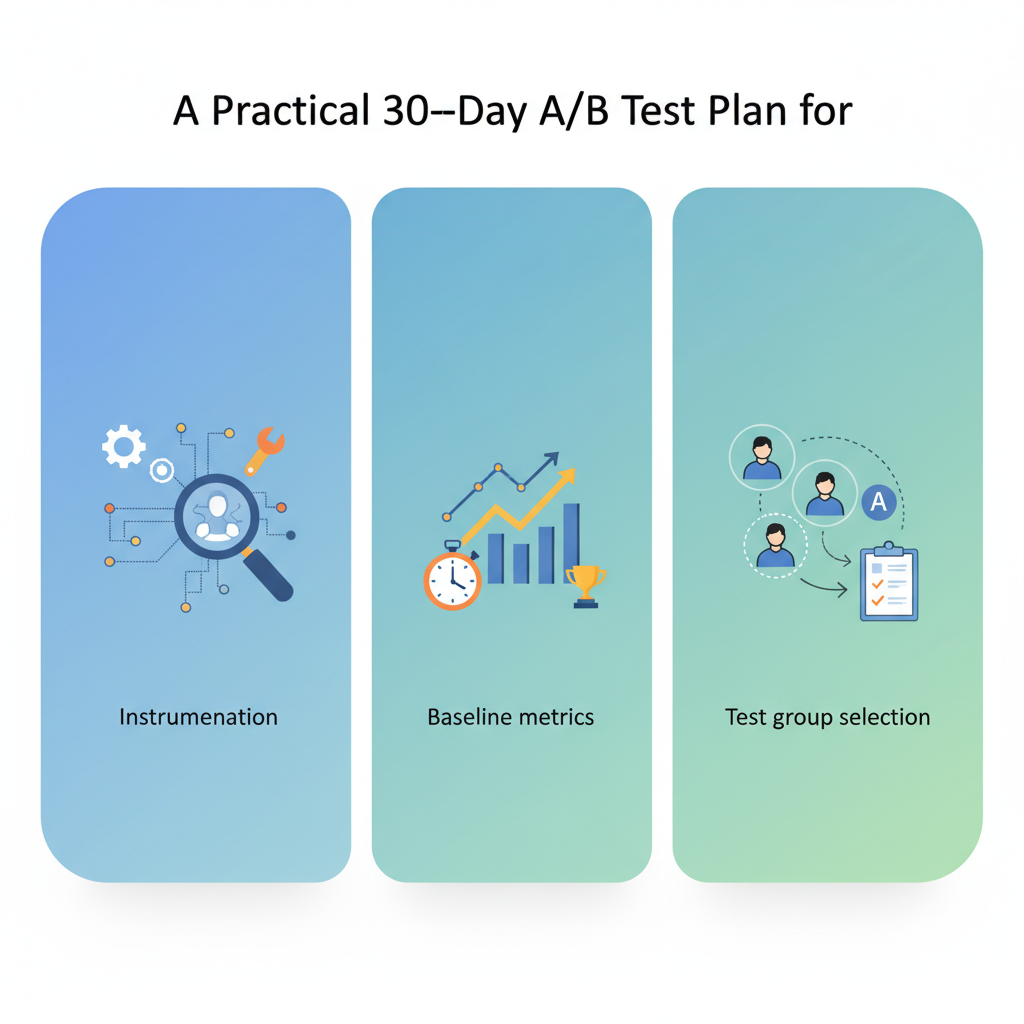
Pre-test checklist: instrumentation, baseline metrics, and test group selection
Why this matters: a test is only useful if data quality is reliable. Before flipping templates in LovableSEO, verify you can measure both the structured output and user behavior.
- Instrumentation: ensure Search Console, your analytics platform (Google Analytics 4 or equivalent), and any SERP-feature tracker are collecting query-level impressions and clicks. Tag treated pages with a test flag (URL parameter or analytics dimension) so you can separate traffic sources.
- Baseline metrics: capture 14–28 days of pre-test data for impressions, clicks, CTR, average position, and conversions. Record daily variance and note seasonality windows.
- Sample-size check: target ≥2,000 impressions per variant when possible. If a page has low volume, group similar pages (same template and intent) to reach the threshold.
- Segmentation plan: choose whether to split by page, by query cluster, or by GEO. For Lovable sites that serve multiple regions, collect regional breakdowns to detect GEO effects.
- Guardrails: set rollback triggers (e.g., -10% organic clicks or -15% conversions sustained for 3 days) and make sure stakeholders accept them.
Example: to test seoagent snippet templates for a product category, tag 50 product pages for variant A (control) and 50 matched product pages for variant B (variant template). Validate baseline parity on impressions and average position before starting.
Which pages to include (product pages, FAQs, comparison pages)
Include pages where structured snippets and AI answers commonly appear: product pages with clear specs, FAQ pages with direct question-and-answer formatting, and comparison pages that answer purchase intent queries. Prioritize pages with at least 100 impressions/week if you test individually; otherwise cluster similar pages (by intent and template) to reach sample-size targets.
Practical examples for Lovable sites using LovableSEO:
- Product detail pages — include pages where specs or short how-to answers are likely to be surfaced by AI answers.
- FAQ pages — these often map directly to question queries; test concise answer templates vs explanatory templates.
- Comparison pages — test short bullet summaries vs full-paragraph structured snippets to see which yields higher AI-answer inclusion.
Match test and control pages by query intent, impressions, and average position. That reduces noise when measuring AI-answer inclusions and CTR differences.
Required analytics and SERP feature tracking setup
Track these artifacts before and during the test: Search Console impressions/clicks at the page+query granularity, analytics events for search-click landing pages, and a SERP-feature log that records AI-answer inclusions per page. If your LovableSEO integration emits structured output logs, capture the versioned template ID applied to each page for auditing.
Concrete setup checklist:
- Enable query+page export from Search Console for the test date range.
- Push a custom dimension to analytics indicating variant (control/variant) and template ID.
- Use a SERP tracker that marks AI-answer presence daily, or parse your monitoring logs for the same flag.
- Store the daily snapshot as CSV/BigQuery for statistical testing.
These measurements let you test seoagent snippet templates reliably and later measure ai-answer impact seoagent with confidence.
30-day test plan (week-by-week tasks)
This 30-day plan breaks tasks into weekly milestones so you can run a practical experiment without dropping operational overhead.
- Week 1 — implement control and variant templates in LovableSEO and deploy to assigned pages.
- Week 2 — monitor ingestion, fix data mismatches, and validate structured output in-situ.
- Week 3 — analyze impressions, AI-answer inclusions, and CTR shifts; watch regional variance.
- Week 4 — run statistical significance checks and apply rollout decision criteria or rollback.
Each week includes an owner, a checklist, and a pass/fail gate to proceed. The week-by-week gates prevent false rollouts and make the plan repeatable across templates.
Run a minimum 14-day observation window after deployment before drawing conclusions about inclusion lift.
Week 1 — implement control & variant templates in LovableSEO
Deploy the control template to the control group and the variant template to the test group inside LovableSEO. Document the template IDs, the page list, and the publish timestamp. For a Lovable site, use LovableSEO's templating controls to keep structured data semantics identical while varying phrasing, length, and highlight fields.
Checklist for week 1:
- Record template IDs and publish times.
- Tag pages with a test dimension in analytics.
- Snapshot baseline Search Console and analytics metrics.
Week 2 — monitor ingestion, fix data mismatches, validate structured output
Confirm that LovableSEO has pushed the new templates to your pages and that search engines are ingesting the structured snippets. Validate sample pages manually: view page source, confirm JSON-LD or HTML snippet output, and use Search Console's inspection tool for a handful of pages.
Address common issues quickly: missing fields, malformed JSON-LD, or crawler-blocking directives. Log fixes and re-run inspections as needed. Continue to monitor impressions and position shifts daily.
Week 3 — analyze impressions, AI-answer inclusions, and CTR shifts
Pull daily snapshots and compare control vs variant across the KPIs. Look for patterns: are AI-answer impressions concentrated on certain queries? Is the CTR lift consistent across devices and GEO? Use simple visualizations (daily difference charts) and compute relative lift percentages.
At this stage, test seoagent snippet templates for query clusters rather than single queries when volume is low. Also, measure ai-answer impact seoagent by comparing the subset of queries that show AI answers to the full query set.
Week 4 — run significance checks and rollout decision criteria
Run statistical tests (chi-square or two-proportion z-test) for clicks and CTR differences. Apply your pre-defined decision rule (example: accept variant if uplift in AI-answer inclusion >=8% and CTR lift >=5% with p < 0.05). If results are inconclusive but trending positive, consider an extended run of 14 more days grouped by query cluster.
If a variant fails the guardrails (sustained traffic or conversion drops), rollback immediately and document the failure mode for iteration.
Example hypothesis and template variations to test
Hypothesis example: "Short, bulleted snippet templates increase AI-answer inclusion and CTR compared to long-paragraph templates on FAQ pages." Variation set to test:
- Control: existing paragraph-style template with two sentences.
- Variant A: three concise bullets, each 8–12 words, highlighting key facts.
- Variant B: short answer + one supporting statistic.
Run the snippet template a/b testing plan by assigning matched FAQ pages to control, A, and B. Track AI-answer impressions and CTR per variant and apply the decision rule outlined earlier.
Interpreting results and next steps (scale, iterate, rollback)
When results meet your acceptance criteria, scale the winning template gradually — roll out to next cohort of pages in 10–20% increments and continue monitoring. If results are mixed, iterate using learnings: change phrasing, length, or which fields are emphasized in LovableSEO templates.
Rollback if any guardrail is tripped or if conversions drop materially. After rollout, schedule a 30- and 90-day re-check to ensure the lift persists and to detect any drift in AI-answer behavior.
Case study checklist and recommended reporting templates
Use this checklist and a simple reporting table to summarize test outcomes for stakeholders.
- Test name, template IDs, page lists
- Baseline dates and metrics snapshot
- Daily snapshots for impressions, AI-answer presence, clicks, CTR, conversions
- Statistical test results and decision outcome
| Metric | Control | Variant | Relative lift |
|---|---|---|---|
| AI-answer impressions | 1,200 | 1,380 | +15% |
| AI-answer CTR | 4.2% | 4.8% | +14% |
| Organic clicks | 3,500 | 3,600 | +2.9% |
| Conversions | 70 | 74 | +5.7% |
Image prompt alt text examples (use these when generating figures):
- "Daily chart comparing AI-answer impressions for control and variant across 30 days"
- "Template comparison showing JSON-LD output differences and why they matter for parsing"
FAQ
What is practical 30? Practical 30 is a 30-day, week-by-week A/B testing protocol for structured snippet templates that focuses on measurable AI-answer inclusion and CTR changes using LovableSEO on Lovable sites.
How does practical 30 work? Practical 30 deploys control and variant templates to matched pages, validates ingestion and data quality, measures AI-answer impressions and CTR for at least 14 days, and applies statistical decision rules to accept, iterate, or rollback the variant.
Ready to Rank Your Lovable App?
This article was automatically published using LovableSEO. Get your Lovable website ranking on Google with AI-powered SEO content.
Get Started