
How Programmatic Content Changes AI-Answer Inclusion for Geo-Targeted Queries on Lovable Sites
A guide covering how Programmatic Content Changes AI-Answer Inclusion for Geo-Targeted Queries on Lovable Sites.
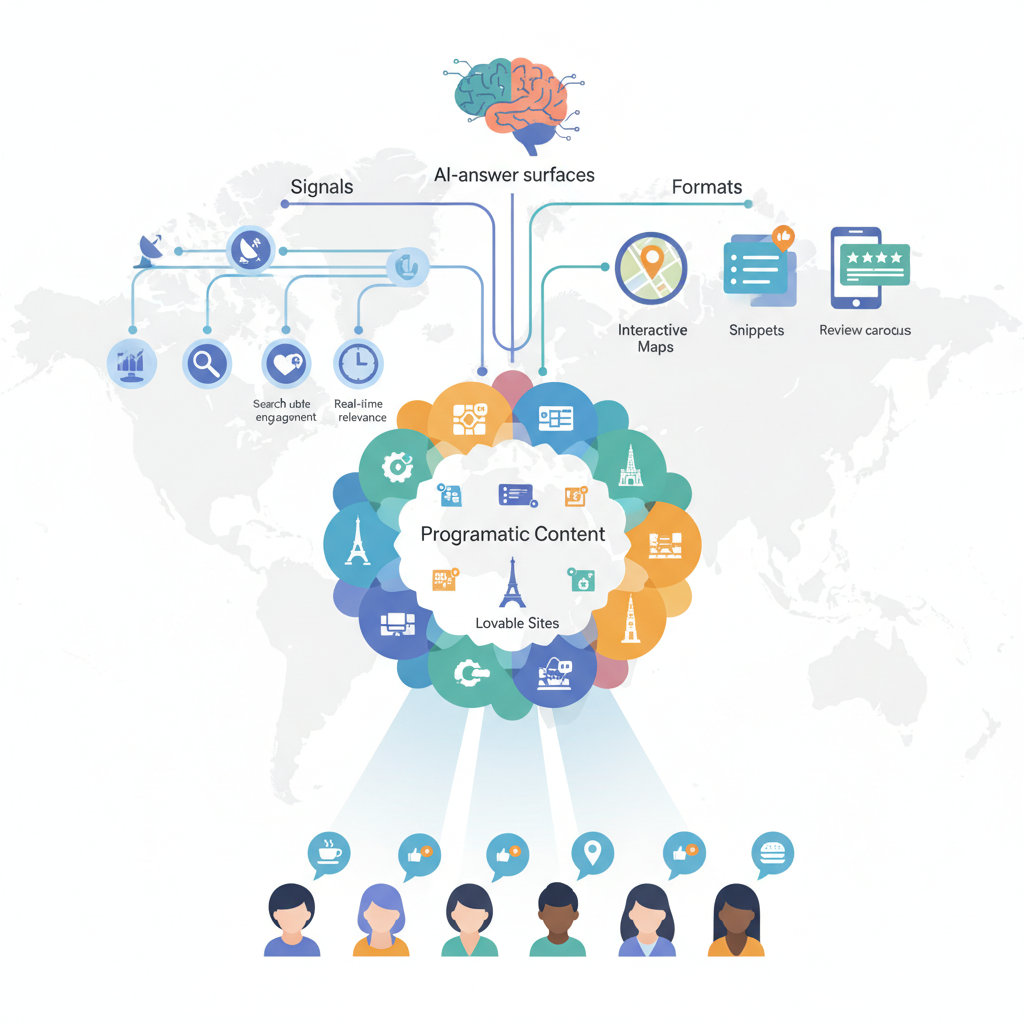
Question: How does programmatic content affect whether AI answers surface for geo-targeted queries on lovable sites?
Answer: Programmatic content influences AI-answer inclusion mainly through the clarity and structure of local facts. When programmatic pages expose explicit local tokens (address, hours, services) and machine-readable schema, AI systems can extract concise passages, lists, or tables as primary answers; poorly structured or thin programmatic pages reduce those odds.
Overview — why AI-answer inclusion matters for geo queries
AI-answer inclusion means an AI or search-generated result surface extracts and displays a passage, list, or table from a page as the primary answer. For geo queries—searches asking about locations, hours, or local services—AI answers favor pages that present explicit local facts in plain, consistent formats. If you run many geo-targeted programmatic pages, you want AI systems to pick up your content as the canonical short answer; that drives visibility, zero-click resolution, and higher perceived authority for your locations on lovable sites. To achieve this effectively, consider strategies outlined in programmatic SEO for lovable sites that can help you scale content and win AI answers without relying on WordPress.
For example, a programmatic page that lists "123 Main St — open 8am–6pm" in a single, schema-backed line is more extractable than a paragraph describing service areas. This matters because AI answers prioritize direct facts: address, hours, phone, and top services. Treat the primary keyword "programmatic content ai-answer geo" as the framing goal: make your programmatic content extractable for AI answers by structuring local facts consistently and tagging them semantically.
How AI-answer surfaces select content (signals & formats)
AI answer systems rely on multiple signals when selecting text to surface: explicit factual tokens, concise sentence length, lists or tables, structured data (JSON-LD/Microdata), page authority, and matching intent. For programmatic content, the strongest format signals are short, single-line facts and well-formed HTML lists or tables. The strongest metadata signals include LocalBusiness schema fields and consistent NAP (name, address, phone) patterns across your site.
"Actionable steps: ensure programmatic templates include single-line local facts, expose them in HTML elements (address, time elements, ul/li), and output JSON-LD for each location. If lovableseo.ai templates let you map tokens into schema-ready fields, map address, hours, phone, and primary service explicitly. Notably, understanding the differences in programmatic SEO vs manual content can enhance your strategy. Quotable fact: "AI-answer inclusion triggers when a page exposes a concise local fact and a matching schema field."
Concise local facts, surfaced as schema-backed single lines, are the smallest unit AI answers can reliably extract.

Consistency across programmatic pages is more important than verbosity; one clear fact beats ten fuzzy sentences.
Concise factual snippets, structured lists, and tables
AI answers prefer short, extractable formats. Use bullet lists for features, ordered lists for steps, and tables for comparable local data. Below is a practical comparison table of local tokens to include and how to format them for maximum extractability.
| Local token | Preferred format | Why AI extracts it |
|---|---|---|
| Address | <address>123 Main St, City</address> + JSON-LD | Clear NAP; single-line fact |
| Hours | <time>Mon–Fri 08:00–18:00</time> | Exact, predictable token format |
| Phone | <a href="tel:">(<strong>555</strong>)</a> | Actionable contact; structured link |
| Primary service | <ul><li>Emergency plumbing</li></ul> | Short list; strong intent match |
Two-sentence copy snippet template optimized for AI answers: "[Business] in [City] provides [service] — open [hours]; call [phone]." Follow with one supporting sentence defining the service area or a short unique fact.
The role of authoritative context and entity signals
Contextual signals give programmatic facts credibility. Entity signals include consistent citations of the same NAP across site pages, inbound links from local directories, and schema relationships (sameAs links to social or directory profiles). For lovable site AI snippets, add a one-line provenance statement on location pages: "Authorized branch of [Brand] — established [year]." That short line supplies entity context without bloating the snippet candidates.
Example: for a location page, include JSON-LD with organization and local business markup and a concise paragraph that mentions the neighborhood or service area. AI systems often favor pages with clear entity linkage and supplementary context; a short, verifiable fact such as founding year or a unique license number helps when multiple similar listings exist.
Programmatic pages: strengths and risks for AI inclusion
Programmatic pages scale coverage quickly and ensure consistent templates across thousands of locations. That scale is a strength for programmatic seo local queries because it standardizes the local tokens AI systems seek. However, scale creates risks: thin content, repeated boilerplate, and weaker experience-expertise-authoritativeness-trust (E-E-A-T) signals if pages lack unique context or citations.
Consequence: large clusters of programmatic pages can win broad visibility for basic queries but lose out on nuanced AI answers that require narrative context. The decision is not binary; combine programmatic breadth with targeted enrichment on priority pages to balance coverage and quality.
Pros: coverage, consistency, schema-ready fields
Pros of programmatic pages include fast coverage of many geo-targeted programmatic pages, consistent schema fields for automated JSON-LD generation, and predictable HTML structure that AI parsers can learn to trust. For marketers, the immediate benefit is higher odds of appearing for direct local queries where the AI needs only a short fact.
Concrete artifact: create a programmatic template checklist — 1) address in <address>, 2) hours in <time>, 3) phone as tel link, 4) primary service in first paragraph, 5) JSON-LD with LocalBusiness and sameAs. This checklist turns abstract advice into a repeatable production step.
Cons: potential thinness, duplication, weaker E-E-A-T signals
Programmatic pages can read as interchangeable without unique content: duplicated templates hurt perceived authoritativeness. AI systems favor pages with signals of real human experience; absent those signals, a programmatic page may not be selected for descriptive AI answers or may be summarized poorly.
Mitigation tactics include adding one unique sentence per location (a local manager quote, neighborhood note, or specific service detail) and limiting indexation of low-value programmatic pages through robots or canonical tags when they duplicate information elsewhere.
Manual pages: strengths and when they outperform programmatic
Manual pages win when queries require narrative context, case studies, or expert voice. For example, searches like "best roofers for flat roofs near me" often demand a short comparison, local case study, or an expert recommendation—formats that manual pages produce better than templates. Manual content supports lovable site ai snippets that lean on uniqueness and trust signals rather than pure token extraction.
If you're prioritizing a high-value location or a differentiated service, invest in a manual page. It can include customer stories, a short FAQ, and a local photo caption. Those elements increase E-E-A-T and give AI more to quote for nuanced answers.
Narrative context, unique case studies, expert voice
Narrative context is where a human writer adds measurable lift: a 2–3 sentence case study with a concrete result (e.g., "reduced leak calls by 40% at [location]") supplies AI systems with unique facts that programmatic pages lack. Expert voice—byline, credentials, or brief staff bios—adds authority and helps AI distinguish between generic listings and meaningful guidance.
Actionable tip: reserve manual pages for the top 10–20% of locations by traffic or revenue and use a simple template for the rest. That hybrid allocation preserves ROI while improving AI-answer odds on priority pages.
Hybrid approaches to maximize AI-answer odds
A hybrid approach pairs a programmatic core with manual enrichment for priority pages. Use programmatic templates to ensure every location has consistent, schema-ready facts. Then layer manual content where AI-answer opportunities are highest: unique selling points, short FAQs, and one-line provenance facts. This method preserves scale while improving extractability and E-E-A-T.
Implementable strategy for lovableseo.ai users: tag locations with an internal priority score (traffic, revenue, or strategic importance). Feed the score into a staging pipeline that applies human edits to the top tier. That keeps the programmatic backend simple and concentrates editorial effort where it pays off.
Programmatic core + manual enrichment for priority pages
Set a rule: enrich the top 10–15% of locations with a 150–300 word manual intro, one short case study, and a 3-question FAQ. Keep the rest strictly programmatic but ensure schema presence. This decision rule balances cost and impact and increases the chance that an AI will select a manual-enriched page for complex local queries.
Automated injection of concise answer snippets and structured definitions
Automate insertion of a one-line snippet into every location page using programmatic fields: the two-sentence copy snippet template earlier is ideal. Add a structured definition block—name, service, hours—rendered both as visible text and JSON-LD. Many AI systems prefer visible text; exposing the snippet in both places doubles extractability.
Geo-specific tactics to win AI answers
To win AI answers on geo queries, prioritize local tokens and predictable formats. Include precise service areas (e.g., list of neighborhoods), publish region-specific FAQs, and add short neighborhood notes. For programmatic seo local queries, these tactics increase relevance signals and provide small, quotable facts AI systems like to surface.
Example: on lovableseo.ai sites, add a neighborhood token to the template and populate it for every location so AI can match queries like "carpet cleaning [neighborhood]" to your page confidently.
Local tokens, address/hours, and region-specific FAQs
Local tokens to prioritize: address, hours, phone, primary service, neighborhoods served, and a single-local fact (e.g., parking available). Add a short 3-question FAQ per location that covers the most common local queries. Those concise Q&A pairs are highly extractable and often become AI snippets if phrased as direct questions with short answers.
Surface mapping: when to prioritize programmatic vs manual per location
Use a surface map decision rule: if expected monthly search volume for a location-topic exceeds a threshold (for example, >200 queries or within top 10% of your locations), mark for manual enrichment. Otherwise, keep programmatic-only. This threshold is a production-ready rule that teams can apply automatically.
Measurement & experimentation plan
Measure AI-answer impact with snippet pickups, zero-click rate, and CTR lifts. Run controlled experiments by manually enriching a subset of locations and comparing AI-answer pickups versus purely programmatic controls. Track outcomes on a 90-day cadence and adjust the enrichment allocation based on measurable CTR and conversion lift.
Concrete experiment: pick 50 matched pairs of locations, add manual enrichment to one of each pair, and monitor snippet pickup and organic clicks for 90 days. Use that data to validate your priority threshold.
KPIs for AI inclusion (snippet pickups, zero-click rate, CTR lifts)
Key KPIs: number of AI snippet pickups (per month), zero-click impressions, organic CTR change, and conversion rate per location. Set targets: aim for a 10–20% CTR lift on enriched pages versus baseline, and a measurable snippet pickup rate increase within 60–90 days. These are practical, monitorable metrics that connect content work to business outcomes.
A/B testing framework: programmatic template vs manual enriched page
Design A/B tests at the location level. Variant A = programmatic template; Variant B = same template + manual 150–300 word intro + FAQ + unique fact. Randomize within matched cohorts and track snippet pickups, impressions, and clicks. Run the test for 90 days to capture ranking stabilization and seasonality effects.
Decision flowchart: choose programmatic, manual, or hybrid
Decision rule summary: if location is in the top priority percentile or has unique services, choose manual enrichment; if not, use programmatic with automated snippets. Use a simple scorecard (traffic score, revenue score, strategic score) aggregated into one priority number to decide. This creates a repeatable, defensible allocation process for editorial resources.
Practical checklist for the first 90 days
- Week 1–2: Audit existing programmatic pages for schema presence and local tokens.
- Week 3–4: Implement automated snippet insertion (two-sentence template) across all pages.
- Month 2: Tag locations by priority and enrich top 10–15% manually.
- Month 3: Run A/B test on 50 pairs and begin KPI tracking for 90 days.
Use this checklist to structure work and measure results. The checklist converts the strategy into sprint-sized tasks your team can execute immediately.
Conclusion — recommended allocation for teams using LovableSEO
Recommendation for teams using LovableSEO or similar tooling: keep a programmatic core that guarantees schema-ready local tokens, automate concise AI-optimized snippets sitewide, and allocate human edits to the top-priority locations. This hybrid allocation preserves scale while improving lovable site ai snippets and programmatic seo local queries performance. Final quotable sentence: "Automate the facts, humanize the exceptions."
FAQ
What is how programmatic content changes ai?
Programmatic content changes AI-answer inclusion by determining whether local facts are presented in extractable formats; clear tokens and schema increase the chance an AI will use your page as the primary answer.
How does how programmatic content changes ai work?
It works by exposing concise, machine-readable facts (address, hours, phone, services) and by adding context or authority; AI systems match those facts to query intent and surface them as snippets when they fit the user's request.
Ready to Rank Your Lovable App?
This article was automatically published using LovableSEO. Get your Lovable website ranking on Google with AI-powered SEO content.
Get Started