How to Preserve AI Answer Snippets When Moving Your SaaS Site to Lovable
A guide covering preserve AI Answer Snippets When Moving Your SaaS Site to Lovable.
TL;DR
- Inventory every URL that currently shows an AI answer and capture its concise answer text and heading structure.
- On Lovable, keep the same short lead-in (50–120 words), matching headings, and the same structured-data type to preserve answer boxes.
- Use snippet-preserving redirects, content parity, and structured-data migration lovableseo steps before launch.
- Monitor Search Console and scrape the SERP post-launch; use quick rewrites or schema re-injection if answers drop.
Introduction: When you need to preserve ai answer snippets when migrating site content to Lovable, the single best practice is strict parity: keep the concise answer text, heading structure, and structured-data type identical on the new URL. A concise result extracted by search engines to answer a user question directly on SERP is vulnerable to small content and markup changes during migrations. This guide walks through inventory, markup, redirects, testing, and recovery steps specific to lovableseo.ai workflows so your AI answers survive the move.
When NOT to preserve ai answer snippets during migration
Who this is NOT for: do not follow these snippet-preservation steps if you are rebranding and intentionally changing product names, removing features, or consolidating multiple answer pages into a single new article. If the old answer is factually incorrect, outdated, or legally sensitive, do not attempt to preserve that exact snippet; update the content first. If you plan to localize every page heavily (complete copy rewrite rather than tokenized GEO additions), expect AI-answer recovery instead of preservation. Finally, if your migration is an A/B experiment where content intentionally varies by cohort, snippet parity can't be guaranteed.
Preserve the short answer text, its level-2 heading, and the same schema type to maximize the chance of keeping an AI answer.
Why AI answer snippets are at risk during migrations
Without pixel-perfect content parity, you lose AI answers. Search engines extract concise answers from page text plus structure and schema. During a migration, common risks include URL changes without correct redirects, trimmed lead paragraphs, different heading labels, missing FAQ/HowTo schema, or altered metadata. For example, a pricing answer that used to read "Pricing: $49/month for Starter plan" may stop showing if the new page changes that sentence to "Starter plan starts at $49/month billed annually." Small reorderings and punctuation changes can prevent answer box preservation and force a re-evaluation by the search engine. Another risk: template changes on Lovable that move the short answer below the fold or behind tabs; answer box algorithms favor top-of-page, immediately visible lead-ins.
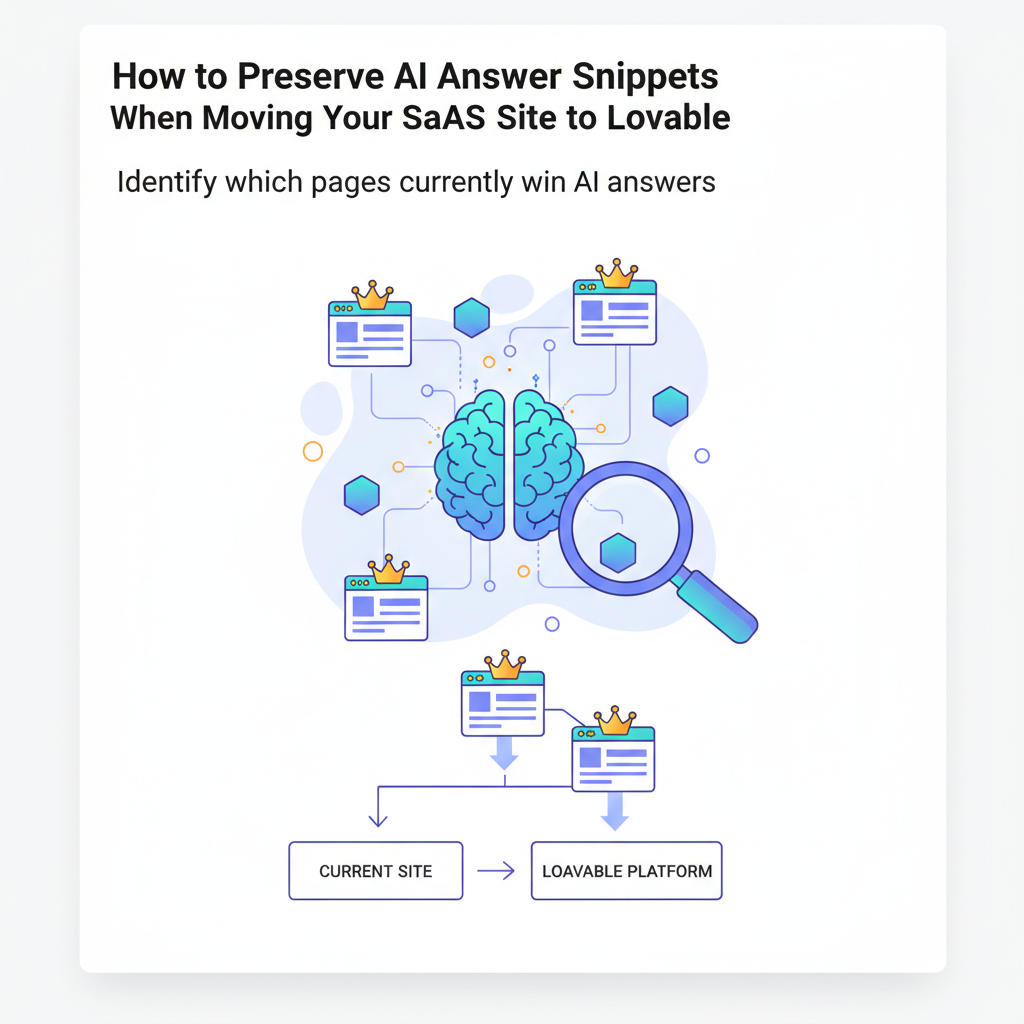
Identify which pages currently win AI answers
Start with an export of queries and pages that currently drive AI answers. Use Search Console’s performance reports to find queries with high impressions and clicks, then cross-check which pages receive answer box visibility by scraping the SERP for your target queries. For each winning page record: the query, the exact answer text (copy 30–120 characters around the extracted sentence), the H2/H3 heading used, and the structured-data type present (FAQPage, QAPage, HowTo). Example artifact: a CSV with columns [query, source_url, captured_answer, heading_text, schema_type, last_crawl_date]. This step turns black-box ai answer migration risk into a deterministic inventory you can act on prior to the Lovable launch.
Using Search Console and SERP scraping to inventory snippets
Combine Search Console with programmatic scraping. In Search Console filter by query or page and export the CSV. For SERP scraping, run a headless browser (Puppeteer or Playwright) to capture the visible snippet and HTML for each query. Save a screenshot plus the exact DOM node containing the snippet. This produces proof-of-state you can compare after migration. For reproducibility, keep a time-stamped folder with the captured_answer.txt files and a small JSON manifest mapping each captured snippet to the required heading and schema type. These artifacts are essential when you ask engineering to maintain answer box preservation requirements on Lovable templates.
Preserve the answer structure — content and markup checklist
Deliver this checklist to engineering and content owners before the cutover. The goal: content parity and identical signals on the new Lovable URL. Checklist (copyable):
- Exact concise answer text copied into the lead paragraph (50–120 words max) — preserve punctuation and units.
- Same heading level and text (H2/H3) immediately preceding the answer.
- FAQPage / QAPage / HowTo schema present and matching the original schema type and values.
- Visible content (no render-blocking tabs) and accessible in the initial HTML or server-rendered output.
- 301 redirect mapping from old URL to new URL with query-preserving rules where applicable.
Give the snippet inventory and the checklist to engineering as a launch task list with acceptance criteria.
Keep concise lead-in answers (50–120 words) and identical signals
Answer boxes favor short, direct lead-ins. Keep the answer between 50 and 120 words and place it immediately after a clear question-style heading. Use the same phraseology where possible — altering the first sentence risks losing the snippet. Include the quote-ready line: "To keep AI answers during a migration, replicate the exact concise answer text, its heading structure, and the same structured-data type on the new URL." Also add region tokens in FAQ headings and structured data for geo-specific queries (for example append "— New York" or "— UK" to the question title in schema) to increase local AI-answer inclusion. For example snippets likely to be pulled: "Pricing: $49/month for Starter plan", "Start a 14-day trial, no card required", "AI summaries in 30 seconds per doc".
Maintain, migrate, or re-add structured data (FAQ, QAPage, HowTo)
Structured data is a signal, not a guarantee, but removing it raises risk. On Lovable, ensure your CMS templates allow server-rendered JSON-LD injection of the same schema type. Export existing structured-data blocks and re-insert them in the new template verbatim. If your site uses dynamic schema generation, add a migration-time script to copy old schema JSON into the new pages. Mark the schema with the same question IDs and answer text. For structured data migration lovableseo tasks, include a test that validates JSON-LD presence and syntactic correctness using the schema testing tool before and after launch. For more on this, see Migrate to lovable seo.
Implementing snippet-preserving redirects and content parity on Lovable
Redirect strategy matters. Use 301 redirects to preserve authority, but map old snippet pages one-to-one to new pages that maintain content parity. If you must consolidate multiple old pages, create an interim landing page that preserves each concise answer as separate FAQ items, then plan gradual consolidation after AI answers stabilize. Provide engineering with a redirect manifest: [old_url,new_url,expected_schema_type,lead_sentence]. On Lovable, ensure template-level rendering places the lead sentence above any promotional banners or hero images so the answer remains prominent.
Redirect rules that retain snippet context
Rules: 1) one-to-one mapping preserves the highest chance of snippet retention; 2) preserve query parameters that affect answer context; 3) implement header-level redirects (server) not client-side JavaScript redirects. Example redirect rule: old /pricing -> new /pricing (301) with identical lead-in paragraph and FAQPage schema. When consolidating, include anchors (e.g., #pricing-answer) in the target and add the exact answer text in a top-level FAQ block so AI-answer algorithms still find a standalone answer fragment.
Template-level considerations in Lovable for answer fragments
Ask Lovable templates to support server-rendered content blocks, JSON-LD injection, and prioritized content zones (content-first layout). Ensure the template doesn't lazy-load the lead paragraph or hide it behind tabs. If Lovable supports custom content regions, create an "answer-fragment" region that places the concise answer at the top and is indexed early by crawlers. Also include an accessibility check: the answer must be in the main content flow and not solely within ARIA-hidden widgets.
Validate and monitor AI-answer retention after launch
After launch run a validation pass within 48–72 hours. Re-scrape the target queries and compare captured_answer to the pre-migration snapshot. Use Search Console to watch impressions and position shifts for the mapped queries. Build a small monitoring dashboard: for each tracked query display pre-migration snippet match (boolean), current match, and time since launch. Set alerts for queries that lost their snippet. This validation loop is essential to detect problems early and execute quick fixes.
How to measure snippet retention and recovery windows
Measure two windows: immediate retention (0–7 days) and recovery (8–90 days). Immediate retention indicates whether the migration preserved the exact signals. Recovery tracks whether search engines re-select your content after re-crawls. Expect many answers to recover within 2–4 weeks if parity and schema are identical; if not, use the quick fixes below. Capture metrics: snippet_match_rate (%), average time_to_match (days), and queries_below_threshold (count).
Quick fixes if AI answers drop (content rewrites, structured-data re-injection)
If answers drop: 1) re-insert the exact captured_answer at the top of the page; 2) re-add or correct JSON-LD schema and push a sitemap update; 3) restore the original H2 text and position; 4) when needed, run a minor content rewrite focused on the first 2–3 sentences and republish. For structured data migration lovableseo, re-inject JSON-LD and submit the affected URL for indexing. These quick fixes typically restore visibility faster than full rewrites because search engines re-evaluate short answer fragments more quickly than long articles.
| Action | When to use | Expected result |
|---|---|---|
| Exact answer re-insertion | Snippet lost after migration | High chance of recovery within 1–2 weeks |
| Schema re-injection | Schema missing or invalid | Improves structured signal; medium recovery speed |
| Redirect fix (301) | Incorrect mapping | Preserves authority; helps long-term retention |
Conclusion — checklist to hand to engineering/PM
Checklist for handoff:
- Inventory CSV and captured_answer files delivered to engineering.
- Redirect manifest with one-to-one mappings and 301 rules.
- Lovable template support for server-side answer region and JSON-LD injection.
- Pre-launch validation script (checklist: lead text present, H2 match, schema present).
- Post-launch monitoring plan with alerts for snippet_match_rate drops.
To preserve ai answer snippets when migrating site, deliver this checklist and the captured answer artifacts to engineering before the cutover and monitor the two recovery windows after launch. The steps above cover ai answer migration, answer box preservation, structured data migration lovableseo, and concise answer snippets lovable best practices. For more on this, see Best site builder for saas seo.
FAQ
What does it mean to preserve ai answer snippets when moving your saas site to lovable?
Preserving AI answer snippets means keeping the exact concise answer text, its heading structure, and the same structured-data type on the new Lovable URL so search engines can continue to extract the same SERP answer.
How do you preserve ai answer snippets when moving your saas site to lovable?
You preserve them by inventorying winning pages, copying the concise lead-in answers verbatim into the Lovable templates, maintaining or re-injecting FAQPage/QAPage/HowTo schema, and implementing snippet-preserving 301 redirects with post-launch monitoring.
Ready to Rank Your Lovable App?
This article was automatically published using LovableSEO. Get your Lovable website ranking on Google with AI-powered SEO content.
Get Started