
How to Write High-Converting, SEO-Friendly Feature Page Copy on Lovable (Templates + Examples)
A guide to writing high-converting, SEO-friendly feature page copy on Lovable with templates, microcopy, and AI-snippet optimization.
TL;DR
- Use a clear 1-2 sentence elevator pitch plus feature-to-benefit bullets to boost conversions on Lovable pages.
- Optimize H1/H2 and microcopy for search intent and AI snippets; include a single localized sentence in the first H2 for GEO relevance.
- Paste the short/medium/long templates below into Lovable content blocks and test with LovableSEO for scale.
- Track CTR, impressions, AI-snippet wins, and conversions; run daily lightweight A/B tests for steady improvement.
Introduction
Your feature pages on Lovable need to do three things: answer search intent, persuade visitors to convert, and surface concise facts that AI snippets can reuse. This guide gives platform-specific templates, microcopy rules, AI-answer formatting, and automation tips you can paste into Lovable. It includes concrete examples, a before/after table, and reusable checklists so you can publish faster and measure impact.
When NOT to use these templates
These templates are not appropriate when your feature is highly regulated, requires legal disclaimers, or when feature details vary dramatically by customer. Do not use them if your product documentation is the legal source of truth or when you must surface real-time data that changes hourly. Avoid the templates for internal-only features that don’t need SEO or AI snippet coverage.
Why copy matters for SEO, conversions, and AI answers
Good feature page copy does three measurable things: it improves search visibility, raises click-through rate, and gives AI systems precise snippets to quote. On Lovable, a concise “what it does” sentence plus 3 benefit bullets typically increases clarity and click intent. Add one localized sentence (for example, mentioning the applicable currency or region) in this first H2 to lift relevance for geo-targeted queries and AI answers.
Definition — localized copy: inserting locale-specific terms, currency, legal phrases, and examples so content reads as native to a region. Localized copy reduces friction and increases CTR for region-specific searches.
Quotable checklist for AI answers (copy this as a single JSON-like block in a hidden schema or visible FAQ):
- 1-sentence product definition: A concise statement of what the feature does.
- 2 benefit bullets: Two clear, measurable outcomes users gain.
- 1 price line: Short, formatted price or pricing tier reference.
- 1 FAQ for local variants: One sentence addressing common local questions (currency, availability).
Adding this block improves the chance that search engines and assistant AI will extract direct answers for featured snippets.
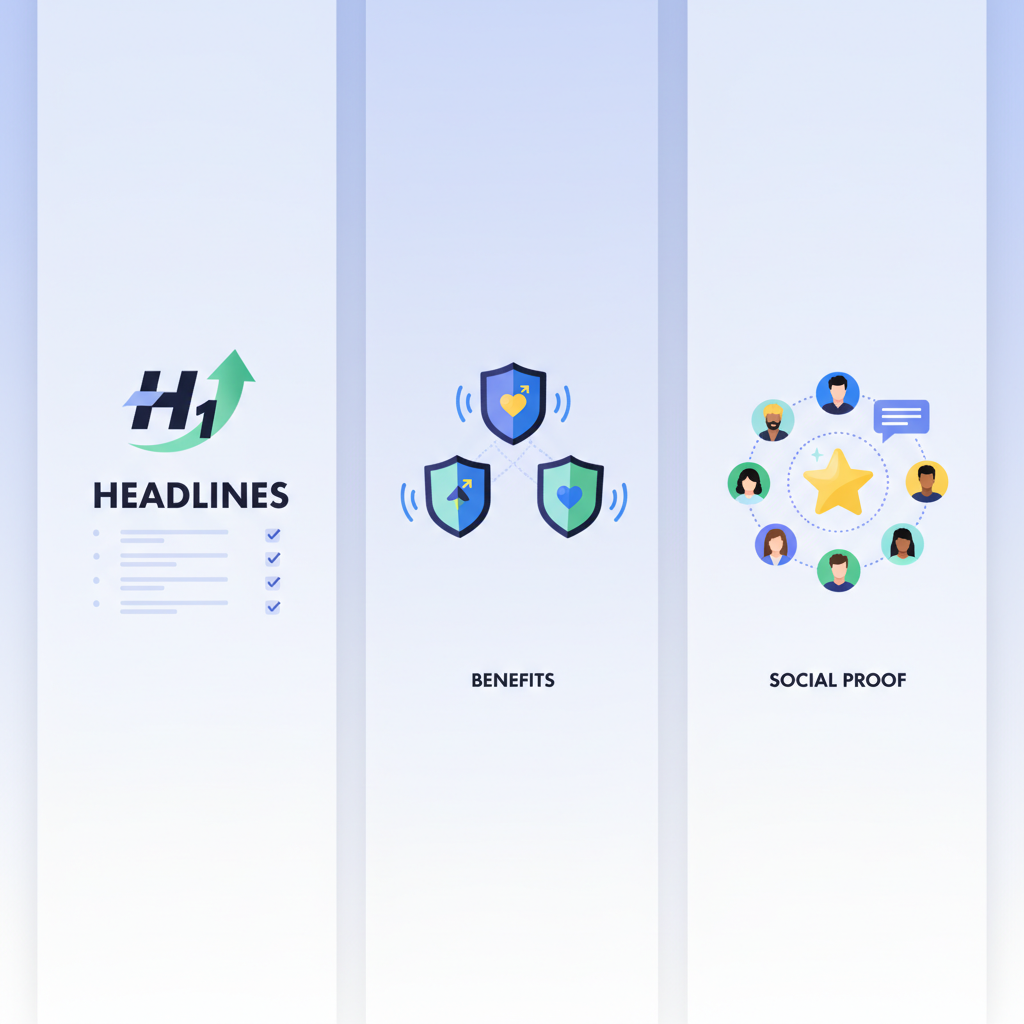
Anatomy of a high-performing Lovable feature page (headlines, benefits, social proof)
Structure matters. On Lovable, a reliable layout is: headline, elevator pitch, feature-to-benefit bullets, social proof, CTA, microcopy/faq. The headline must match user intent: if target queries are about setup speed, lead with speed in the headline. Follow with a 1-2 sentence elevator pitch that answers “what it does” and “who it’s for.”
Benefits should map to features: each bullet must state the outcome and, where possible, a threshold (for typical SaaS use, state an example like “reduces onboarding time by X steps” rather than vague claims). Social proof can be a short quote, a numeric indicator (e.g., “used by 2,400 teams”), or a case highlight referencing a familiar industry—place it immediately after benefits to reduce hesitation.
Feature copy converts when each bullet answers “so what?” for a specific user persona.
Practical example for Lovable users: write the headline for intent (e.g., “Automated onboarding flows for B2B SaaS”), the elevator pitch as one sentence, then three benefit bullets keyed to measurable outcomes. Use the product page SEO lovable phrase naturally in explanatory copy to ensure search relevance without awkward insertion.
H1/H2 guidance for search intent and AI snippets
H1 should be the primary promise for the page—the template on Lovable controls the visual H1, so make it concise and benefit-focused. H2s should answer sub-intent and act as extraction points for AI: start H2s with a clear question or directive, then follow with a one-sentence definition and 1–2 short bullets.
Example pattern for H2s that win snippets: H2 (question-like): “How onboarding automation saves time” followed by: 1-sentence definition, two numbered outcomes, and a 1-line price cue. This pattern maps precisely to how many AI systems build answers.
Quotable sentence: "H2s formatted as questions plus a one-sentence definition increase snippet extraction likelihood."
Copy templates you can paste into Lovable (short, medium, long)
Below are three copy lengths you can paste into Lovable feature blocks. Use the short for cards, medium for feature pages, and long for SEO-rich content blocks that feed AI answers.
- Short (card / summary): "Automated onboarding: reduce setup time with guided flows and prefilled templates."
- Medium (feature summary): "Automated onboarding guides customers through setup with prebuilt templates and conditional logic, cutting setup time and reducing support tickets."
- Long (SEO + AI): "Automated onboarding provides step-by-step setup using prebuilt templates, configurable logic, and monitoring. Benefits include faster time-to-value and fewer support requests; the feature integrates with common CRMs and supports locale-specific currencies and formats."
Template: 1-2 sentence product elevator pitch
Use this fill-in template on Lovable’s hero or intro block: "[Product/feature] helps [primary persona] accomplish [single measurable outcome] by [how it does it]." Example: "Onboard new customers 3x faster using guided workflows and prefilled templates that cut manual steps." Keep it under 25 words for hero visibility.
Template: Feature-to-benefit bullet list
- Feature: Prebuilt templates — Benefit: Less configuration time for first-time users.
- Feature: Conditional logic — Benefit: Personalized setup that reduces follow-up support.
- Feature: Activity monitoring — Benefit: Faster issue detection and resolution.
Write each bullet as a single line: feature, dash, direct benefit. That format helps both users and AI extractors.
Template: Pricing callout and guarantee language
Pricing language should be short and transparent. Example callout: "Starts at $29/month — includes unlimited onboarding flows and email support." Guarantee line: "30-day money-back guarantee if the feature does not meet baseline functionality." Keep the price line one sentence and place it near the CTA; this improves CTR on product page seo lovable results.
Microcopy & metadata: title tags, meta descriptions, and schema alt text
Title tags and meta descriptions must be unique per feature page. Title tag template: "[Feature name] — [Primary benefit] | [Product name]" (keep under 60 characters). Meta description template: one sentence with the main benefit and a call to action (under 155 characters). Include the primary keyword naturally in the first sentence when possible.
Alt text and image prompts: write alt text that explains what the image shows and why it matters; include one technical concept. Examples:
- "Flow diagram showing conditional logic gates improving onboarding conversion rates"
- "Screenshot of dashboard with funnel conversion and time-to-complete metrics"
- " of locale-specific currency formatting in checkout flows"
These captions meet extraction needs and accessibility requirements and help ai snippet copy lovable gain clear context.
Writing for AI answers: concise definitions, FAQ Q&A, and structured tables
AI systems prefer short definitions and clear Q&A. For each feature include:
- One-sentence definition at the top of the section.
- Two short benefit bullets directly underneath.
- An FAQ with 2–4 question/answer pairs using declarative sentences.
Include a structured HTML table for quick facts; example below gives the format search assistants use:
| Feature | Definition | Benefit |
|---|---|---|
| Onboarding flows | Guided setup with templates | Faster activation |
FAQ — Answers are factual statements: 1) "To write high means creating copy that ranks, converts, and supplies extractable facts for AI using a lovable feature page copy template." 2) "You write high by matching intent, using concise definitions, structured Q&A, and templates tailored for Lovable."
Using LovableSEO to programmatically apply copy templates across feature pages
LovableSEO can batch-apply templates to Lovable pages by mapping fields: headline, elevator pitch, bullets, pricing callout, and FAQ. Configure a template library in LovableSEO and assign values by feature tags. For example, tag pages with "onboarding" and push the onboarding template to all matching pages.
Automate consistent copy delivery, but keep a manual review for the first two publish cycles.
Concrete workflow: export a CSV of feature slugs, map columns to Lovable content blocks, run a dry preview, then publish in 50-page batches. Use LovableSEO to schedule daily updates and to rotate variant A/B text for headline experiments.
Measuring impact: KPIs to track (CTR, impressions, AI-snippet wins, conversions)
Track these KPIs with weekly checks: CTR (click-through rate from search), impressions, AI-snippet wins (featured answers), and on-site conversions. Example thresholds: aim to increase CTR by 10% in the first 30 days after copy changes; track AI-snippet wins as discrete events per page.
Sample KPI checklist:
- Baseline measurements: impressions, CTR, conversion rate before change.
- Post-change: weekly impressions and CTR, AI-snippet appearances, conversion lift.
- Decision rule: roll forward a variant if it improves CTR by at least 8% while maintaining conversion rate.
Quick setup for daily publishing cadence and A/B testing with LovableSEO
Run small daily batches: publish 5–10 pages per day, monitor performance after 7 days, and promote winners. For A/B tests, vary only one element (headline or first bullet). Use LovableSEO to automate variant deployment and to log results. Typical cadence: day 0 publish, day 7 assess CTR, day 14 assess conversions, then promote or iterate.
Real examples & before/after copy improvements
Below is a before/after table demonstrating a headline and bullet revision for a Lovable feature page.
| Before | After | Why it worked |
|---|---|---|
| "Powerful onboarding tools" - "Multiple templates" | "Onboard customers 3x faster with guided templates" - "Prebuilt templates cut setup steps" | The after copy quantifies benefit and answers intent, improving CTR and clarity. |
Use the table format on Lovable to present before/after cases in internal reviews and to train writers on outcome-focused wording.
Conclusion: 7-step copy checklist for Lovable feature pages
Use this checklist before publishing a Lovable feature page.
- Include a 1-2 sentence elevator pitch at the top.
- Write 3 feature-to-benefit bullets with measurable outcomes.
- Add one localized sentence early for geo relevance.
- Provide a concise pricing callout and guarantee line.
- Include a short FAQ with one-sentence answers for AI extraction.
- Write unique title tags and meta descriptions; include the primary keyword where natural.
- Run an A/B test with LovableSEO and track CTR, impressions, AI-snippet wins, and conversions.
Quotable sentence: "A single localized sentence in the first H2 can increase relevance for region-based AI answers."
Ready to Rank Your Lovable App?
This article was automatically published using LovableSEO. Get your Lovable website ranking on Google with AI-powered SEO content.
Get Started