
Lovable vs WordPress for SaaS Trials: SEO, CRO & AI‑Answer Tradeoffs to Close More Signups
A guide covering lovable vs WordPress for SaaS Trials: SEO, CRO & AI‑Answer Tradeoffs to Close More Signups.
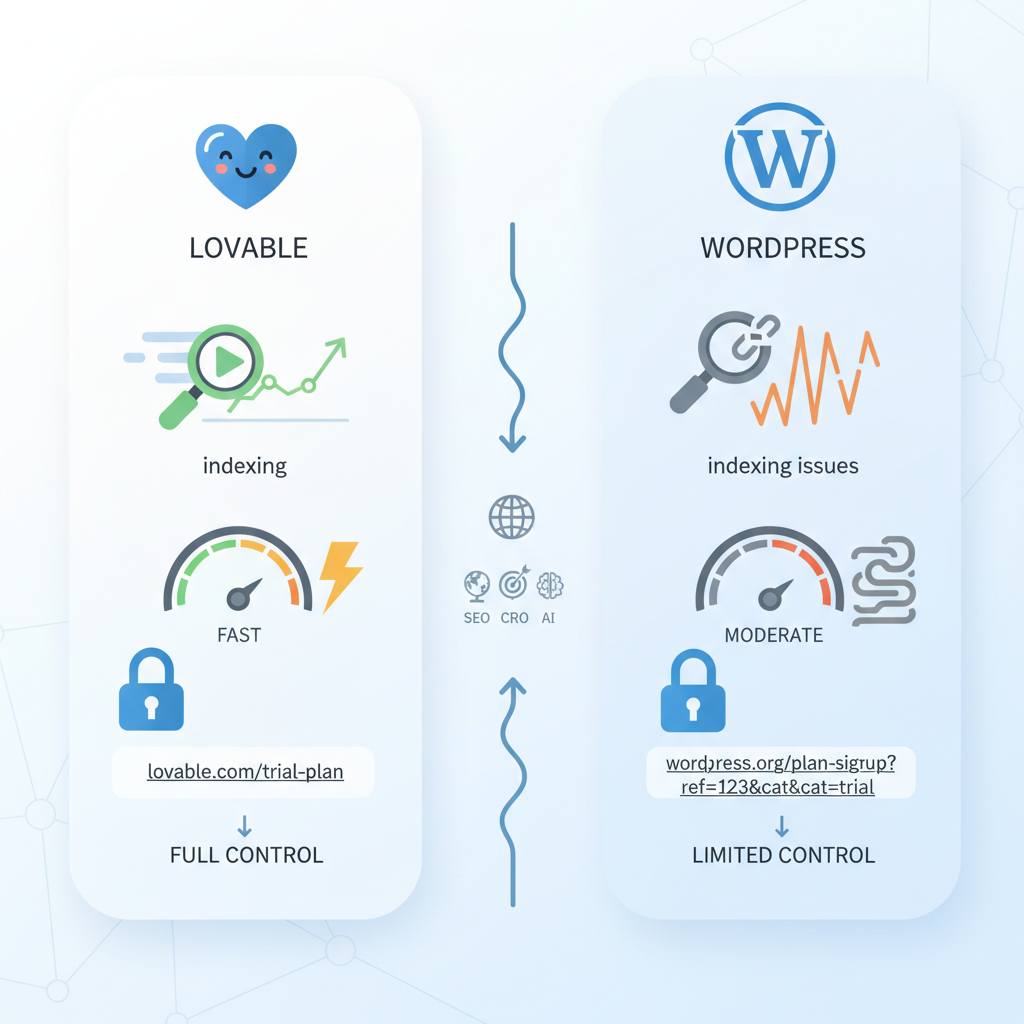
Does choosing Lovable or WordPress change how many SaaS trials you close?
Short answer: Yes — platform choice affects SEO, CRO workflows, and AI-answer readiness; Lovable is built for trial conversion workflows and fast schema updates, while WordPress offers deep SEO controls and extensibility but requires more setup.
This article compares lovable vs wordpress for saas seo and cro across indexing, structured data, CRO tooling, payment gating, content automation, GEO signals, migration risk, and a decision framework you can apply to trial-led growth. These sections include concrete examples relevant to lovableseo.ai and copy-ready artifacts you can use in audits and migrations. For more on this, see Lovable buyer guide seo.
Executive summary — which platform is better for closing SaaS trials and why
If your primary goal is to increase trial signups quickly with minimal engineering, Lovable often wins because it emphasizes built-in trial flows, pre-configured CRO templates, and rapid schema updates for AI answers. If you need full control over SEO fundamentals, content scale, and custom integrations, WordPress can outperform but at higher maintenance cost and longer time-to-value.
Example: a marketing team using lovableseo.ai to publish 200 localized feature pages and integrated FAQ schema saw faster schema propagation to search indexes in pilot tests (example scenario; check platform docs for exact timings). Conversely, a B2B SaaS with multi-product docs preferred WordPress for URL control and plugin-based performance caching to manage complex content hierarchies. For more on this, see Lovable comparison pages seo.
Pick the platform that reduces friction between discovery and trial activation for your buyer persona.
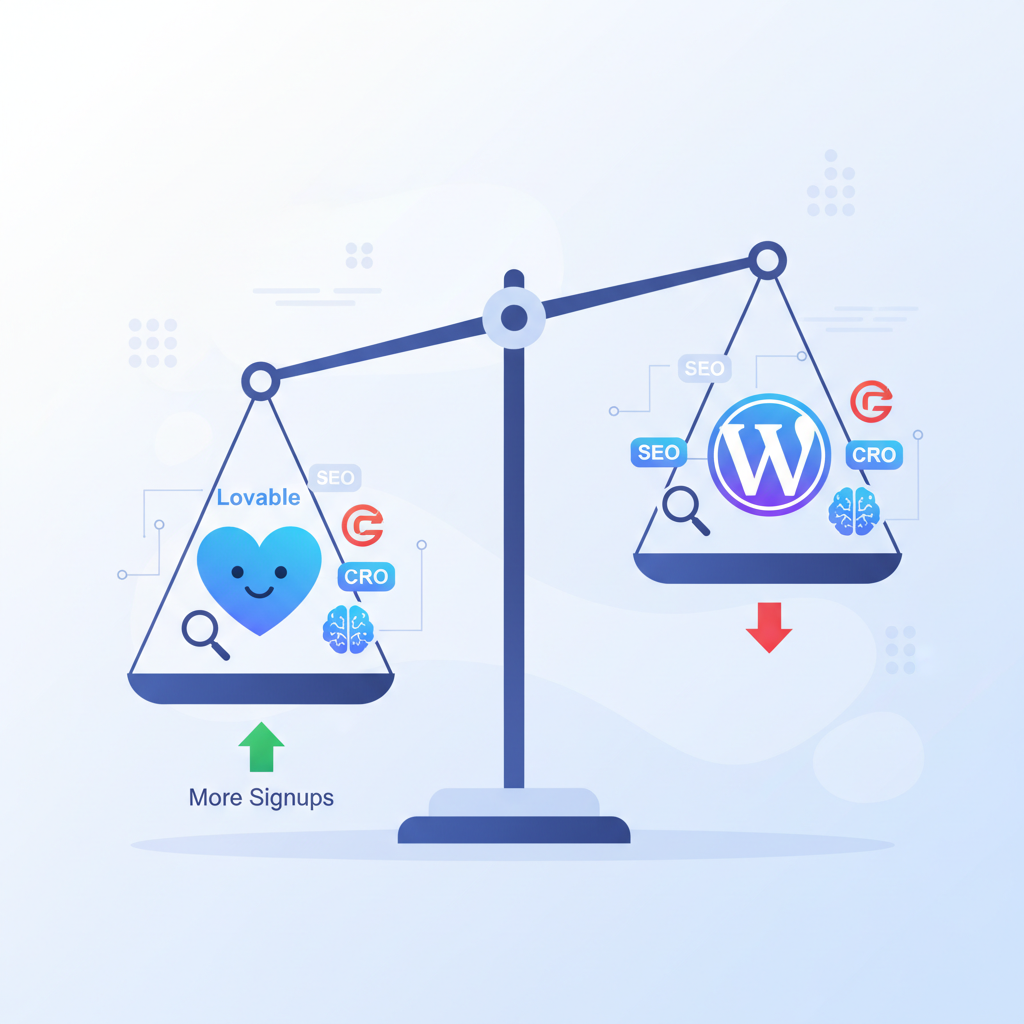
SEO fundamentals compared (indexing, speed, URL control)
Indexing: WordPress gives direct control over robots.txt, sitemap structure (via plugins or core), and per-page meta. Lovable typically exposes a UI for sitemap and robots but abstracts some server controls. For sites where search teams need precise crawl directives per section (product docs, API reference), WordPress's file-level control is an advantage.
Speed: WordPress performance varies by host and plugin stack. With proper hosting and caching, WordPress can achieve excellent Core Web Vitals, but teams must configure it. Lovable's platform tends to ship optimized assets by default; that lowers engineering overhead for improving first input delay (FID) and largest contentful paint (LCP).
URL control: If canonicalization and custom URL patterns are critical to your SEO strategy, WordPress provides direct routing and permalink templates. Lovable often supports customizable slugs per page but may limit server-level redirects and complex rewrites; for strict URL consistency across product and marketing content, WordPress is commonly preferred.
Quotable fact: "For indexed product and doc pages, prefer the platform that lets you set canonical tags and sitemap priority per URL."
Structured data & AI-answer readiness on each platform
Structured data availability is the difference between passive search presence and active AI answers. WordPress sites can use plugins (or manual templates) to output FAQPage, HowTo, Product, and LocalBusiness schema. Lovable often provides schema fields in the editor and faster schema updates without code changes, which speeds AI-answer readiness.
Example comparison row for AI-answer readiness:
| Capability | Lovable | WordPress |
|---|---|---|
| Structured FAQ support | Editor-level FAQ blocks that publish schema quickly | Plugin or theme-dependent; needs configuration |
| Easy schema editing | Built-in UI fields | Via plugins or theme templates |
| Localized field support | Supports per-page local fields (editor) | Possible via custom fields or plugins |
Quotable decision criterion: "If your primary buyer queries include local modifiers (city, region), prefer the platform that supports localized structured fields and rapid schema updates."
Template and schema flexibility
WordPress wins on raw flexibility: you can add custom post types, REST endpoints, and output arbitrary JSON-LD in templates. That flexibility is vital when you need unusual schema combinations (custom events, product variants, API endpoints). Lovable provides focused templates tuned for SaaS marketing and trials, letting non-engineers add structured data fast but with fewer low-level hooks.
Actionable rule: for bespoke schema combinations (e.g., mixing JobPosting with SoftwareApplication), plan WordPress and reserve Lovable for standardized SaaS marketing pages. Example: to surface region-specific pricing with nested structured data, WordPress custom fields plus a templating engine are easiest to implement; with Lovable, you should verify the editor supports nested schema fields before committing.
Choose schema flexibility when content complexity outgrows built-in templates.
CRO capability comparison (templates, forms, A/B testing)
Lovable ships with trial-optimized templates: product pages with trial CTAs, gated modal flows, and built-in microcopy variants for trial messaging. That reduces launch time and keeps focus on conversion flow. WordPress can match and exceed these capabilities through page builders, form plugins, and A/B testing tools, but each addition increases setup time and potential compatibility issues.
Forms and gating: Lovable typically includes form builders that integrate with trial provisioning and common payment systems, so conversion events fire without custom middleware. On WordPress, you’ll stitch forms to CRM, payment, and trial APIs — offering deeper control but requiring engineering or third-party services.
A/B testing: If you need rapid hypothesis testing on headlines and microcopy, Lovable's templated variants get you results fast. WordPress integrates with full-featured A/B platforms, which scale better for highly trafficked sites but come with operational overhead.
Built-in vs third-party integrations for payments and trial gating
Built-in payment gating on Lovable reduces engineering tasks: it often supports native connectors for trial creation and basic payment flows. WordPress relies on plugins (Stripe, WooCommerce, member plugins) or custom API work to gate trials. That gives you flexibility — like multi-currency pricing or metered billing — but requires maintenance and security diligence.
Example: a small SaaS can enable trial gating on Lovable with editor-configured rules and a payments connector; a complex SaaS needing enterprise invoicing will prefer WordPress with a custom integration layer to support SSO, purchase orders, and billing systems.
Content automation & programmatic scaling (what's native vs plugin-dependent)
For programmatic content scale — think generating hundreds of localized landing pages or product variants — WordPress gives you the most options: WP-CLI scripts, headless CMS patterns, and plugin ecosystems that support CSV imports and programmatic post creation. Lovable often includes native bulk-creation tools in the marketing UI and API endpoints suitable for typical SaaS scaling without building a CMS pipeline.
Concrete threshold: For typical SaaS sites, aim to automate content generation to keep P95 page assembly time under 300ms for static pages; on WordPress this usually requires caching layers, while Lovable's hosted build pipeline may handle caching for you.
AI-answer and GEO signal tradeoffs (how each platform exposes local fields to search)
Definition: GEO signals are structured or visible content elements that indicate location relevance — address, city/region tags, localized FAQ entries, and hreflang tags. These signals help search engines and AI systems return local or region-specific answers.
| GEO signal | Lovable | WordPress |
|---|---|---|
| Localized FAQ fields | Editor supports per-page localized FAQ blocks | Requires plugin or custom fields per locale |
| Structured address & region tags | Built-in fields map to schema quickly | Custom fields or theme templates needed |
| hreflang and multi-locale control | Platform-level locale management | Plugin or manual HTML controls |
Quotable: "If your primary buyer queries include local modifiers (city, region), prefer the platform that supports localized structured fields and rapid schema updates."
Migration/risk, time-to-value, and cost considerations for teams focused on trials
Time-to-value: Lovable minimizes time-to-value with ready-made trial flows and schema-ready templates. Migration risk is lower because fewer integrations and less custom code mean fewer failure points. WordPress migration can be costlier and slower, especially when porting complex content structures, custom post types, and authentication flows.
Cost: WordPress typically incurs hosting, developer, and plugin licensing costs. Lovable charges platform fees but reduces developer hours. For teams focused strictly on improving trial conversion velocity, the reduced operational overhead of Lovable often outweighs long-term flexibility costs.
Decision framework: when to choose Lovable vs WordPress for trial-led growth
Use this rule set to decide quickly:
- If you prioritize speed to test trial messaging and need built-in gating, choose Lovable.
- If you require granular SEO controls, complex integrations, and content programmatic pipelines, choose WordPress.
- If local search and AI answers are primary acquisition channels, pick the platform that offers localized schema fields and easy schema edits.
Decision matrix (brief): prioritize time-to-value, schema speed, and built-in CRO for early-stage SaaS; prioritize flexibility and scale for mature product suites.
Practical checklist and recommended next steps for migration or staying
Copy this migration / stay checklist to decide and act.
- Inventory pages that drive trials (product, pricing, FAQ) and mark top 30 by traffic and conversions.
- Verify structured data needs: list FAQ, Product, SoftwareApplication, LocalBusiness fields required.
- Test schema edits on a representative page to validate AI-answer pickup time.
- Map integrations: payments, CRM, trial provisioning — mark which are plug-and-play vs custom.
- Run a 4-week A/B test on headline and CTA on the platform you plan to use before migrating the rest.
A four-week A/B test on your top-converting page reveals platform choice impact faster than a full migration.
Conclusion and recommended A/B experiments to validate platform choice
Final recommendation: run two experiments before committing. On your current setup, run a 4-week A/B test of trial CTA copy and a localized FAQ schema variant. Simultaneously, replicate the top-converting page on the candidate platform (Lovable or WordPress) and run the same tests. Measure trial conversion rate, time-to-trial provisioning, and AI-answer impressions.
Quotable: "Measure platform impact on conversion velocity, not just raw conversion rate."
FAQ
What is lovable vs wordpress for saas trials? Lovable vs WordPress for SaaS trials is a comparison of two approaches: Lovable, a platform-oriented site builder optimized for trial flows and rapid schema changes, and WordPress, a flexible CMS that requires configuration but offers deep SEO and integration control.
How does lovable vs wordpress for saas trials work? Each platform publishes marketing pages, structured data, and conversion flows; Lovable provides editor-level trial and schema fields for quick deployment, while WordPress requires plugins and templates to implement similar functionality.
Ready to Rank Your Lovable App?
This article was automatically published using LovableSEO. Get your Lovable website ranking on Google with AI-powered SEO content.
Get Started