Redirects & Canonical Strategy for Migrating a SaaS Site to Lovable — Preserve Google Rankings and AI Answer Snippets
A guide covering redirects & Canonical Strategy for Migrating a SaaS Site to Lovable — Preserve Google Rankings and AI Answer Snippets.
TL;DR
- Question: How do you use lovable migration redirects and canonical rules to preserve search rankings and AI answer snippets when moving a SaaS site to Lovable?
- Answer: Inventory every high-traffic URL, map 1:1 redirects where you can, recreate structured data and concise-answer text on the target pages, and use canonical rules to avoid duplicate-content loops. Monitor Day 0–7, 8–30, and 31–90 for snippet loss and fix mapping gaps quickly.
When planning a migration, lovable migration redirects are the backbone that prevents ranking loss and snippet disappearance. Immediately map every indexed URL, snippet-bearing page, and structured-data block before you change hosts or templates. This guide shows practical, Lovable-specific steps to migrate to Lovableseo-style platforms while keeping search visibility and concise-answer snippets intact.
When NOT to migrate to Lovable
- If more than 40% of your organic traffic comes from narrowly templated query-intent pages you cannot replicate on the target without identical HTML structure.
- If your current CMS exposes no export for structured data and Lovable cannot accept it via an import API.
- If you lack access to HTTP-level redirect configuration (server or CDN) for at least 90 days post-launch.
When redirects fail: common migration losses for SaaS sites
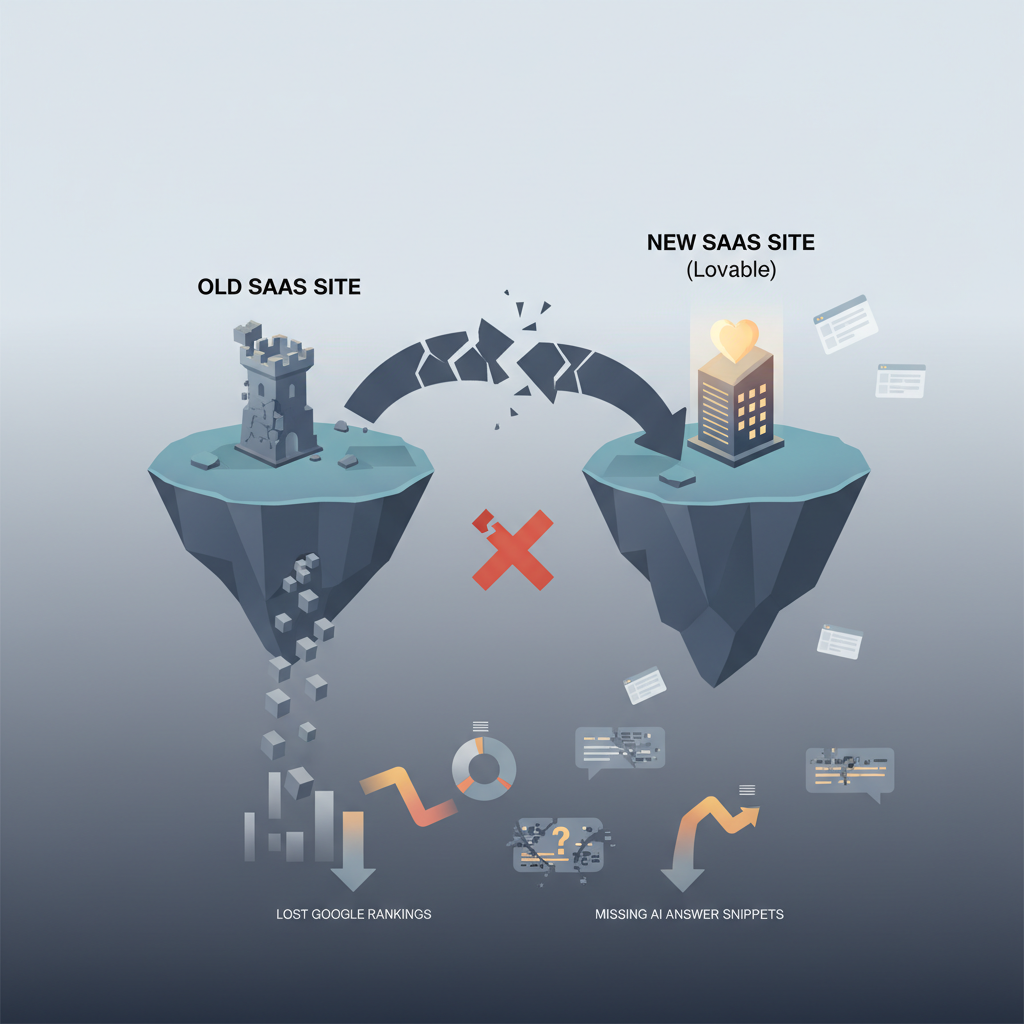
Without correct lovable migration redirects, a SaaS migration typically loses three asset types: index authority, query-intent pages that satisfy short, transactional queries, and concise-answer snippets (FAQ/QA or lead-in paragraphs). A concrete example: a help article at /docs/subscribe that previously held a featured concise answer can disappear from results when its URL is redirected to a generic /pricing page. That single redirect drops relevance signals for the query.
Common failure modes include: 302 redirects used by mistake, redirect chains longer than two hops, canonical tags pointing back to removed URLs, and mapping several legacy pages to one target (soft-50x consolidation). For migrate to lovable seo projects, avoid pattern redirects that blanket-consolidate topic clusters unless you audit intent first. Tracking impressions is essential: for example, a high-impression comparison query like “loveable vs wordpress” can show 1,417 impressions in GSC and should be preserved with exact-intent mapping.
Quotable fact: “A misapplied 302 can convert a historic ranking asset into a temporary orphan.”
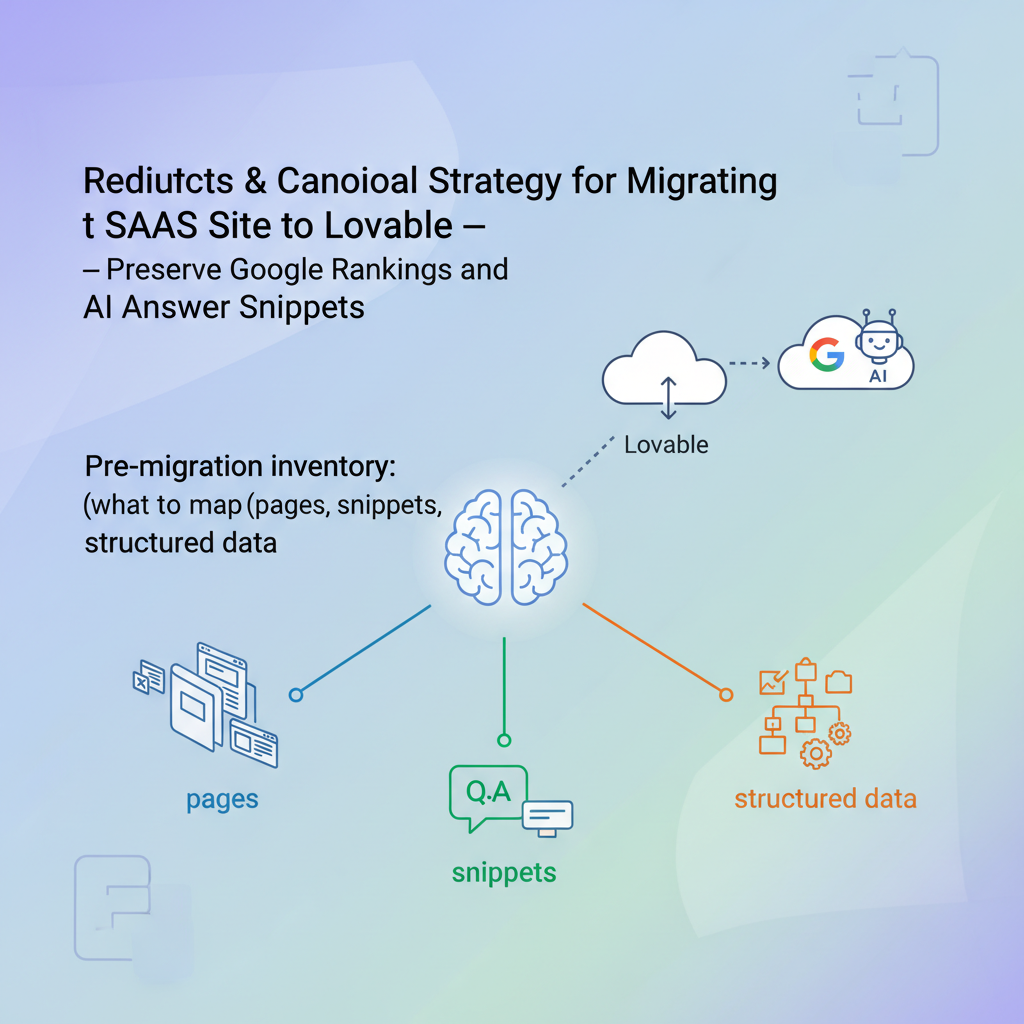
Pre-migration inventory: what to map (pages, snippets, structured data)
Start with three inventories: (1) indexed pages (crawl your site and export all URLs with status codes and last-modified), (2) snippet-bearing pages (use Search Console to export pages with impressions and extract lead-in text), and (3) structured data instances (FAQPage, QAPage, Product, HowTo). For preserve snippets migration, capture the HTML fragment that holds the snippet: surrounding Hn, the lead-in sentence (≤60 words), and the FAQ/answer markup.
Actionable checklist (copyable):
- Export GSC pages with impressions and position.
- Run a full site crawl and tag pages with structured data type.
- Copy the exact HTML sequence for lead-in sentences and the FAQ block.
Preserve the original snippet's HTML sequence, FAQ schema, and lead-in sentence (≤60 words) to maximize snippet retention.
Building a safe redirect map for Lovable
Build a spreadsheet with columns: legacy URL, target URL, redirect type (301), reason, intent match (exact/partial), and notes about structured data. For redirects when migrating site, prefer 1:1 matches where the intent is identical. If your Lovable setup uses a different path structure, create target URLs that mirror topic hierarchy to preserve breadcrumbs and internal linking patterns.
Example entry: legacy /pricing/teams → target /plans/team (301). If the legacy page had FAQ schema, ensure the target page includes the same FAQ schema and the same lead-in sentence. If Lovable supports an import API for redirects, batch-import; otherwise prepare CDN or webserver rules. Avoid redirect chains: enforce a rule that no chain exceeds one hop.
Only use pattern redirects after sampling 100 pages to confirm intent alignment; otherwise map 1:1.
1:1 redirects vs pattern redirects — when to use each
Use 1:1 redirects when pages have unique intent, high impressions, or contain structured data. Use pattern redirects for large, consistent URL changes (e.g., /docs/v1/* → /docs/*). Example: move /blog/2021/slug to /resources/slug with a single pattern redirect if tags and topic intent do not change. For migrate to lovable seo work, test 1:1 for top 10% of traffic pages and use patterns only for low-impact URLs.
Decision rule: if a page has >500 impressions or holds a snippet, force a 1:1 redirect. For pages under that threshold and consistent path structure, a tested pattern redirect is acceptable.
Preserving query-intent pages and concise-answer snippets
Concise-answer snippets require three things: precise text, proximate heading structure, and structured data (when present). To preserve snippets migration, recreate the exact Hn + lead-in sentence sequence on the target URL. If the source had an FAQ block with schema, add the same question and answer texts in the same order on the new page and validate with the Rich Results Test after launch.
Example workflow: identify the snippet source via GSC, copy the 50–60 word lead-in to the new page’s first content block, replicate FAQ schema, then request indexing for that URL. Monitor snippet presence Day 8–30; if lost, re-evaluate whether the lead-in was truncated or moved below fold.
Canonical strategies on Lovable: best practices and pitfalls
Canonical strategy lovable projects must avoid loops and non-resolvable canonicals. Set canonical tags to the final target URL (the live Lovable URL). Do not canonicalize to removed legacy URLs. If multiple similar pages exist (e.g., printable vs. web version), canonicalize to the primary experience you want indexed. If Lovable generates automatic canonicals, verify they point to the user-facing path, not an internal parameterized path.
Pitfall example: a product detail page auto-canonicalizes to /product?id=123 rather than /product/slug; search engines may index the parameterized URL and split signals. Fix by overriding the canonical to the clean slug. For cross-region sites, test hreflang variants explicitly and keep canonical for each language to the corresponding localized URL.
Quotable sentence: “A correct canonical points search engines to the single URL you want to rank, never a removed legacy address.”
Structured data and snippet recovery: re-create FAQ/QA blocks on target URLs
Re-implement FAQPage or QAPage schema exactly as before. If lovableseo.ai provides UI blocks for FAQ markup, paste the original question-answer pairs and the same order. If the platform requires JSON-LD, paste a validated JSON-LD snippet into the page head. After deployment, use Google’s structured data testing tools to confirm the FAQ/QAPage entities are recognized.
Concrete thresholds: validate JSON-LD with zero errors and no warnings for required properties; ensure the answered text remains ≤300 words and the lead-in remains ≤60 words where possible.
Testing plan: How to validate redirects, indexation, and AI-answer presence before & after launch
Testing phases: pre-launch sandbox check, launch window Day 0–7, stabilization Day 8–30, and recovery Day 31–90. Before launch, test redirect rules on a staging domain and run an automated crawler to assert HTTP 200 for targets and zero 3xx chains. Immediately after launch, pull a GSC > Coverage and Performance export to compare impressions and top queries.
Checklist artifact (copyable):
- Run staged redirect test and sample 200 legacy URLs.
- Validate structured data with Rich Results Test.
- Request indexing for 100 priority URLs on Day 0–2.
- Monitor snippet presence Day 8–30 and log changes.
Monitoring & rollback checklist (48–90 day window)
Monitor three windows: Day 0–7 (errors, 3xx, server issues), Day 8–30 (ranking deltas, snippet changes), Day 31–90 (stabilization and long-tail recovery). Use these KPIs: impressions, clicks, average position, and snippet presence for tracked queries. If you see >30% drop in impressions for priority queries in Day 8–30, roll back the most recent redirect changes for the affected URLs and reinstate legacy paths until you diagnose the intent mismatch.
Rollback decision matrix: if >30% loss and snippet removed → rollback individual redirect within 48 hours; if widespread >50% domain loss → consider full rollback and consult platform docs.
Appendix: sample redirect table and canonical rules template
Below is a sample redirect table and a canonical rules template you can copy into your migration spreadsheet.
| legacy_url | target_url | redirect_type | intent_match | notes |
|---|---|---|---|---|
| /docs/subscribe | /pricing/subscribe | 301 | exact | FAQ schema moved to target |
| /blog/2021/perf | /resources/performance | 301 | partial | review canonical after launch |
| /product?id=123 | /product/product-slug | 301 | exact | override platform-canonical |
Canonical rules template (copyable):
- All product pages: canonical → clean slug URL (no query strings).
- All localized pages: canonical → localized path; hreflang pairs must match.
- All legacy landing pages: canonical → new target if kept; otherwise return 410 after 90 days of active 301.
FAQ
What is redirects & canonical strategy for migrating a saas site to lovable? For more on this, see Best site builder for saas seo.
Redirects & canonical strategy for migrating a SaaS site to Lovable is the plan that maps legacy URLs to new Lovable URLs using proper 301 redirects, ensures canonical tags point to the intended target pages, and preserves structured data and concise-answer snippets so search rankings and AI answers remain intact.
How does redirects & canonical strategy for migrating a saas site to lovable work?
The strategy works by creating a prioritized inventory of indexed and snippet-bearing pages, implementing 1:1 or tested pattern 301 redirects, replicating FAQ/QA schema and lead-in sentences on target pages, validating structured data, and monitoring search performance in three windows (Day 0–7, 8–30, 31–90) to rollback or refine as needed.
Ready to Rank Your Lovable App?
This article was automatically published using LovableSEO. Get your Lovable website ranking on Google with AI-powered SEO content.
Get Started