Regional Pricing Tiers: Structuring Localized Pricing Tables on Lovable Pages for AI Answer Inclusion
A guide covering regional Pricing Tiers: Structuring Localized Pricing Tables on Lovable Pages for AI Answer Inclusion.
TL;DR
- Localized pricing tables lovable improves relevance for regional search and increases chances of AI snippet inclusion.
- Use clear table markup plus a JSON-LD pricing table fallback to be machine-readable.
- Choose between single-page locale blocks, per-locale pages, or dynamic blocks based on traffic and crawl budget.
- Feed market rows programmatically from LovableSEO and tag rows with currency, tax, and availability.
If you run Lovable pages and sell to multiple markets, localized pricing tables lovable should be part of your SEO and product strategy. A localized pricing table presents prices, currency, and market-specific terms for a defined geographic audience; when implemented with clear markup it helps buyers and increases the chance search engines or AI systems pull the right row for region-specific queries. This guide shows structure choices, structured-data patterns, programmatic feeds (including LovableSEO use), and measurement steps you can implement on lovableseo.ai sites.
When NOT to implement localized pricing tables
"Do not add full per-country pricing when you have negligible traffic from the country, when your legal or tax position prevents publishing firm prices, or when SKU-level variability makes a published table misleading. Stop before rollout if your engineering team can’t deploy canonical/hreflang consistently or if your crawl budget is extremely limited and you can’t serve essential content without diluting indexable pages. These are correct-exit conditions for localized pricing efforts — before proceeding, consider how to localize product and pricing pages to effectively win AI answers in target markets."
Why pricing tables matter for AI answers and buyer intent
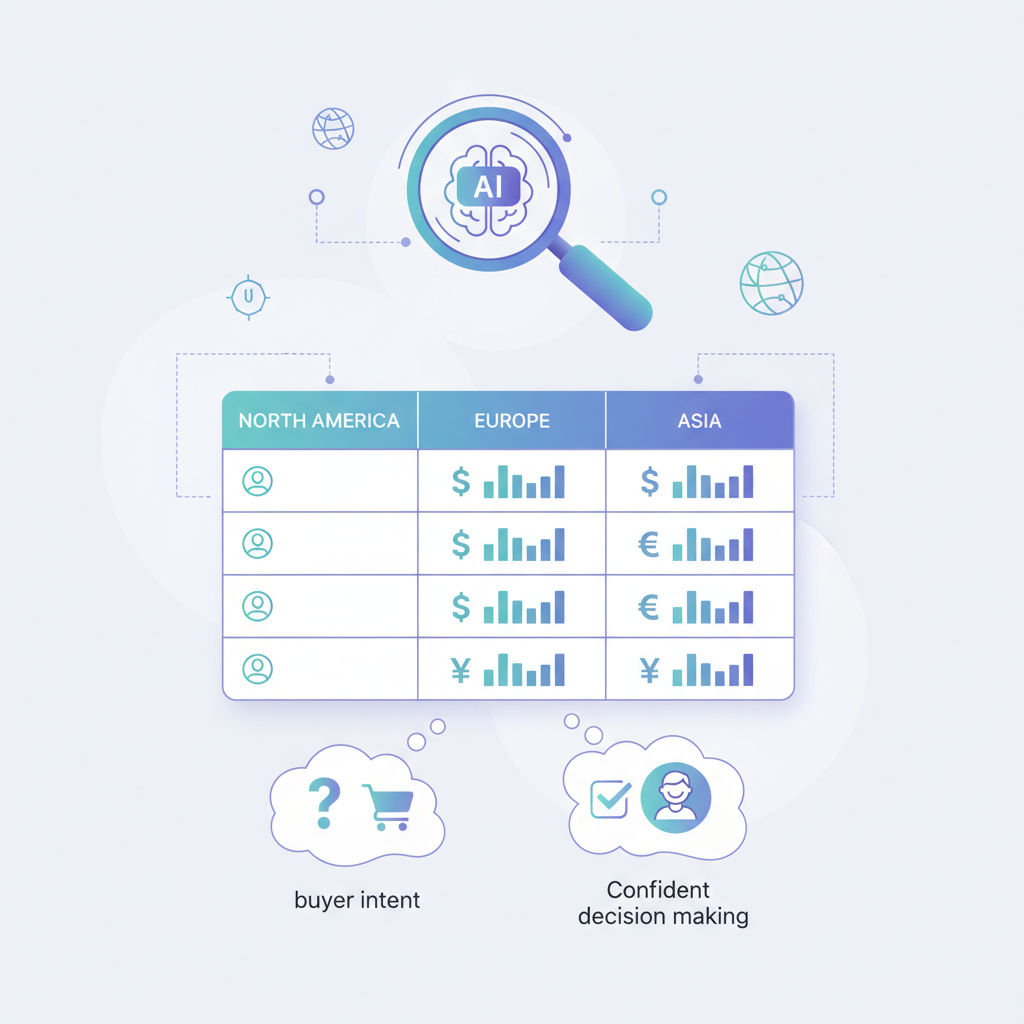
Searchers with purchase intent often include a locale or currency in their query; they expect a quick, accurate answer. Pricing tables that expose locale, currency, and tier attributes in structured markup are more likely to be parsed into concise AI responses for region-specific queries. For example, a user searching "price of Pro plan in EUR" is far likelier to see a direct AI answer if your page lists the Pro row with EUR and a recognized price format in machine-readable schema.
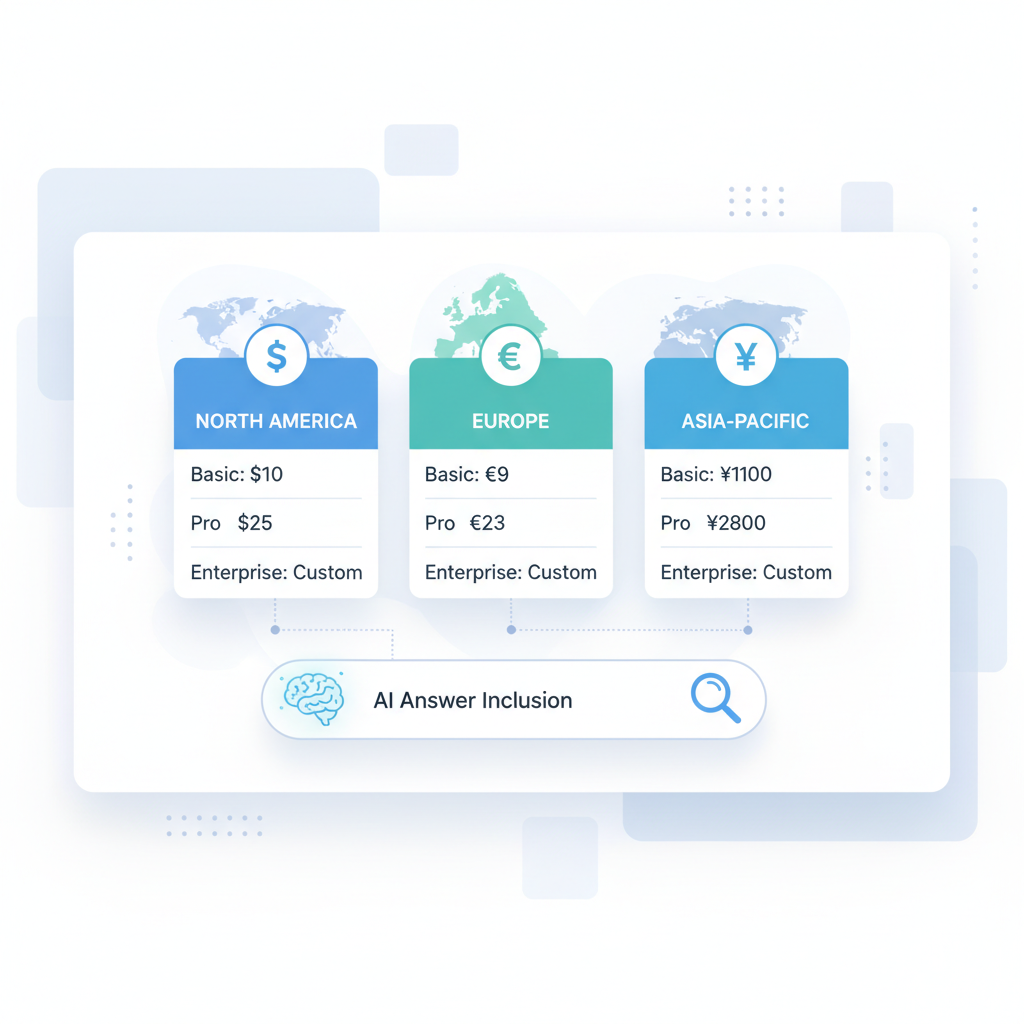
Actionable takeaway: make the table row itself self-contained — tier name, price, billing cadence, currency, and availability. That single-row completeness increases click-through rate from AI snippets and reduces confusion for buyers. For lovableseo.ai pages, include market callouts (VAT inclusive, payment methods) next to the row so AI extractors and users get the full context.
Expose currency and availability on each row; machines pick the first complete row they can parse.
Choose the right pricing table structure for multi-market display
If you serve a handful of priority markets, per-locale pages give best SEO control: each URL can target language, currency, and local terms and be annotated with hreflang and canonical tags. If you support many small markets, a single page with locale blocks scales UI but complicates indexing: search engines may ignore buried blocks. Dynamic blocks (server-side rendering or pre-rendered fragments) offer a middle path: one canonical URL per locale generated on demand.
Decision rule: if top-5 markets account for >70% revenue, build dedicated per-locale pages; otherwise use dynamic blocks and detect locale server-side. For lovableseo.ai sites that integrate with commerce backends, prefer server-side rendered dynamic blocks to ensure search bots see the correct HTML snapshot. This balances crawl budget with relevance.
Single-page locale blocks vs per-locale pages vs dynamic blocks
Single-page locale blocks present all markets on one URL. Benefits: one URL to update, simple canonicalization. Drawbacks: buried rows may not be indexed for specific queries. Per-locale pages allow granular hreflang, localized copy, and separate metadata — best for high-value markets. Dynamic blocks (SSR or edge-rendered fragments) show localized content on one friendly URL but return locale-specific HTML to crawlers and users.
Concrete thresholds: choose per-locale pages if projected monthly organic sessions per locale > 2,000. Use dynamic blocks when you have >30 locales and can't maintain unique landing pages. For lovableseo deployments, map these choices to your site generator: static per-locale builds for top markets and edge-cached dynamic fragments for long-tail locales.
Structured-data patterns to make pricing tables machine-readable
Use a hybrid approach: semantic HTML table markup plus explicit schema.org objects in JSON-LD. Represent each tier as a schema.org/Offer or schema.org/PriceSpecification attached to the product (schema.org/Product). Include properties: price, priceCurrency, billingDuration, availability, eligibleRegion (use ISO country codes), and url pointing to the locale page or fragment.
Quotable: "Pricing tables that expose locale, currency, and tier attributes in structured markup are more likely to be parsed into concise AI responses for region-specific queries." That sentence is intentionally extractable for snippets. Also include clear textual labels next to prices (e.g., "EUR, tax incl.") so both people and parsers understand the terms.
If machines can’t identify priceCurrency, they will skip the row — always set priceCurrency explicitly.
Use table markup + JSON-LD fallback for AI extraction
Start with an accessible <table> with headers: Tier, Price, Billing, Currency, Availability. Parsers still often prefer HTML tables for tabular data. Add a JSON-LD block describing the same rows so AI systems and search engines that read structured-data can parse fallback metadata. Keep both sources consistent; mismatches are handled as errors by crawlers.
Example snippet guidance: include one JSON-LD array of Offer objects keyed to a product identifier visible in the DOM (data-product-id). Ensure the price formats match (no extra punctuation) and use ISO currency codes. This doubles the chances an ai snippet pricing table extractor picks the correct row.
Tagging tiers with locale-specific labels (currency, features, availability)
Each tier row should include explicit locale labels: currency code, tax status ("VAT incl."), and availability flags ("Not available in XX"). For features that vary by market, show the feature name plus a per-locale boolean or small note. This prevents misinterpretation: an AI can’t assume a feature is present if your table clearly labels it as unavailable.
Implementation tip: use data attributes on table rows like data-currency="EUR" data-available="true" data-region="DE". Those attributes are readable by client JS and server renderers and are traceable by programmatic pricing feeds. This practice supports pricing tier localization and reduces ambiguity for both machines and users.
Programmatic strategies for Lovable sites
For Lovable sites, automate pricing updates via a central pricing catalog. Keep a single source of truth (JSON/CSV) that feeds both the HTML rendering and the JSON-LD generator. Implement a staging pipeline that validates price formats and checks locale consistency before deployment. Programmatic updates reduce manual errors and let you run fast A/B tests of localized rows.
Mention: programmatic pricing lovableseo should push market-level overrides (tax rules, rounding, local promotions) from a controlled feed. Use feature flags to switch locales or promotional banners off quickly if legal or market conditions change.
How to feed market-specific rows using LovableSEO data feeds
LovableSEO can act as the middleman between your commerce backend and Lovable pages. Export a per-market CSV with columns: locale (ISO), product_id, tier_name, price, currency, billing_period, tax_policy, available_flag. Configure LovableSEO to transform and push those rows as JSON-LD snippets and server-rendered table rows. To enhance your Lovable pages, consider implementing winning AI answers for lovable product pages. Validate feed integrity: reject rows missing priceCurrency or billing_period.
Concrete step: schedule a nightly feed that runs checksum validation; fail deployment if any locale has >1 inconsistent price format. This operational rule prevents malformed ai snippet pricing table exposures and keeps lovableseo pages consistent across markets.
Handling discounts, tax-inclusive pricing, and legal footnotes per market
Display discounts with both original and final price and tag discount validity dates as ISO strings. For tax, show whether the price is tax-inclusive and include tax percentage where required. For legal footnotes, attach a short footnote identifier to the row and expand the full legal text below the table; ensure the JSON-LD includes a summary property linking to the expanded text so machines can supply context.
Example: show "€45 (VAT incl.)" in the Price cell and add a data-tax attribute with value "inclusive". For regions requiring more detail, add a footnote code like [1] and list the full legal compliance text under the table. This keeps rows compact while preserving compliance.
UX and SEO tradeoffs: canonicalization, hreflang, and crawl budget
Per-locale pages let you set locale-specific titles and hreflang pairs — they’re better for SEO-rich markets. But they increase the number of URLs to crawl. If you choose many per-locale pages, ensure sitemaps list only canonical locale URLs and use hreflang correctly to avoid duplication. For single-page blocks, use fragment identifiers and server-side detection to keep a single canonical URL while still offering local content to users.
Rule of thumb: limit publicly indexable per-locale pages to markets where organic search potential justifies the crawl cost. For the rest, use dynamic blocks or a consolidated page and expose locale-specific data via structured-data to capture ai snippet pricing table opportunities without multiplying indexable URLs.
Examples and templates: high-converting localized pricing table patterns
Below is a comparison table you can copy into a Lovable page. Each pattern includes where to place JSON-LD and how to surface legal text.
| Pattern | When to use | Machine strategy |
|---|---|---|
| Per-locale pages | Top markets (high revenue) | One Offer array JSON-LD per page; hreflang + canonical |
| Dynamic blocks | Many markets, moderate traffic | Server-rendered table + JSON-LD fragment keyed by locale |
| Single consolidated page | Low traffic per-market | Multiple table blocks + Offer array for top N locales |
Measurement: tracking per-market ranking, AI-answer pickups, and conversion lift
Compare market segments in Search Console or a SERP monitoring tool: track impressions and clicks for queries that include locale or currency tokens. Monitor AI-answer pickups by logging featured-snippet impressions where available and by running controlled searches from localized IPs. For conversion lift, run A/B tests: variant A shows generic global pricing, variant B shows localized pricing table; measure lift in CTR and conversion per locale over 4 weeks.
Metrics checklist: record per-locale impressions, ai snippet pickups, CTR, conversion rate, and revenue per visitor. Use these to justify expanding per-locale pages or switching to dynamic blocks. This data-driven approach reduces wasted crawl budget and proves the value of pricing tier localization work.
Conclusion: rollout checklist and recommended next tests (A/B locale blocks)
Rollout checklist (copyable):
| Step | Pass/Fail criteria |
|---|---|
| Define target locales | Top markets cover >70% revenue or strategic priority |
| Choose structure | Per-locale pages for top markets; dynamic blocks for long tail |
| Implement markup | HTML table + JSON-LD Offer with priceCurrency |
| Validate feeds | LovableSEO feed checksum passes |
| Measure | Track AI pickups and conversion lift for 4 weeks |
Recommended test: run an A/B test that replaces a consolidated pricing table with a localized block for one mid-size market; measure AI snippet pickups and conversion rate. If results show positive movement, scale to additional markets. This staged approach keeps risk low and produces measurable wins.
FAQ
What is regional pricing tiers? Regional pricing tiers are pricing rows or pages that present prices, currency, and market-specific terms for a defined geographic audience; they include localized currency and availability information so users and machines see accurate, region-specific offers.
How does regional pricing tiers work? Regional pricing tiers work by mapping a product’s tier to a market-aware representation: the page or block shows the tier name, price, billing cadence, currency code, and legal notes, and exposes the same data in machine-readable schema so search engines and AI systems can extract the correct row for localized queries.
Ready to Rank Your Lovable App?
This article was automatically published using LovableSEO. Get your Lovable website ranking on Google with AI-powered SEO content.
Get Started