
SEO Headline and Microcopy Formulas for Lovable Feature Pages (AI-Answer Optimized)
A guide covering sEO Headline and Microcopy Formulas for Lovable Feature Pages (AI-Answer Optimized).
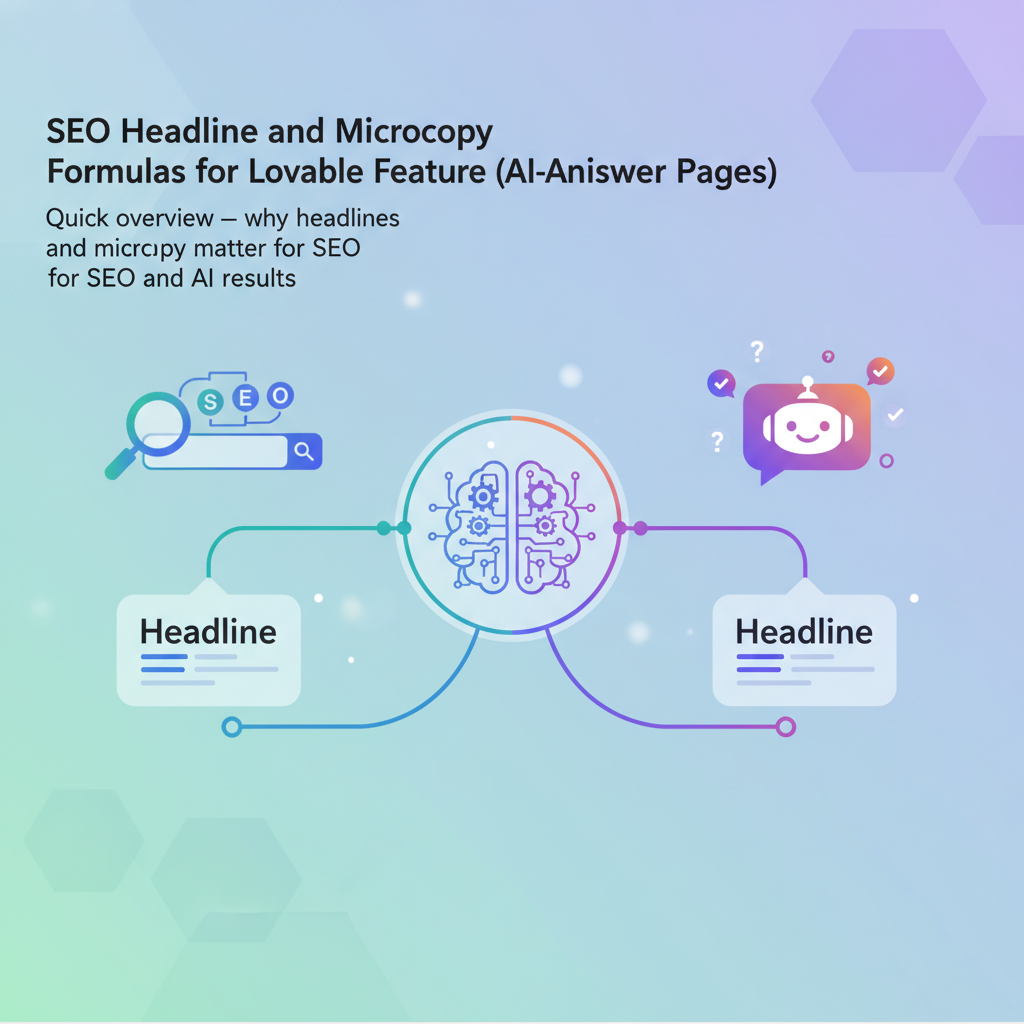
Do lovable feature page headlines actually improve SEO and AI results?
Yes. Clear, benefit-focused headlines plus short microcopy raise click-through rates and make pages more likely to be selected for AI answers when they emit concise, extractable snippets. Use formulaic headlines, tight CTA microcopy, and 20–50-word answer snippets to increase discoverability.
Start by writing headlines that state the primary user benefit and include the feature name or keyword. Then add microcopy that removes friction—one line, one action—and craft a 20–50 word concise answer snippet that an AI system can quote. The rest of this guide shows repeatable formulas, ready-to-use templates, and implementation tips specific to lovable sites and LovableSEO-style publishing flows.
Quick overview — why headlines and microcopy matter for SEO and AI results
Without scannable headlines and tightly-written microcopy, feature pages look interchangeable to both humans and search algorithms. Lovable feature page headlines signal intent, context, and outcome in a single line; microcopy seals the click by removing doubts (pricing, setup time, risk).
AI systems and search snippets favor short, factual sentences. A headline that contains an actionable benefit plus the feature name is easy for extractors to parse. Microcopy that follows (pricing callouts, CTA qualifiers) supplies the extra facts AI uses for answer cards.
When NOT to use these formulas
- When a feature is experimental and specs will change daily—don’t lock claims into the headline.
- If legal or compliance prevents concise benefit statements about outcomes.
- When your product is aimed at a research audience that expects nuance rather than benefits-first copy.
Headlines must answer one question: what will the user get and why now.

Headline formulas that work (benefit + keyword, problem + solution, numbers + outcome)
Use repeatable formulas so teams can generate consistent, testable headlines. Three high-performing patterns are: benefit + keyword, problem + solution, and numbers + outcome. Each maps to a different intent stage and extracts well for AI answers.
- Benefit + keyword: "Reduce support tickets with AI ticket triage" — states outcome and includes the feature phrase for indexing.
- Problem + solution: "Slow onboarding? Automate welcome flows in 3 steps" — acknowledges a pain and promises a clear fix.
- Numbers + outcome: "Cut login time by 40% with passwordless auth" — numbers increase credibility and scan-ability.
Write three variants per page — one per formula — and A/B test them. Keep headlines under 65 characters when possible so SERPs and AI extractors see the full phrase.
Make the headline the one-line promise your page will prove below.
8 headline templates with examples for Lovable feature pages
Use these templates to speed writing. Replace bracketed parts with the specific feature or metric.
- "[Primary benefit] with [feature name]" — "Faster customer onboarding with Guided Flows"
- "[Problem]? [solution] in [timeframe]" — "High churn? Reduce it with 1-click re-engagement"
- "[Number] ways to [outcome] using [feature]" — "3 ways to boost retention using event targeting"
- "[Feature] for [audience]: [one-line benefit]" — "API access for devs: ship integrations in hours"
- "Stop [problem]—try [feature]" — "Stop manual tagging—try automated labels"
- "[Feature] that [measurable result]" — "Search that finds results in under 200ms"
- "How [feature] reduces [cost/time/error]" — "How autosave reduces data loss and support calls"
- "From [before] to [after] with [feature]" — "From 5 steps to 1 step checkout with FastPay"
Pair each headline with a 10–20 word subhead that answers “How?” and a 20–50 word concise answer snippet for AI use.
Microcopy for CTAs, pricing callouts, and benefit bullets (concise, scannable)
Microcopy must be scannable: CTAs, one-line pricing notes, and 3–5 benefit bullets. Each piece should remove a specific objection. Use present-tense verbs, quantifiable outcomes, and friction-removing qualifiers.
- CTA microcopy example: "Start free trial — no card required" (removes payment friction)
- Pricing callout example: "Plans from $XX/mo for teams" (sets expectation in one line)
- Benefit bullets (3): short, parallel, outcome-first — "Save time: automate reports", "Reduce errors: real-time validation", "Scale: multi-tenant support"
Keep bullets to 6–8 words each. Use feature page microcopy lovable to emphasize empathy and reduce cognitive load—think helpful, not hype.
Microcopy is the trust bridge between headline and CTA; make every word count.
Microcopy formulas for CTAs (action + benefit + friction removal)
Use the formula: action + benefit + friction removal. Examples:
- "Try free — export data anytime"
- "Get started — onboarding in 10 minutes"
- "See pricing — no hidden fees"
Test CTA verbs: "Try," "See," "Get," "Start." Add benefit phrases for higher CTR: "Try free — reduce setup time". Always include a short qualifier if there is a constraint (team size, trial length).
Integrate feature page copy formulas into your content templates so writers and engineers produce consistent CTAs across the product surface.
Crafting concise answer snippets for AI (length, format, and token strategy)
Concise answer snippets should be 20–50 words and formatted as 1–2 sentences. Lead with the primary fact, then add a single qualifier. This length fits well into SERP featured snippets and AI answer slots.
Structure: one-line fact + qualifier. Example pattern: "[We do X] for [audience]: [one-line benefit]. [Price/constraint]." For platform-specific output, include a product token like "Lovable" or a workflow token like "LovableSEO template" where relevant, but avoid unverifiable claims. For more on this, see Lovable product page seo.
Token strategy: keep the snippet dense with nouns and numbers, avoid stop-word clutter, and ensure the page contains supporting H2/H3 content that expands each fact — AI systems prefer pages they can validate.
5 ready-to-use concise snippet examples (product, feature comparison, pricing)
Copy and adapt these 20–50 word snippets. Replace bracketed placeholders.
- Product: "We provide [feature] to product teams: faster releases and fewer regressions. Setup integrates with existing CI pipelines and scales with your repo."
- Comparison: "Compared to [competitor], [feature] reduces setup steps by 50% and centralizes alerts into one dashboard for faster triage."
- Pricing: "Plans start at [price]. Includes [core feature] and email support; add-ons available for enterprise teams."
- Local AI-ready: "We offer [service] in [city]: one-line benefit for local customers. Onsite setup and training available."
- Quick how-to: "Enable [feature] in settings to start auto-tagging; historical data is processed in the background with no downtime."
These snippets are designed to be quoted verbatim by AI features; use natural punctuation and a clear subject to improve extraction.
Implementing these formulas in LovableSEO templates and auto-publishing flows
To scale lovable headlines, bake the formulas into your LovableSEO templates. Create fields for: headline template type, 10–15 word subhead, 20–50 word AI snippet, 3 benefit bullets, and a CTA line. Populate these fields in content staging so auto-publishing renders consistent meta titles and structured content blocks.
Operational checklist for implementation:
- Create headline template options in your CMS (benefit, problem-solution, numbers).
- Add required microcopy fields to the template (CTA, pricing callout, bullets).
- Require a 20–50 word AI snippet field for each page.
- Automate quality checks: headline length < 65 characters, snippet length 20–50 words, bullets 6–8 words each.
These steps let marketing, product, and engineering push consistent, AI-optimized pages with minimal manual editing.
Measurement: which KPIs to watch (CTR, dwell, AI-inclusion signals) and quick A/B tests
Track headline and microcopy impact with these KPIs: organic CTR, pogo-sticking (dwell time under 10s), conversion rate on CTA clicks, and inclusion in AI answer features where your analytics platform reports impressions from assistants or rich results.
Run two quick A/B tests:
- Headline A/B: benefit-based headline vs numbers-based headline. Measure CTR and time on page for 2–4 weeks.
- CTA microcopy A/B: action-only CTA vs action+benefit+friction removal. Measure CTA click rate and downstream conversion.
Decision rule: prefer the variant that increases CTR by at least 10% and maintains or improves conversion. For typical SaaS pages, aim for organic CTR > 3% as an early target and average dwell > 40 seconds for feature pages.
Wrap-up: copy checklist and copy block library
Use this quick checklist before publishing any lovable feature page:
- Headline follows one of the three formulas and includes the feature or keyword.
- Subhead explains how in one sentence.
- AI snippet is 20–50 words and extractable.
- CTA follows action + benefit + friction removal.
- 3 benefit bullets, 6–8 words each.
- Run headline and CTA A/B tests for 2–4 weeks.
| Copy block | Template | Example |
|---|---|---|
| Headline | [Benefit] with [Feature] | Faster onboarding with Guided Flows |
| AI snippet | [What we do for whom]: [one-line benefit]. [Qualifier] | We automate onboarding for SMBs: one-step setup and analytics. Free trial available. |
| CTA | [Action] — [benefit]. [friction removal] | Start free — onboard in 15 minutes. No card required. |
Lifecycle diagram showing how headline, snippet, and CTA funnel users from search to activation
Screenshot wireframe illustrating headline, subhead, and microcopy positions on a feature page
FAQ
What is seo headline and microcopy formulas for lovable feature pages (ai?
SEO headline and microcopy formulas for lovable feature pages are repeatable patterns that combine benefit-focused headlines, concise microcopy, and 20–50 word answer snippets to improve organic CTR and increase the chance of being used in AI-generated answers.
How does seo headline and microcopy formulas for lovable feature pages (ai work?
These formulas work by making key facts—outcome, how, and constraint—easy to extract: headlines capture intent, microcopy removes friction, and concise snippets supply AI-ready facts that search systems prefer for featured answers.
Ready to Rank Your Lovable App?
This article was automatically published using LovableSEO. Get your Lovable website ranking on Google with AI-powered SEO content.
Get Started