URL, Canonical & Pagination Handling: Practical Checklist to Prevent AI-Answer Fragmentation on Site Builders
A guide covering uRL, Canonical & Pagination Handling: Practical Checklist to Prevent AI-Answer Fragmentation on Site Builders.
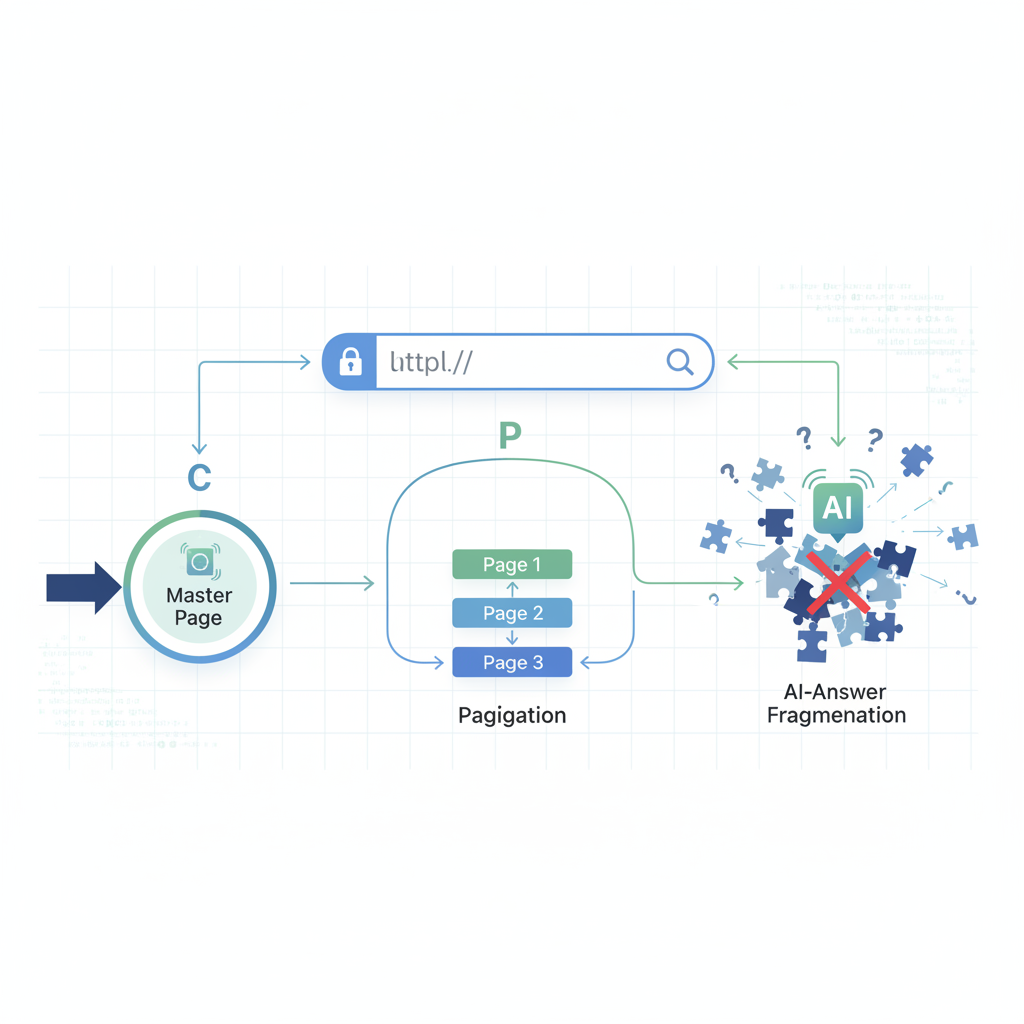
Question: How do canonical, hreflang and pagination problems cause AI systems to return fragmented or wrong answers from your site?
Answer: Misconfigured canonicals, inconsistent URLs and missing hreflang signals create multiple pages that expose overlapping concise answers. AI systems and search engines then pick different URLs for the same snippet, producing out-of-date, regional, or truncated answers. Fixing URL canonicalization and locale signals centralizes the answer and restores snippet consistency.
How URL and canonical problems lead to fragmented AI answers
When a single content item is reachable at multiple URLs, AI models and search engines may index several versions. That creates what we call AI-answer fragmentation: multiple URLs exposing overlapping concise answers so the model can select any of them. "AI-answer fragmentation" means the same short factual sentence appears on several URLs with different meta and regional signals.
Related failure mode: canonical collapse — when site signals conflict (rel=canonical, HTTP headers, sitemap) and crawlers ignore your preferred URL. Definition: "canonical collapse occurs when conflicting canonical signals produce no clear preferred URL, leading to multiple indexed copies."
Quotable diagnostic: "If multiple URLs expose overlapping concise answers, AI systems may choose an out-of-date or regional page—ensure a single canonical answer per query-region."
Example: A product description on lovableseo.ai that appears at /product/widget, /product/widget?ref=feed, and /p/widget?page=1 can present three slightly different answers. If /p/widget?page=1 is crawlable and lacks canonical to /product/widget, an AI may surface the paginated version without the full context. The result: fragmented AI answers and unpredictable snippet selection.
When NOT to apply these fixes (boundary cases)
Do not force a single canonical when:
- Content is intentionally variant by region (use hreflang instead of a single canonical).
- Pages are intentionally transient APIs or session-specific (block indexing or use noindex instead).
- Your site uses A/B tests that intentionally change short answer text across URLs during experiments (use robots-noindex on experiment variants).
- Canonicalizing would merge content that must remain independently addressable for legal or regulatory reasons.
Ensure one canonical per query-region to avoid AI-answer fragmentation across localized pages.

Essential canonical and URL behaviors to validate in a site builder
Why this matters: AI-answer fragmentation starts with inconsistent URL behavior. Validate these behaviors in your site builder to ensure a single source of truth for concise answers. For more on this, see Site builder ai answer seo.
- Canonical tag consistency: each content page should emit a single rel="canonical" tag pointing to the canonical URL.
- Canonical header parity: if your platform supports HTTP Link headers, ensure they match the page’s rel="canonical" tag.
- Sitemap authority: the canonical URL should be the version listed in the sitemap.
- 301 behavior: redirect duplicate variants (query-parameter variants, old slugs) with 301s to the canonical URL.
Actionable test: pick a sample page on lovableseo.ai, fetch the HTML, check rel="canonical", then request the same URL with common parameters (?utm_source=, ?session=). Confirm the canonical remains identical and that parameterized URLs redirect or include the same canonical.
Default canonical rules (self vs system-assigned)
Many site builders either set canonicals to the page itself (self-canonical) or auto-assign canonicals based on routing rules. Self-canonical is safe when each URL maps one-to-one to content. System-assigned canonicals can be risky when the builder guesses the canonical based on a template or a content ID. For more on this, see Best site builder for saas seo.
Checklist to validate system behavior:
- Verify whether the builder outputs <link rel="canonical"> automatically and whether you can override it per template.
- Confirm system-assigned canonicals use stable slugs, not transient query IDs.
- When possible, override canonical in a page-level setting; if not, file a template patch request with your platform team.
<link rel="canonical" href="https://example.com/product/widget" />
Concrete rule: prefer stable, human-readable canonical URLs; when system-assigned canonicals break this rule, escalate to template-level fixes.
Handling query strings, parameters and session IDs
Query strings commonly cause duplicate content. Parameters like ?ref= or ?session= should not create indexable copies of the same answer. Actionable options:
- Canonical to the clean URL: page at /article/123 should canonicalize to that slug even when query parameters are present.
- Redirect parameter-only URLs to the canonical URL with a 301 when safe.
- Use robots.txt or parameter handling settings to tell crawlers to ignore tracking parameters where appropriate.
Example: if lovableseo.ai appends session IDs for preview, ensure those preview URLs either return noindex or canonical to the public URL so AI systems do not surface preview answers.
Pagination and view-all patterns that preserve snippet context
Pagination splits content across numbered pages. AI snippets often extract concise answers from the first page only, losing context. Two approaches preserve snippet context:
- View-all pattern: provide /collection/view-all that contains full content and canonicalize paginated pages to themselves but cross-link with rel="next/prev" and a clear canonical for the view-all if you want a single snippet source.
- Correct rel="prev/next": keep rel="prev/next" in paginated sequences and make sure the view-all is canonicalized only when it intentionally replaces the series.
Decision rule: if your snippets are short answers (definition, specs), prefer a view-all page canonicalized as the main snippet source; for long series (forums), keep pagination canonical to each page and improve each page’s contextual headers.
Hreflang and locale handling: ensure AI answers are localized correctly
Hreflang tells search engines which language and regional version of a page to serve. For AI-answer localization, inconsistent hreflang signals lead to a US page being surfaced for UK queries or vice versa.
Actionable hreflang testing: implement explicit hreflang links for each country-language pair and include an x-default. Test both domain variants (example.com vs example.co.uk) and path-based locales (/en-gb/ vs /en-us/).
| Test | Expected | Why it matters |
|---|---|---|
| example.com (US) vs example.co.uk (UK) | Each domain links hreflang to the other and to itself | Prevents AI from picking the wrong regional page |
| /en-us/ vs /en-gb/ | Rel alternate hreflang set with x-default | Ensures locale-specific answers |
| Canonical + hreflang parity | Canonical must point to the same URL referenced by hreflang | Avoids canonical collapse across locales |
Quotable: "Canonical collapse happens when canonical and hreflang signals disagree, leaving AI systems to guess the correct regional answer."
Always align rel=canonical with hreflang entries to prevent canonical collapse across regions.
Practical tests (live examples) to catch misconfigurations
Run these live checks on representative pages (product, article, listing):
- Fetch the raw HTML and confirm rel=canonical, rel=alternate hreflang entries, and rel=prev/next where applicable.
- Fetch parameterized variants and inspect canonical tags and HTTP status codes.
- Request pages from different geolocations (or use a geo-testing proxy) to confirm the same regional canonical selection.
Localization matrix (copyable):
| Region | URL tested | Canonical | Hreflang |
|---|---|---|---|
| US | https://example.com/product/widget | https://example.com/product/widget | en-US |
| UK | https://example.co.uk/product/widget | https://example.co.uk/product/widget | en-GB |
| DE | https://example.de/produkt/widget | https://example.de/produkt/widget | de-DE |
Use this matrix as an artifact during audits to validate localized AI-answer selection.
Crawl the site to detect duplicate content and conflicting canonicals
Use a crawler (Screaming Frog, Sitebulb) to list pages with identical titles, meta descriptions, or matching snippet text. Filter by pages that either lack canonical tags or have canonicals pointing to different domains. Export a CSV and prioritize pages where canonical and hreflang disagree.
Use search operators to find indexed duplicates
Search operators (site:example.com "short snippet phrase") reveal localized or parameterized pages that are indexed. Combine queries with intitle: or intext: to surface duplicates that may cause AI-answer fragmentation. When duplicates show up in results, mark them for canonical fixes or noindexing.
Fix patterns and platform workarounds (platform-level vs template-level)
Two fix levels:
- Template-level: edit theme templates to output correct rel=canonical and hreflang. This is the long-term fix.
- Platform-level: request a platform setting that forces parameter handling or allows canonical overrides for specific content types when template edits aren't possible.
Example workaround for lovableseo.ai: if you cannot edit templates, add an automated post-render step (server-side or CDN edge rule) that enforces the canonical header for known URL patterns.
When to patch with SEOAgent: automated canonical overrides and URL mapping
Use an automation tool like SEOAgent when platform limitations prevent manual template edits. SEOAgent-style patches can map parameterized URLs to canonical targets, inject canonical headers, and rewrite hreflang entries at the edge.
Decision rule: if more than 5% of your indexed pages show conflicting canonical signals after template fixes, use automated mapping for a site-wide sweep while you roll permanent fixes.
Monitoring and alerting: signals that AI snippets are fragmenting
Monitor these signals to detect fragmentation early:
- Spike in indexed parameterized URLs (monitor via Search Console or index logs).
- Multiple top-10 URLs for the same query with different canonical domains (manual SERP checks).
- Increase in support tickets about regional content appearing for the wrong audience.
Set alerts for sudden increases in unique canonical URLs per content ID and for hreflang errors reported in the search console. Track these weekly; fast detection reduces AI-answer fragmentation windows.
Checklist: 10-minute, 60-minute, and developer-level remediation steps
Use this actionable checklist during an audit.
10-minute checks
- Fetch page HTML: confirm rel=canonical and rel=alternate hreflang entries.
- Search for parameterized duplicates using site: queries.
- Ensure paginated pages include rel=prev/next.
60-minute actions
- Run a focused crawl of 500 pages to find canonical/hreflang mismatches.
- Apply 301 redirects for obvious parameter duplicates and set noindex on preview/test pages.
- Update a sample template or page-level override to correct canonical output.
Developer-level remediation
- Patch templates to output stable canonical URLs and matching hreflang.
- Add server-side rules to rewrite or redirect parameterized URLs.
- Implement monitoring: weekly crawl, Search Console alerts, and a CSV export of canonical mismatches.
Conclusion and recommended next steps
Canonical and hreflang handling for ai answers requires methodical checks: confirm canonical parity, manage parameters, and validate hreflang per-region. Start with the 10-minute checklist, escalate to template fixes, and use automation when templates can’t be changed.
Quotable: "Ensure a single canonical answer per query-region to avoid fragmented AI responses."
FAQ
What is url, canonical & pagination handling?
URL, canonical & pagination handling is the set of rules and technical signals (canonical tags, redirects, rel=prev/next, and view-all patterns) that determine which URL represents the authoritative version of content for indexing and snippet extraction.
How does url, canonical & pagination handling work?
These mechanisms work together to signal to crawlers which URL to index (rel=canonical), how paginated series relate (rel=prev/next), and how regional variants should be mapped (hreflang), thus ensuring a single consistent source for concise answers.
Ready to Rank Your Lovable App?
This article was automatically published using LovableSEO. Get your Lovable website ranking on Google with AI-powered SEO content.
Get Started