

When to Use Programmatic SEO vs Manual Content for Product & Service Pages on Lovable Sites
A guide covering when to Use Programmatic SEO vs Manual Content for Product & Service Pages on Lovable Sites.
TL;DR
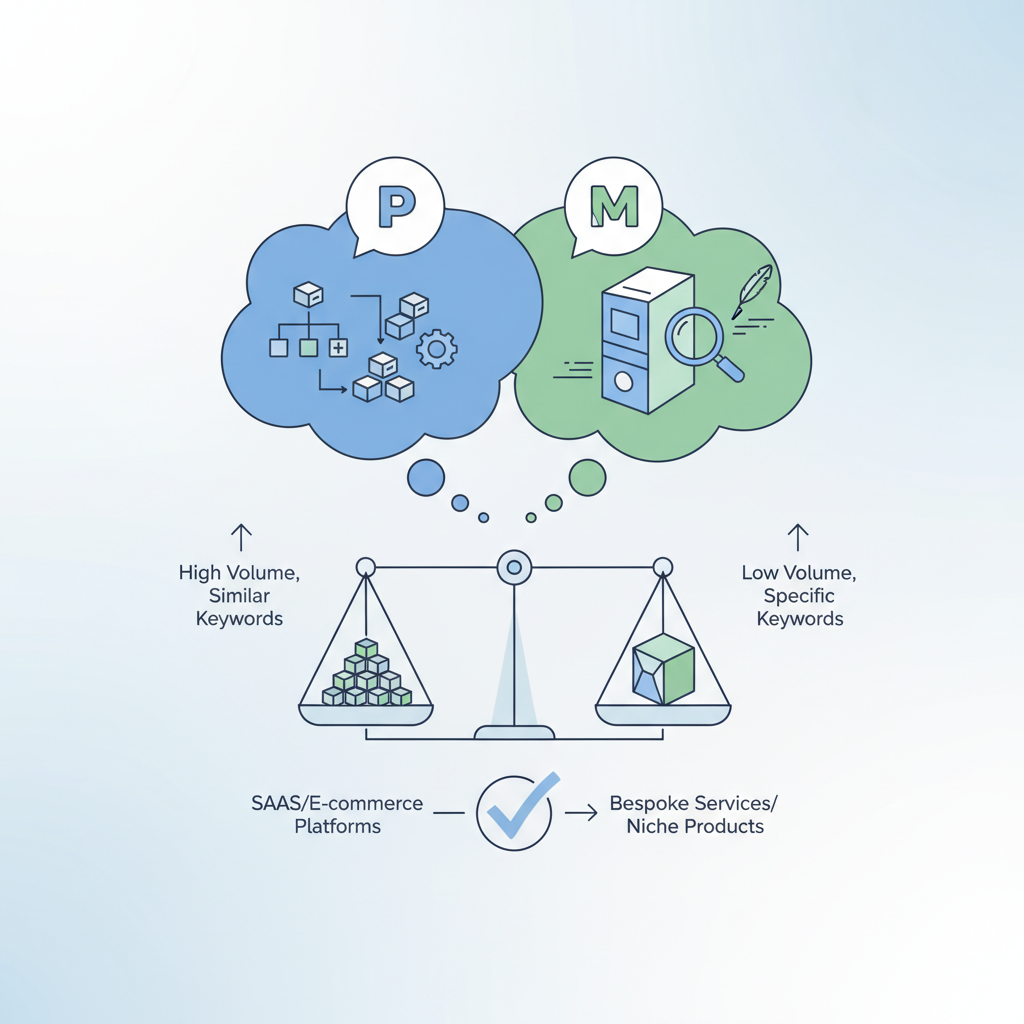
- Use programmatic SEO for large, low-variance catalogs and regionally indexed inventories; use manual content for flagship pages and complex user intent.
- Programmatic SEO creates many templated landing pages from structured data, ideal for large catalogs — include localized fields for local queries.
- Measure traffic, CTR, conversions, crawl budget, and AI-answer odds in the first 90 days; use a short checklist for each path.
If you manage product pages on a Lovable site, this guide helps you choose between programmatic vs manual seo for product pages depending on intent, volume, conversion value, and brand sensitivity. Read on for definitions, decision factors, concrete checklists, an example 90-day KPI table for local vs global pages, and step-by-step LovableSEO setup recommendations tailored to Lovable workflows.
Quick summary — who this guide is for and the decision outcome
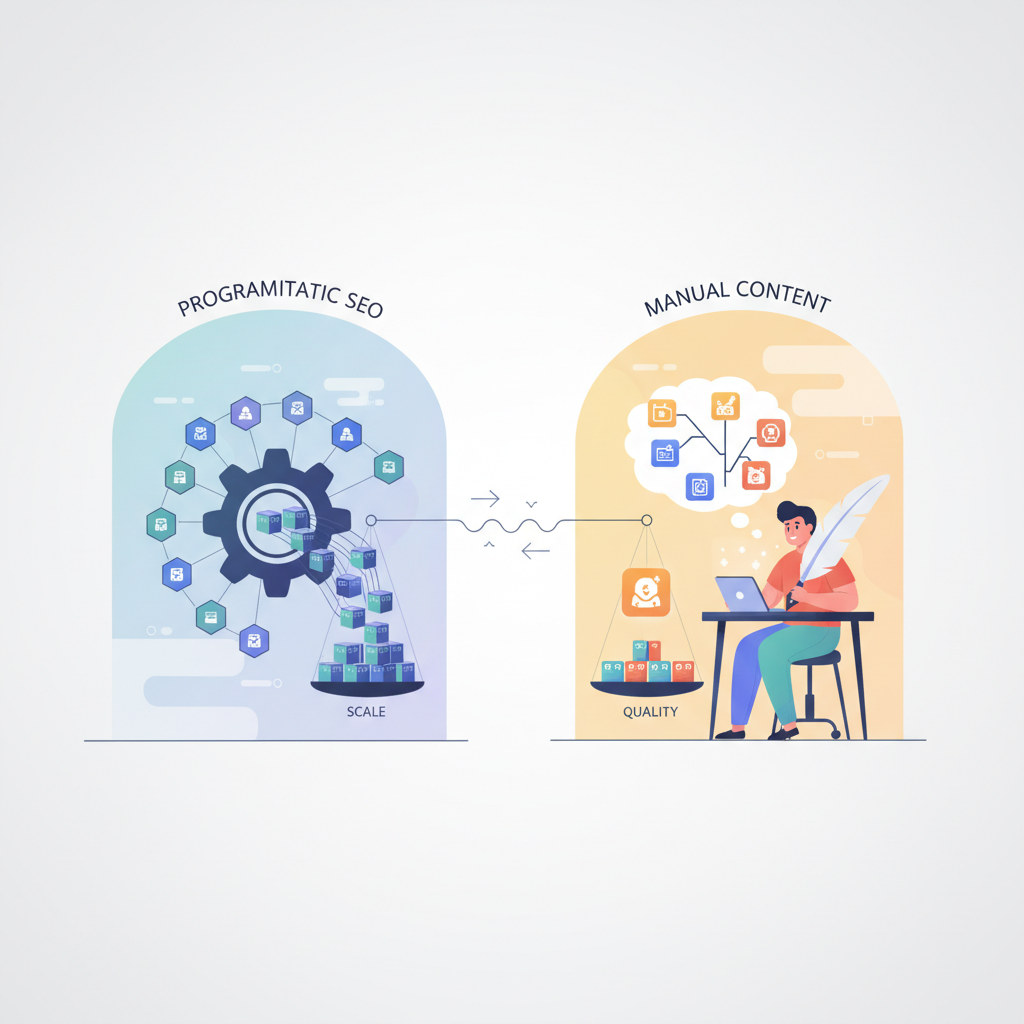
This guide is for website owners, marketers, and developers who run product or service listings on Lovable sites and must decide between programmatic content product pages and manual content product pages. If you have thousands of SKUs or region-specific inventories where attributes are consistent, programmatic SEO is usually the faster path. If pages represent high-value products, need brand-tight messaging, or address complex purchase intent, manual optimization is the better choice.
Decision outcome: prioritize programmatic SEO for scale and regionally-indexed inventories; prioritize manual content for flagship, trust-building pages. Track early KPIs to confirm which path drives conversions for your catalog segments.
Definitions and core differences
Understanding the difference helps you avoid common mistakes. Programmatic pages are template-driven and populated from structured data; manual pages are written and reviewed by humans. The main trade-offs are scale versus control: programmatic content product pages let you cover many long-tail queries quickly, while manual content product pages let you tailor messaging, brand voice, and edge-case information.
Programmatic pages should only go live when structured data is complete, canonical rules exist, and quality checks are automated.
What is programmatic SEO (concise definition)
Programmatic SEO creates many templated landing pages from structured data, ideal for large catalogs. On Lovable sites, that means using product attributes (category, color, size, city) to generate pages such as "blue wool scarf — neighborhood" that match long-tail queries. Programmatic content product pages scale quickly, reduce manual labor, and target volume-driven keyword segments. For regional queries, include localized fields (city, neighborhood, zip) to increase the chance of AI-answer inclusion for local searches.
Quotable: "Programmatic SEO creates many templated landing pages from structured data, ideal for large catalogs."
What is manual content optimization (concise definition)
Manual content optimization is a human-led process: editorial briefs, research, design, and expert reviews produce product pages with tailored copy, bespoke headings, and curated schema. Manual content product pages excel when user intent is complex (how-to, comparison, trust signals) or purchase value is high. Use manual pages to control tone, resolve user objections, and add original content like expert reviews or usage guides that templates can’t replicate.
Always reserve manual effort for pages where marginal conversion lift exceeds the per-page production cost.
Decision factors to evaluate (framework)
Use a simple scoring framework to decide: Intent complexity, search volume distribution, conversion value (AOV/LTV), content maintenance burden, and brand/UX sensitivity. Score each page or SKU 1–5 on these axes and route pages above a defined threshold to manual optimization. A concrete rule: if expected lifetime margin from a page exceeds the cost of producing and maintaining manual content, choose manual; otherwise choose programmatic.
Page intent and user intent complexity
If intent is transactional and simple (buy X in city Y), a programmatic page often suffices. If intent requires education, trust, or comparison (e.g., "best mattress for back pain"), manual pages convert better. Example decision rule: route to manual when queries include words like "compare", "best", or "reviews", or when users expect authoritative guidance beyond specs.
Search volume and keyword distribution
Use search-volume tiers to prioritize. High-volume, generic keywords deserve manual flagship pages. Long-tail, low-volume keywords are ideal candidates for programmatic templates. For Lovable sites, group keywords by attribute combinations; if a group contains thousands of variations with low individual volume, programmatic content product pages are more efficient than manual creation.
Conversion value per page (AOV, LTV)
Measure average order value (AOV) and lifetime value (LTV) per SKU. A concrete threshold example: if manual content costs $200 to produce and expected gross margin per page over 12 months is under $600, programmatic is likely the better ROI. Use your site's historical conversion data to set your thresholds rather than guessing.
Content maintenance & freshness requirements
If product attributes change frequently or stock/pricing updates are common, programmatic templates that pull live data reduce stale content risk. If content needs periodic expert updates (regulatory info, manuals), manual pages are preferable because they make editorial updates clearer and keep quality high.
Brand and UX sensitivity
Flag pages that must reflect brand voice, visual storytelling, or complex UX elements for manual treatment. Programmatic pages should follow design-safe templates and always include clear CTAs and trust markers, but avoid using them for pages where a poor UX harms the brand.
Practical examples for Lovable sites (use-case breakdown)
Below are concrete examples relevant to lovableseo.ai customers. Use these to map current catalog segments to a path.
Best fit: high-volume, low-variance product catalogs (programmatic)
Example: a vendor with 12,000 socks SKUs differing only by color and size. Programmatic templates can generate landing pages combining attributes (color + size + material). Include schema, canonical rules, and localized city fields for regionally-indexed inventories. Use programmatic content product pages to capture long-tail color-size queries without manual work.
Best fit: flagship pages, cornerstone guides, and service pages (manual)
Example: flagship product pages for your top 20 SKUs, service pages explaining installation, and buying guides should be manual. These pages need tailored headlines, in-depth comparisons, and original visuals to earn featured snippets and build trust that drives higher conversions.
Hybrid examples — when to mix both
Use programmatic templates for the base specification content and layer manual sections where needed (hero copy, FAQs, reviews). For example, programmatic product pages can include a curated manual block for top-selling variations while less important variants remain purely templated.
Implementation checklist for each path
Two practical checklists you can copy into project plans. Use the checklists to move from decision to execution quickly.
Programmatic checklist — templates, structured data, automated internal linking
- 1. Define attributes and canonical rules for templates.
- 2. Build templates for meta title, H1, product specs, and description snippets.
- 3. Add structured data (Product, Offer, AggregateRating) via template fields.
- 4. Implement automated internal linking rules to category pages and related items.
- 5. Run a staging crawl to identify duplicate or thin pages before indexing.
Manual checklist — editorial brief, expert review, targeted schema
- 1. Write an editorial brief with target keywords, user scenarios, and CTA.
- 2. Include unique visuals, comparison tables, and user reviews.
- 3. Add targeted schema types (HowTo, Review, Product) and test with rich result tools.
- 4. Schedule content review cycles (90 days) and A/B test hero messaging.
- 5. Measure LTV uplift before rolling manual treatment to sibling pages.
Quick LovableSEO setup recommendations per path (actionable steps)
If you use LovableSEO on a Lovable site, follow a short setup flow per path: configure templates and structured-data fields for programmatic pages; create editorial task templates and review workflows for manual pages. If LovableSEO supports crawl rules, set crawl-priority and noindex rules for low-value programmatic variants.
Template fields & structured data to prioritize
Prioritize fields: product name, SKU, category, price, availability, locality (city, neighborhood), short description, and canonical URL. Add JSON-LD Product and Offer blocks and ensure localized fields are present for region-specific pages. Below is a sample comparison table you can copy into planning documents.
| Field | Programmatic | Manual |
|---|---|---|
| Title template | Automated | Crafted |
| Long-form content | Optional | Required |
| Schema | Standard Product/Offer | Product + Review/HowTo |
Internal linking and sitemap rules
Programmatic pages: include rules to link up to category hubs and tag pages; only include programmatic variants in sitemap if they meet quality thresholds. Manual pages: add prominent internal links from top navigation or megamenus. Concrete rule: limit sitemap to pages with expected monthly sessions > threshold you define from historical data.
KPIs and monitoring: what to track in the first 90 days
Track a short list of KPIs for each page type and compare local vs global performance. Monitor organic traffic, CTR, conversion rate, crawl frequency, and AI-answer inclusion signals (featured snippets, People Also Ask). Use your site's historical conversion data to make local CTR/traffic benchmarks.
Example 90-day KPI table (local vs global pages)
| KPI | Local programmatic target | Global manual target |
|---|---|---|
| Sessions | Use historical local traffic baseline + 10% | Use flagship baseline + 20% |
| CTR | 3–6% | 5–10% |
| Conversion rate | 0.5–2% | 2–6% |
| Crawl frequency | Weekly | Daily/On update |
Image prompt: "Dashboard mock showing 90-day KPI comparison for local versus global pages"
Traffic, CTR, conversions, crawl budget, and AI-answer inclusion odds
Focus on early signals: a rising CTR with stable bounce rate suggests good SERP relevance; conversions indicate product-market fit. Monitor crawl budget: large programmatic sets can waste budget—use noindex or parameter rules for thin variants. Track AI-answer inclusion odds by checking presence in featured snippets and adjusting page depth and schema accordingly.
Conclusion — decision flowchart and recommended next steps
Decision flowchart (text): If user intent is simple and attributes are consistent => programmatic; if intent is complex or conversion value is high => manual; if mixed => hybrid. Recommended next steps: run the scoring framework across your catalog, pilot 500 programmatic pages with structured data and 10 manual flagship pages, then measure the 90-day KPI table above. Repeat iterations based on observed lift.
Quotable: "Reserve manual effort for pages where marginal conversion lift exceeds the cost of production."
FAQ
What is when to use programmatic seo vs manual content for product & service pages on lovable sites? This guide compares programmatic vs manual SEO for product pages and recommends programmatic for large, consistent catalogs and manual content for flagship pages and complex user intent.
How does when to use programmatic seo vs manual content for product & service pages on lovable sites work? Use a scoring framework that evaluates intent complexity, search volume, conversion value, maintenance, and brand sensitivity to route pages to programmatic, manual, or hybrid paths.
Ready to Rank Your Lovable App?
This article was automatically published using LovableSEO. Get your Lovable website ranking on Google with AI-powered SEO content.
Get Started