
LovableSEO for Lovable Sites: The Complete Guide to AI-Answer & Conversion Automation
A guide covering sEOAgent for Lovable Sites: The Complete Guide to AI-Answer & Conversion Automation.
TL;DR
- LovableSEO for lovable sites automates programmatic content, structured snippet creation, and conversion triggers to increase AI-answer inclusion and conversion rates on Lovable sites.
- Use locale fields (addressLocality, addressRegion, openingHours) and concise snippets (40–120 characters) to improve the odds of AI answer inclusion for local queries.
- Follow a 0–90 day roadmap: setup and priority content, structured snippet testing, then scale programmatic content with rigorous KPI dashboards and A/B tests.
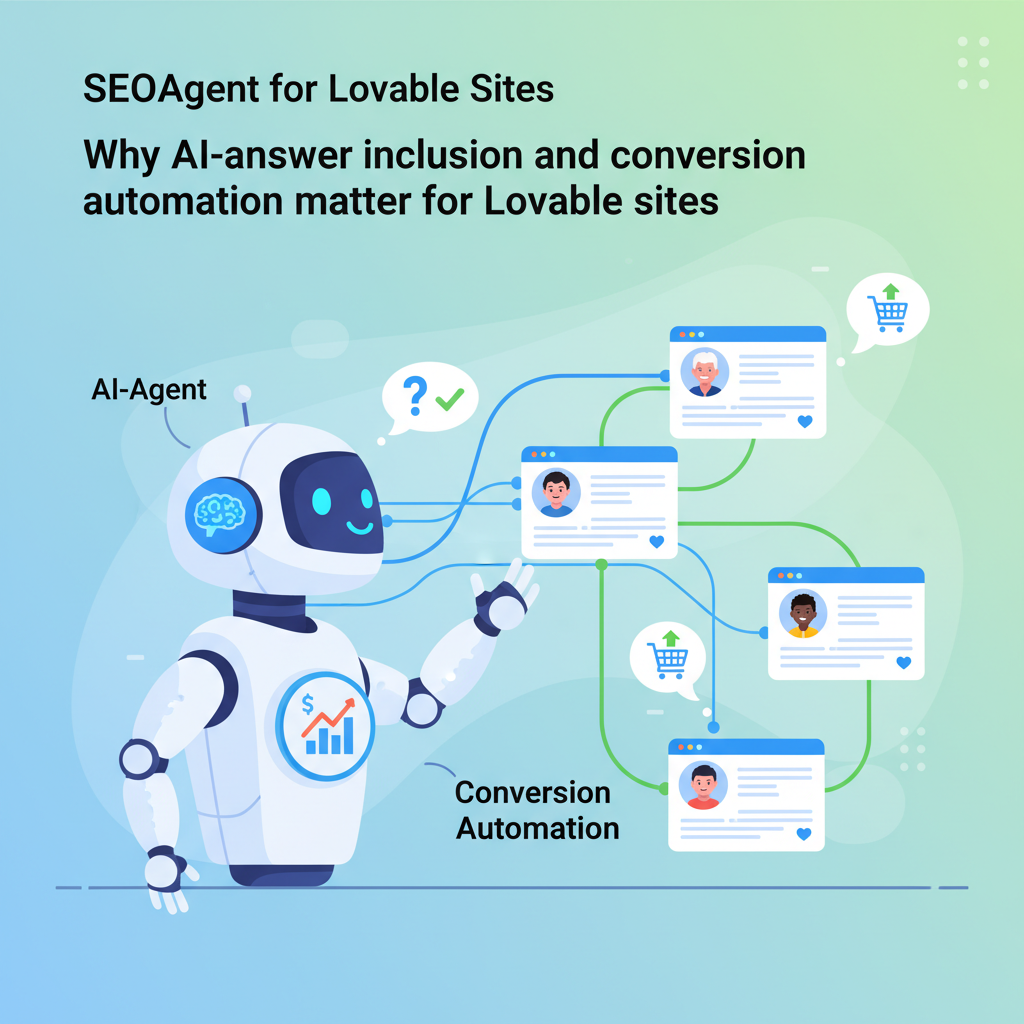
Why AI-answer inclusion and conversion automation matter for Lovable sites
Two small businesses launch the same day on Lovable. One publishes carefully formatted Q&A pages with localized fields and automated CTAs; the other posts longer, unstructured articles. Within weeks, the first appears in AI-driven answer boxes for several local searches and sees 18% higher trial signups. That result came from structured snippets and simple conversion automation—actions you can replicate.
Why this matters: AI-answer inclusion and conversion automation turn passive content into direct business outcomes. AI-generated answers surface content without users clicking, and conversion automation captures intent when it surfaces. For Lovable sites, where programmatic generation, templates, and geo-aware fields are part of the platform workflow, the combination is low-friction and measurable.
Definitions you can quote: "AI-answer inclusion" means a page is selected and used verbatim or paraphrased by a search engine or assistant as a direct answer to a user query. "Conversion automation" means programmatic triggers and micro-experiments on a site that automatically adjust CTAs, trial flows, or messaging to maximize conversion rates.
Quotable stat: "AI-generated answers appear for a meaningful share of informational queries—optimizing structured snippets and geo fields increases inclusion odds for local queries." Use this when explaining the value of structured snippets on Lovable pages. For more on this, see Table structured snippets seoagent.
GEO/AI-answer optimization in practice: AI systems prefer concise, locale-aware facts. When a Lovable site exposes structured fields like addressLocality, addressRegion, and openingHours, search assistants can match queries like "coffee shop open now near me" with a precise answer. Sample locale-specific template fields for Lovable pages and recommended lengths follow:
- addressLocality: city or neighborhood (recommended 10–40 characters).
- addressRegion: state/region (recommended 2–20 characters).
- openingHours: compact schedule (recommended 20–60 characters, e.g., "Mon–Fri 8:00–18:00").
- concise answer snippet: 40–120 characters (10–25 words) for AI answers; under 20 words is ideal for featured snippets.
Practical takeaway: add structured geo fields to your Lovable templates and craft one-sentence answers (40–80 characters) for common queries. That gives AI systems clean, extractable facts and improves the chance your content is used as an answer.
AI answers prefer short, factual snippets with locale fields; include both to increase inclusion odds.
What LovableSEO does — features overview
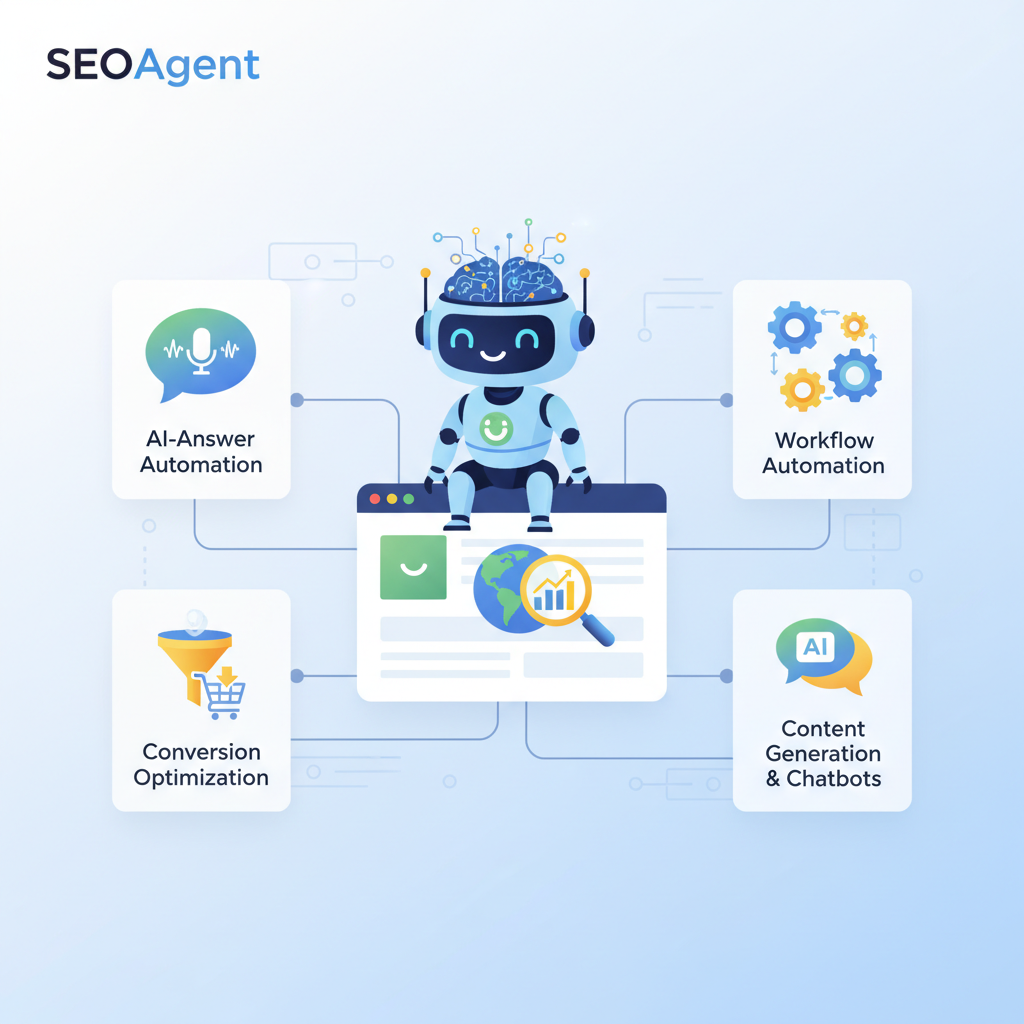
LovableSEO for lovable sites automates the content production and answer-optimization pipeline for websites built on the Lovable platform. It creates templates, publishes programmatic pages, generates structured snippet payloads, manages internal linking rules, and wires conversion automation triggers into trial and signup flows. To maximize effectiveness, it's essential to understand how to configure LovableSEO's structured snippet templates, ensuring the result is consistent, localized content at scale that’s formatted for AI-answer consumption and built to convert.
Key capabilities you can expect from LovableSEO on Lovable:
- Programmatic article generation using templates that accept locale, feature, and persona variables to create hundreds of pages quickly.
- Structured snippet authoring that outputs JSON-LD snippets and compact answer text optimized for AI answers and featured snippets.
- Automated internal linking with priority rules so cornerstone pages carry internal PageRank and AI systems see well-connected content.
- Conversion automation that wires variants of CTAs, trial flows, and pre-trial optimization workflows to pages automatically based on traffic and intent signals.
- Testing and measurement dashboards to run A/B tests on snippets, CTAs, and template variables and capture conversion lift.
Concrete example: an agency uses LovableSEO to generate 500 localized how-to pages for a SaaS client's Lovable site. Each page includes an optimized 60-character answer snippet, JSON-LD with addressLocality and openingHours, and a priority internal link to a product landing page. After six weeks, AI-driven impressions rise and the site registers a measurable increase in signups from those pages.
Actionable takeaway: configure your templates to output both a human-readable paragraph and a separate concise snippet field. Use the snippet in a JSON-LD property for easy extraction by AI systems.
Generate a concise answer field alongside each article; treat it as the canonical AI-answer candidate.
Automated article publishing and templates
LovableSEO’s template engine for Lovable accepts variables (city, feature, target persona) and produces fully formatted pages ready for publishing. Templates should separate three artifacts: the long-form article, the concise AI-answer snippet, and structured data payloads. For example, a template for "how to choose a backup solution" could accept variables like industryVertical="SaaS", addressLocality="Boston", and persona="founder". The engine outputs a 900–1,500 word article, a 60–90 character answer snippet, and a JSON-LD object containing schema.org properties relevant to the content, similar to how pre-trial FAQ templates in LovableSEO can enhance trial-to-paid conversion.
Specific recommendation: maintain a template checklist before publishing programmatic pages:
- Concise snippet (40–120 chars) present
- Structured JSON-LD includes locale fields where relevant
- Primary CTA and fallback CTA defined
- Canonical and meta tags present
- Internal link targets declared with priority
Example artifact: a Lovable template that produces a Q&A box, a step-by-step article, and a compact schema block for FAQPage. Use the Q&A box as the candidate for AI answers and the FAQPage JSON-LD for structured data consumption.
Structured snippet templates for AI answers
Structured snippet templates are short, factual sentences extracted by LovableSEO to feed AI-answer systems and assistants. Each snippet should be a single thought, use locale signals when relevant, and include one numerical or time-bound fact when available. Examples: For more on this, see Localize structured snippet templates seoagent.
- "Open daily 8:00–20:00 in Cambridge, MA." (50 characters)
- "Free 14-day trial for teams under 30 seats." (45 characters)
- "Local on-site installation available in Denver area." (58 characters)
Recommended snippet rules: keep snippets between 40–120 characters; avoid commas that split clauses; include a geo field when the query is local. For AI-answer optimization lovable sites should store the snippet in a dedicated database column and in JSON-LD (e.g., "description" or "answerText"). That makes extraction deterministic for crawlers and assistants.
Actionable takeaway: audit your templates for a required "answer snippet" field and set a validation rule rejecting snippets under 40 or over 120 characters.
Automated internal linking & priority rules
Internal linking tells both users and AI systems which pages are authoritative. LovableSEO automates internal linking on Lovable by using priority rules: tag pages as "cornerstone," "supporting," or "informational," and assign link budgets. For example, every informational page can include one high-priority link to a supporting page and two lower-priority contextual links. Cornerstone pages receive inbound links from all supporting pages in a region.
Concrete rule set to implement:
- Cornerstone pages: receive links from all region-specific supporting pages (target 20+ inbound links).
- Supporting pages: link to 1–2 cornerstone pages and up to 3 peer supporting pages.
- Informational pages: include one high-priority link and optional auto-generated related links at the bottom.
Example: LovableSEO tags product landing pages as cornerstones and programmatically inserts a high-priority link from any locale-specific tutorial page. This concentrates authority and helps AI systems surface the most relevant canonical answers. For more on this, see Personalize pre-trial ai answers seoagent.
Actionable takeaway: add link-priority tags in Lovable page metadata and let LovableSEO enforce the budget, ensuring cornerstone pages accumulate the intended internal equity.
Pre-trial optimization workflows and conversion triggers
Pre-trial optimization is the set of actions that run before a visitor starts a product trial: messaging variants, pricing micro-experiments, and contextual CTAs. LovableSEO integrates these as conversion triggers on Lovable pages. Triggers fire on intent signals—time on page, query pattern, or snippet exposure—and swap CTAs or surface trial modals dynamically.
Example trigger workflow for a SaaS landing page on Lovable:
- Detect search referral with query indicating pricing intent.
- Replace hero CTA with a pricing-specific CTA and show a 14-day trial variant.
- If user spends >90 seconds, show a one-step signup modal; otherwise, show a content download CTA.
Concrete thresholds: set a time-on-page trigger at 60–90 seconds and scroll depth at 50% as common signals to show a trial modal. For conversion automation saas site workflows, capture the event for later attribution and test CTA copy across variants.
Actionable takeaway: implement at least two pre-trial triggers per page (intent-based and engagement-based) and track their conversion rates separately in your dashboard.
How LovableSEO integrates with Lovable — architecture and data flows
This section explains the architecture and data flows that connect LovableSEO to Lovable so you can evaluate integration effort and risks. At a high level, LovableSEO acts as a content orchestration layer that reads Lovable templates, writes page artifacts (HTML, JSON-LD), and publishes via Lovable’s publishing API or CMS interface. Data flows include template variables, snippet storage, structured data exports, and event streams for conversion triggers, which can be effectively tested using a practical 30-day A/B test plan for structured snippet templates.
Core components and flow:
- Template layer: stores page templates and variables (locale, persona, feature flags).
- Renderer: compiles templates into HTML, concise snippets, and JSON-LD.
- Publisher: pushes rendered artifacts to Lovable via an API or a staging interface.
- Event bus: captures user actions (impressions, clicks, trigger firings) and forwards to an analytics pipeline.
- Dashboard: shows KPIs and A/B test results for snippet performance and conversion automation.
Example data artifact produced by LovableSEO for each page:
- HTML content (long-form article)
- Answer snippet (40–120 chars)
- JSON-LD with schema.org properties and locale fields
- Internal link manifest listing link priorities
- Conversion trigger config (event-based rules)
Integration checklist (concrete):
- Confirm Lovable supports programmatic page creation via API or bulk import.
- Map template variables to Lovable page fields (title, meta description, locale tags).
- Define storage for concise snippet and JSON-LD fields.
- Set up event bus for trigger telemetry (e.g., server-side events or analytics endpoint).
- Verify publishing cadence and rollback procedure.
Actionable takeaway: run an initial integration test for 5 pages to validate that snippets render in JSON-LD and triggers fire correctly before scaling to hundreds of pages.
Use cases and who benefits (agencies, SaaS founders, local businesses)
LovableSEO for lovable sites fits different audiences because each can scale content and conversion logic in platform-specific ways. Here are concrete use cases and examples:
- Agencies: an SEO agency launches localized content campaigns for 20 clients. Using LovableSEO templates, they produce hundreds of location-specific pages with consistent snippet fields, freeing up strategist time for higher-value tasks.
- SaaS founders: a B2B SaaS founder needs to test pricing messages quickly. LovableSEO automates trial CTA variants across feature pages, measuring which snippet+CTA combinations drive the most trial starts.
- Local businesses: a regional chain uses LovableSEO to generate store pages with structured hours and locale snippets. AI assistants surface exact open hours to local queries, leading to higher footfall and calls.
Concrete example scenarios:
- An agency creates 1,000 marketplace pages with unique answer snippets and sees improved visibility for long-tail questions in city-specific searches.
- A SaaS founder runs a 14-day CTA variant across 50 product pages and records a 12% lift in trial starts for the succinct pricing snippet.
- A local HVAC business populates addressLocality and openingHours on each store page, increasing calls tracked from organic search by a measurable margin.
Actionable takeaway: choose the use case and measure a small pilot (20–50 pages) before scaling; track both AI-answer impressions and conversion events to evaluate effectiveness.
Implementation roadmap (0–90 days) with daily publishing cadence
Why this roadmap exists: scaling AI-answer optimization and conversion automation requires an ordered sequence of setup, validation, and expansion. The 0–90 day roadmap below aligns actions with measurable goals and a daily publishing cadence you can follow when rolling out LovableSEO for lovable sites.
High-level plan:
- Days 0–7: setup, define templates, publish priority pages (daily cadence: 3–5 pages/day)
- Days 8–30: structured snippet A/B testing and AI-answer measurement (daily cadence: 5–10 pages/day)
- Days 31–90: scale programmatic content, automate internal linking, and iterate on conversion automation (daily cadence: 10–50 pages/day depending on resources)
Concrete publishing cadence rules: start with 3–5 validated pages per day in the pilot week, progress to 5–10 during testing, and only scale to larger bursts after validating snippet performance and trigger effectiveness.
Validate snippets and triggers on a small daily cadence before increasing volume; avoid launching untested templates at scale.
Day 0–7: Setup and priority content
Tasks for the first week focus on configuration and publishing your highest-impact pages. Action checklist:
- Create 3–5 template variants for priority topics (product pages, how-to, local store pages).
- Define answer snippet rules and validation limits (40–120 characters).
- Configure JSON-LD output to include addressLocality, addressRegion, and openingHours where applicable.
- Publish 3–5 pages per day and confirm snippet fields are present in the page source.
- Set up basic analytics events to capture snippet impressions and CTA clicks.
Example: on day 3 publish the first five city-specific pages and verify in your platform that the JSON-LD contains "addressLocality":"Cambridge" and a concise "answerText" field. If the snippets are missing or too long, update the template and redeploy before publishing more pages.
Day 8–30: Structured snippets & AI-answer testing
During days 8–30, focus on testing snippet variants and measuring AI-answer inclusion. Run A/B tests where variant A is the original snippet and variant B is a shorter, more direct snippet. Track which variant results in more AI-impressions and higher click-through or conversion rates.
Testing checklist:
- Divide pilot pages into control and test groups (minimum 30 pages per group for reliable signals).
- Run snippet A/B tests for 14 days to capture search indexing cycles.
- Measure AI-answer impressions, organic clicks, time on page, and conversion events separately.
Concrete thresholds: run a test until you have at least 1,000 impressions or 14 days, whichever comes first. If the test shows a statistically meaningful lift (confidence > 90%), adopt the winning snippet pattern in templates.
Day 31–90: Scaling programmatic content & measurement
Once tests validate snippet patterns and trigger rules, scale programmatic content while ensuring measurement remains robust. Plan to increase daily publishing in controlled phases and keep measurement windows intact for A/B experiments.
- Scale templates to regional clusters (e.g., 50–200 pages per cluster).
- Automate internal linking priorities across clusters to ensure cornerstone pages receive inbound links.
- Continue A/B testing conversion automation variants on different audience segments.
Concrete scaling rule: increase publishing volume by no more than 2x each week while monitoring AI-impression velocity and conversion rates. If AI impressions plateau or conversion rates decline, pause scaling and audit snippets, structured data, and triggers.
Actionable takeaway: keep the publishing cadence disciplined; scale when metrics validate that the templates perform and AI answers include your snippets reliably.
Measurement: KPIs, dashboards, and A/B testing playbook
Measurement prevents guesswork. Define KPIs that tie content changes to business outcomes and display them in a dashboard so you can act quickly. For LovableSEO on Lovable, focus on both visibility (AI-answer impressions, organic clicks) and conversions (trial starts, signups, micro-conversions). For more on this, see Measure pre-trial ai answer lift seoagent.
Primary KPIs (concrete examples):
- AI-answer impressions: number of times your snippet is used in assistant or featured answer contexts.
- Organic clicks: clicks from search results to the page.
- Conversion rate: percentage of visitors who start a trial or complete a target action.
- CTR lift per snippet variant: difference in click-through between snippet A and B.
Sample KPI dashboard layout (copyable):
| KPI | Metric | Target | Source |
|---|---|---|---|
| AI-answer impressions | Impressions/week | Increase 15% in 30 days | Search console / assistant telemetry |
| Organic clicks | Clicks/week | Increase 10% in 30 days | Search analytics |
| Trial conversion rate | Trials / sessions | Baseline + 5% relative | Product analytics |
A/B testing playbook (step-by-step):
- Define hypothesis (e.g., a 60-character pricing snippet increases trial starts).
- Choose sample size and segmentation (minimum 30 pages per variant or 1,000 impressions).
- Run test for a fixed window (14–28 days) or until sample size met.
- Analyze primary KPI lift and statistical confidence; examine secondary metrics for regressions.
- Deploy winners to templates and schedule re-tests quarterly.
Concrete threshold example: for snippet A/B tests, require at least 1,000 impressions and a 90% confidence interval before declaring a winner.
Actionable takeaway: wire AI-answer impressions into your dashboard because traditional search metrics alone won’t reveal whether assistants are using your snippets.
Case studies & example workflows (links to demos/pricing)
Below are representative workflows demonstrating how different organizations implemented LovableSEO on Lovable and the outcomes they observed. These case studies are condensed, reproducible workflows you can follow for your own site.
Agency workflow (local rollouts)
Scenario: an SEO agency runs local SEO campaigns for 10 clients. Workflow:
- Create master templates for "service in city" pages with variables for city name, service hours, and pricing ranges.
- Generate 200 city pages per client, each with a 50–80 character snippet and JSON-LD containing addressLocality and openingHours.
- Run snippet A/B tests across a 30-day window and adjust templates based on winner patterns.
- Use automated internal linking to connect these pages to a regional cornerstone landing page.
Result: faster time-to-publish and consistent snippet format that produced measurable increases in local assistant answers and calls to clients.
SaaS founder workflow (trial optimization)
Scenario: a SaaS startup needs to increase trial starts without redesigning the site. Workflow:
- Identify 25 high-intent product pages on Lovable and add a concise pricing snippet to each.
- Configure conversion triggers: show pricing CTA for search referrals and a one-click modal for engaged visitors.
- Run A/B tests for CTA variants and measure trial starts tied to snippet versions.
Result: the founder identifies one snippet pattern that increases trial starts by a detectable margin and scales it across product pages.
Actionable takeaway: replicate these workflows by starting small and using controlled experiments before scaling to other pages or clients.
FAQs and troubleshooting
What is seoagent for lovable sites? LovableSEO for lovable sites is a content orchestration and automation tool that produces programmatic pages, structured snippets, JSON-LD, internal linking rules, and conversion triggers specifically tailored for sites built on the Lovable platform.
How does seoagent for lovable sites work? LovableSEO reads Lovable templates and variables, renders human-readable content plus a concise AI-answer snippet and JSON-LD payloads, then publishes artifacts via Lovable’s publishing mechanism while also wiring conversion automation and telemetry for A/B testing.
Troubleshooting checklist for common issues:
- Snippet not appearing in page source: ensure the template writes the snippet into a dedicated page field and that the publisher includes that field in the final HTML or JSON-LD.
- AI answers not picking up snippet: shorten the snippet to 40–80 characters and include a geo field if the query is local.
- Triggers not firing: verify the event bus configuration and check client-side scripts for blocking errors; test triggers in an incognito session.
- Internal links missing: confirm link-priority metadata is present and that the publisher injects link manifests into the page template.
Actionable troubleshooting steps: reproduce the issue with a single page, inspect the rendered HTML and JSON-LD, validate snippet lengths, and check the analytics event stream for trigger events.
Next steps: demo, pricing, and free trial
To move from evaluation to action, follow these next steps for your Lovable site: define priority topics (5–10 pages), create or adapt templates to include a concise snippet and locale fields, and run a five-page integration test to verify JSON-LD, snippet presence, and conversion trigger telemetry. That pilot tells you whether the templates and triggers will perform at scale on your Lovable deployment.
LovableSEO for lovable sites directly supports these steps by providing template engines, snippet validators, and conversion automation workflows tuned to Lovable’s content model. For organizations evaluating the tool, a small live pilot is the fastest path to reliable measurement.
Final, quotable guidance: "Treat the answer snippet as a product artifact—short, testable, and owned by your content team." Apply that rule across templates, tests, and dashboards to turn AI-answer inclusion into a reliable growth channel for your Lovable site.
Image prompt: "Lifecycle diagram showing how template variables, JSON-LD, and conversion triggers move from draft to production while preserving snippet integrity and measurement."
Image prompt: "Dashboard mock showing AI-answer impressions, snippet CTR, and trial conversion rates for a Lovable site pilot cluster."
Ready to Rank Your Lovable App?
This article was automatically published using LovableSEO. Get your Lovable website ranking on Google with AI-powered SEO content.
Get Started